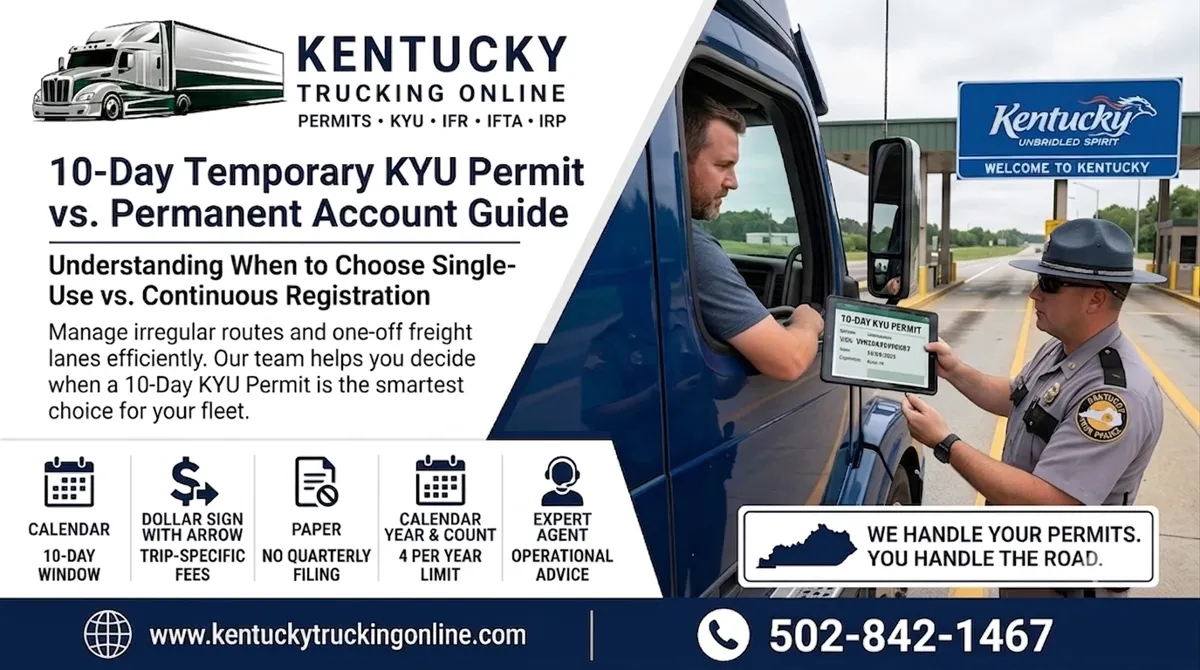
The 10-Day Temporary KYU Mileage Permit: When Is It Smarter Than a Permanent Account?
Managing a commercial fleet means constantly balancing regulatory compliance with operational overhead. When routing heavy-duty trucks through the Bluegrass State, one of the most critical state-specific regulations you must account for is the Kentucky Weight-Distance Tax, commonly known as the KYU. Unlike standard federal or interstate frameworks, Kentucky requires specialized credentials for heavy vehicles before they ever cross state lines.
For fleet owners and owner-operators, the Kentucky Transportation Cabinet (KYTC) offers two distinct paths to compliance: maintaining a permanent KYU account or purchasing a temporary 10-Day KYU Mileage Permit. Choosing the wrong option can burden your office with unnecessary quarterly paperwork or drain your budget through high-frequency permit fees.
This comprehensive guide breaks down the core structural differences between these two options, explains the exact weight thresholds that trigger the tax, and outlines exactly when a temporary permit is the smarter operational choice for your business.
Table of Contents
-
What is the Kentucky KYU Weight-Distance Tax?
-
The 60,000-Pound Regulatory Threshold
-
Permanent vs. Temporary KYU Accounts: Key Differences
-
When the 10-Day Temporary Permit is Smarter
-
The State-Mandated Calendar Year Limits
-
Why Many Trucking Companies Choose Us
-
Frequently Asked Questions
What is the Kentucky KYU Weight-Distance Tax?
The state of Kentucky collects a specialized highway use tax directly from motor carriers to help fund the maintenance of its public roadway infrastructure. This tax is completely separate from standard International Registration Plan (IRP) commercial license plates and International Fuel Tax Agreement (IFTA) quarterly fuel tracking filings.
Kentucky belongs to a select group of states alongside New York, New Mexico, and Oregon that demand a separate mileage-based weight-distance registration on top of your normal interstate credentials. If your truck passes a state weigh station on routes like I-65, I-75, or I-64 without this active coverage, your driver faces immediate fines, citations, and potential roadside detention.
The 60,000-Pound Regulatory Threshold
A commercial motor vehicle configuration triggers the legal requirement for KYU compliance the moment its combined licensed gross vehicle weight (GVW) or declared operating weight exceeds 60,000 pounds. It is critical to recognize that this weight baseline is significantly lower than the standard 80,000-pound federal interstate limit.
Furthermore, this tax regulation is calculated strictly on the truck's registered maximum weight capacity, not its actual scale weight during a specific trip. Even if your tractor-trailer is bobtailing empty or hauling a light commodity through Kentucky, you are fully legally bound to possess KYU credentials if the truck's registered threshold matches or exceeds 60,000 pounds.
Permanent vs. Temporary KYU Accounts: Key Differences
Understanding the operational differences between permanent and temporary credentials helps clarify which path fits your fleet's schedule. A permanent KYU account provides an annual, continuous registration for carriers who consistently enter the state, but it comes with a strict administrative trade-off: your company must file a mandatory KYU-100 quarterly mileage return every single tax quarter.
On the other hand, the 10-Day Temporary KYU Permit acts as a single-use, trip-specific authorization document. It covers a specific truck for a 10-day window from its activation date, requiring a flat upfront purchase fee rather than long-term administrative reporting.
When the 10-Day Temporary Permit is Smarter
For out-of-state fleets, irregular-route carriers, and specialized owner-operators, using the temporary 10-day permit is frequently the most strategic, cost-effective option for three distinct reasons:
-
Zero Quarterly Reporting Obligations: The highest hidden cost of a permanent account is the administrative labor. If you have a permanent KYU number, you are legally required to file a tax return every quarter, even if your trucks drove zero miles in Kentucky during those months. Forgetting to file a "zero return" results in immediate account suspensions, late penalties, and audit triggers. A temporary permit eliminates this long-term paperwork because there is no post-trip filing requirement.
-
Perfect for Seasonal or One-Off Freight Lanes: If you take an irregular broker load that drops in Kentucky once or twice a year, or if you are simply routing a truck through the state to deliver a seasonal project, purchasing a temporary permit is much more efficient than setting up a permanent highway use account.
-
Immediate Roadside Compliance: If a dispatcher realizes a truck is approaching the Kentucky border without proper weight-distance coverage, a temporary permit can be issued and sent straight to the driver's smartphone or tablet in minutes, letting them pass through enforcement scales safely without waiting for a permanent account approval.
The State-Mandated Calendar Year Limits
While temporary permits provide excellent administrative relief, the Kentucky Transportation Cabinet enforces a strict boundary to prevent high-volume carriers from using them as a permanent tax shelter. The state caps temporary permits at a maximum of four 10-day temporary KYU permits per motor carrier company, per calendar year.
Once your company reaches this state-enforced limit of four temporary filings, you are legally restricted from buying any further temporary trip credentials. At that point, you are required to transition and register for a permanent KYU account before running any additional equipment through the state. Therefore, if your trucks cross into Kentucky more than four times a year, building a permanent account framework is necessary.
Why Many Trucking Companies Choose Us
Calculating weight thresholds, balancing temporary permit limits, and keeping track of specialized state tax filings can quickly bog down busy logistics offices. That is why professional carriers rely on Kentucky Trucking Online to handle their regional permit portfolios.
We take the confusion out of Midwestern highway compliance. Our direct electronic connections to the KYTC systems enable us to secure your 10-Day Temporary KYU Permits, IRP trip authorizations, and temporary fuel permits quickly and accurately.
We don't just process paperwork; we analyze your lanes, monitor your annual permit counts, and advise you exactly when it's time to switch to a permanent account to protect your business from unnecessary penalties. Partnering with our specialized compliance team means your drivers stay loaded, your routes stay clear, and your fleet avoids costly scale house delays.
Frequently Asked Questions
-
Does a standard IRP plate cover the weight-distance tax in Kentucky?
No. Your IRP registration only covers your basic apportioned vehicle registration plates. The KYU is an entirely separate mileage tax that applies to any truck over 60,000 pounds gross weight, meaning you need both active credentials to remain legal.
-
Can I buy a temporary fuel permit and a temporary KYU permit together?
Yes. If your truck is not permanently registered under IFTA or IRP, you can purchase temporary 10-day trip and fuel credentials alongside your temporary KYU permit to ensure 100% border compliance.
-
What happens if I forget to file a quarterly return for a permanent KYU number?
The state will automatically suspend or cancel your KYU number, which flags your USDOT number at every weigh station scale house in Kentucky. Your vehicles can be detained at the roadside until back taxes and penalties are resolved.
-
Can a temporary 10-day KYU permit be transferred to a different truck in my fleet?
No. All temporary permits are vehicle-specific and are issued to a single matching truck using its unique VIN, license plate number, and registered weight configuration. They cannot be transferred under any circumstances.