Emergency Trip & Fuel Permit Waivers: How Kentucky Handles Disaster Relief Transport
Table of Contents
-
Introduction
-
The Executive Order Rule vs. Standard Operations
-
Calculating the Exact Scope of the Waiver
-
One Waiver, One Load: Strict Emergency Cargo Enforcement
-
The Triple-Permit Bypass: What Is Actually Waived?
-
The Annual Cap Impact during State Emergencies
-
Financial Consequences at the Scale House
-
Why Many Trucking Companies Choose Our Service
-
Frequently Asked Questions (FAQ)
Introduction
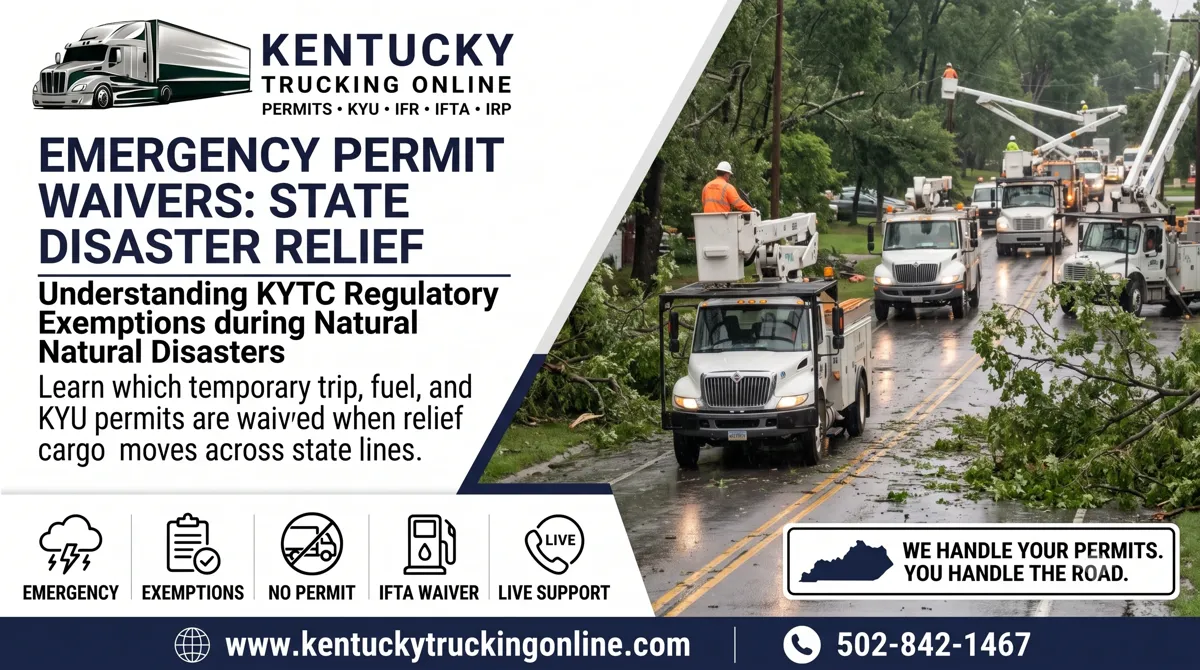
Operating a commercial motor vehicle through Kentucky without permanent IRP, IFTA, or KYU registration means relying on temporary trip permits to keep your fleet legal. However, when natural disasters, severe winter weather, or infrastructure emergencies strike, the speed of the logistics response becomes a matter of life and safety. For motor carriers transporting utility equipment, emergency supplies, food, or fuel into affected areas, stopping at the state line to purchase temporary credentials isn't just an administrative hassle; it is a critical delay.
For temporary emergency operations, timing and compliance aren't just administrative details; they are the boundary line between legal operation and severe operational disruptions. To protect your drivers, keep your loads moving on schedule, and leverage state-level regulatory relief safely, you need to understand the exact mechanics, legal restrictions, and structural deadlines of Kentucky's emergency permit waivers.
The Executive Order Rule vs. Standard Operations
Many fleet managers assume that when a severe storm or natural disaster is broadcast on the news, state permit requirements are instantly suspended. Kentucky does not follow an automatic activation rule. Instead, the state utilizes a strict regulatory relief protocol that is only activated through a formal declaration issued by the state.
Your authority to operate without standard temporary permits begins precisely at the date and time designated in an official executive order signed by the governor or a formal declaration issued by the secretary of the Kentucky Transportation Cabinet (KYTC). The waiver remains legally valid only for the duration specified in the document, typically lasting between 15 and 30 days. If a truck is still rolling on a Kentucky highway after the order expires, and you have not secured standard permits, your vehicle is operating entirely out of compliance. Furthermore, the state maintains a strict policy that these waivers are completely non-transferable and cannot be used retroactively for trips made before the order was officially signed.
Calculating the Exact Scope of the Waiver
To avoid enforcement actions, dispatchers and logisticians must treat the geographic and cargo boundaries of an emergency declaration as an absolute wall. Because the waiver is strictly tied to active disaster relief efforts, your vehicle only qualifies for exemption if it is directly engaged in restoring critical infrastructure or delivering essential emergency cargo.
For example, if an emergency declaration is issued with an effective start date of October 1st to support power restoration, only trucks hauling utility poles, bucket trucks, or emergency generators are exempt during the active window. A truck hauling standard commercial retail goods along the exact same route is not covered by the waiver. Entering a Kentucky weigh station without standard permits while carrying non-emergency freight will immediately flag the vehicle as operating without valid credentials, regardless of whether a statewide emergency declaration is currently active.
One Waiver, One Load: Strict Emergency Cargo Enforcement
A common dispatch pitfall occurs when carriers assume that an active emergency waiver acts as a blanket license for their entire fleet. If a carrier has multiple trucks running through Kentucky, they cannot use an active disaster relief waiver to cover trucks carrying standard commercial loads.
Kentucky emergency waivers are strictly cargo-specific and tightly monitored. Every exempt vehicle must be actively carrying cargo or equipment directly tied to the emergency recovery effort. The moment your truck offloads its emergency cargo and begins the return trip empty or carrying a standard commercial backhaul, the emergency waiver is no longer valid. If an enforcement officer catches an unpermitted truck hauling standard commercial freight or returning empty without the proper temporary permits, it triggers an immediate out-of-service hold and an expensive citation at the scale house.
The Triple-Permit Bypass: What Is Actually Waived?
Depending on your vehicle's weight class and configuration, entering Kentucky during a declared emergency requires understanding exactly which temporary credentials are bypassed. Under a standard emergency declaration, the state typically waives up to three distinct temporary clearances:
-
Temporary IRP (Trip) Permit: Required for out-of-state vehicles over 26,000 pounds or those configured with 3 or more axles that lack regular apportioned registration. Under an active waiver, these vehicles can enter the state to deliver relief supplies without purchasing this temporary permit.
-
Temporary IFTA (Fuel) Permit: Required for out-of-state vehicles over 26,000 pounds or with 3+ axles that do not carry permanent IFTA credentials or local fuel decals. The waiver suspends the requirement to purchase this temporary fuel permit, and carriers are exempt from licensing and tax reporting for those emergency miles.
-
Temporary KYU Permit: Required for any commercial motor vehicle or combination with a Gross Vehicle Weight (GVW) or licensed weight over 59,999 pounds passing through without a permanent weight-distance account. This requirement is only suspended if the active executive order explicitly includes KYU weight-distance tax relief.
Because these exemptions are strictly temporary, once the emergency declaration expires or your relief contract ends, your fleet must immediately return to standard temporary permitting or permanent registration.
The Annual Cap Impact during State Emergencies
A critical piece of Kentucky regulation that surprises many irregular-route carriers is how emergency operations interact with standard permit limits. Under standard rules, the Kentucky Transportation Cabinet restricts individual commercial vehicles to a maximum of four temporary KYU trip permits per calendar year.
Fortunately, miles and trips operated under an official emergency waiver do not count against your truck's annual four-permit limit. This policy ensures that carriers assisting with major recovery efforts are not penalized or blocked from standard commercial operations later in the year. However, tracking your emergency dispatch logs and keeping copies of the active Executive Orders is vital to ensure your automated permit history is recorded correctly and doesn't trigger an accidental block on your VINs.
Financial Consequences at the Scale House
Operating under the assumption of an emergency waiver without meeting the strict cargo or documentation requirements turns a relief mission into a major enforcement event. When a vehicle enters a Kentucky weigh station with an invalid or unproven exemption, enforcement personnel treat the vehicle as completely unregistered for weight-distance and fuel tax purposes.
The standard penalty for operating without active credentials starts with a baseline citation, often reaching hundreds of dollars, alongside immediate vehicle grounding. The truck is placed under an administrative hold at the scale house or a designated safe parking area until valid credentials are secured. To release the vehicle, the carrier must purchase a brand-new temporary permit on the spot and resolve all pending state assessments. This process causes missed delivery windows, driver detention costs, and logistical disruptions that far exceed the price of proactive compliance management.
Why Many Trucking Companies Choose Our Service
Managing temporary trucking compliance under strict deadlines requires total accuracy. That is why fleet managers partner with Kentucky Trucking Online. Our processing platform eliminates long wait times and confusing government portals, rapidly reviewing your submission to verify that your equipment data matches your active profiles perfectly before your drivers hit the pavement.
We also protect your long-term operational margins. If your trucks cross into Kentucky frequently enough to trigger the annual four-permit cap, our team seamlessly handles your transition to permanent KYU, IRP, and IFTA accounts. From initial state setup to continuous quarterly mileage reporting, we clear the administrative hurdles so you can focus strictly on keeping your lanes profitable.
Frequently Asked Questions (FAQ)
What paperwork must my driver carry to prove we are under the emergency waiver?
Your driver must carry a physical copy of the active Executive Order or official state declaration in the cab, along with a Bill of Lading (BOL) or dispatch work order that explicitly proves the cargo is destined for the disaster relief zone.
Can my driver use the emergency waiver for an oversize or overweight load?
Generally, no. While trip and fuel registration requirements are routinely suspended during emergencies, oversize and overweight permit requirements are rarely bypassed. Vehicles exceeding standard legal dimensions must still secure official routing clearance to protect highway infrastructure.
What happens if my truck enters Kentucky after the emergency order expires?
The regulatory exemption is instantly void the moment the executive order reaches its expiration date and time. If your truck enters the state after the waiver expires, you must secure standard temporary trip, fuel, and KYU permits before crossing the state line.