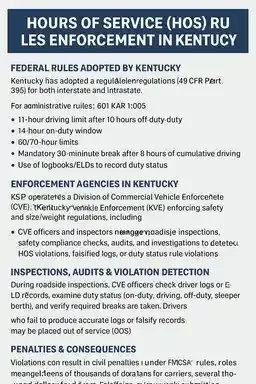
1. Federal Rules Adopted by Kentucky
-
Kentucky has adopted the federal HOS regulations (49 CFR Part 395) for both interstate and intrastate operations via its administrative rules.
-
Under Kentucky administrative regulation 601 KAR 1:005, commercial motor vehicles (whether for-hire or private, interstate or intrastate) must comply with the rules in CFR Parts 390–399, including the HOS rules.
-
This means that drivers in Kentucky must follow:
-
11-hour driving limit after 10 hours off-duty
-
A 14-hour window for on-duty (driving + non-driving)
-
60/70‑hour limits (based on a 7‑ or 8‑day period)
-
Mandatory 30‑minute break after 8 cumulative hours of driving
-
Use of logbooks / ELDs to record duty status
-
2. Enforcement Agencies in Kentucky
-
The Kentucky State Police (KSP) operates a Division of Commercial Vehicle Enforcement (CVE) (also called Kentucky Vehicle Enforcement, KVE) that enforces safety and size/weight regulations, including HOS compliance.
-
CVE officers and inspectors conduct roadside inspections, safety compliance checks, audits, and investigations to detect HOS violations, falsified logs, or violations of duty status rules.
-
Through Kentucky’s Commercial Vehicle Safety Plan (CVSP), the state aligns with FMCSA priorities (inspections, enforcement, compliance reviews, public awareness) to target violations, including HOS infractions
3. Inspections, Audits & Violation Detection
-
During roadside inspections, CVE officers check driver logs or ELD records, examine duty status (on-duty, driving, off-duty, sleeper berth), and ensure required breaks are taken.
-
Drivers who fail to produce accurate logs or falsify records may be placed out of service (OOS) until they comply.
-
In crash investigations or compliance audits, transportation authorities often scrutinize HOS records to detect fatigue-related violations or pressure by the carrier.
4. Penalties & Consequences
-
Violations of HOS (non-recordkeeping), such as exceeding driving hours or failing to take required breaks, carry civil penalties under FMCSA rules. For carriers, fines may reach tens of thousands per violation; for drivers, several thousand.
-
Falsifying or knowingly submitting false logs is treated more severely (“knowing falsification”) with higher penalties.
-
Repeated or severe violations can lead the state to revoke or suspend a carrier’s operating authority or certificate. Kentucky law allows revocation or suspension for repeated noncompliance with safety rules.
-
Drivers found in violation may be placed out-of-service, meaning they must stop driving until they meet off-duty requirements.
5. Key Practical Considerations for Drivers & Carriers
-
Maintain accurate logs / ELD usage: Since Kentucky enforces federal HOS rules, relying on correct records is crucial.
-
Be ready for inspections without advance notice: CVE officers may inspect at any time, so documents and logs must always be in good order.
-
Respond promptly to violations: If an inspection reveals an issue, taking corrective actions early can mitigate more severe penalties or suspension.
-
Avoid falsification: Submitting misleading or double logs exposes a driver or carrier to severe fines and legal risk.
-
Watch for “egregious” violations: Exceeding limits by 3+ hours is often flagged as severe and punished harshly.