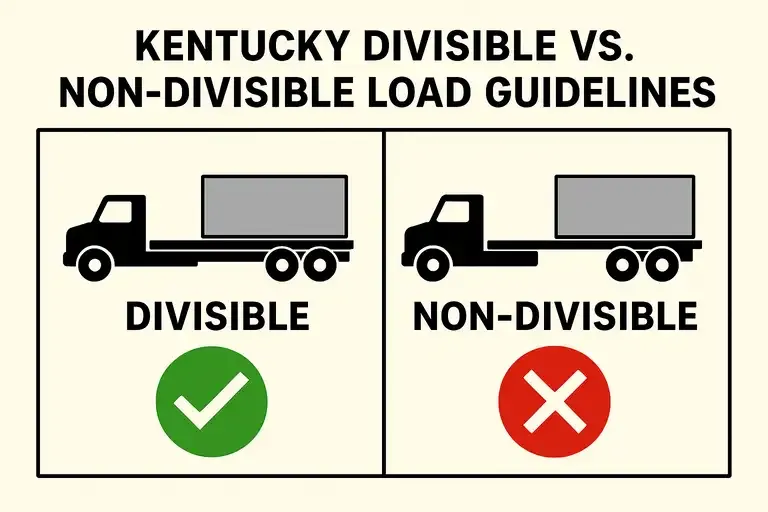
1. What Is a Divisible Load in Kentucky?
A divisible load is freight that can be reduced in size or weight by unloading, separating, or rearranging items without compromising the cargo’s intended use.
Examples of Divisible Loads
-
Palletized goods
-
Bulk materials (grain, gravel, sand)
-
Multiple pieces of machinery that can be separated
-
Construction materials (steel beams, pipes, lumber)
Key Kentucky Rules for Divisible Loads
-
Kentucky generally does not issue oversize or overweight permits for divisible loads that exceed legal weight limits.
-
If the freight can be reduced below statutory limits, it must be.
-
Special programs—like Kentucky’s Coal Haul permits—are exceptions for certain corridors and industries.
Bottom line: If it can be separated, it must be transported legally without OS/OW permitting.
2. What Is a Non-Divisible Load in Kentucky?
A non-divisible load is defined as cargo that cannot be reasonably dismantled into smaller pieces to meet legal size or weight limits without:
-
Compromising the item’s intended purpose,
-
Requiring more than 8 hours of work to dismantle, or
-
Destroying the value or structural integrity of the load.
Examples of Non-Divisible Loads
-
Large industrial machinery
-
Generators, transformers
-
Bridge beams or girders
-
Oversized tanks or silos
-
Manufactured homes
-
Wind turbine components
Kentucky Rules for Non-Divisible Loads
-
Eligible for oversize/overweight permits (annual or single-trip).
-
May require route surveys, pilot cars, or engineering review depending on weight/dimensions.
-
Must follow Kentucky’s OS/OW travel hours and holiday restrictions.
Bottom line: If the load cannot be reduced practically, it qualifies for a Kentucky OS/OW permit.
3. Legal Size & Weight Limits (Divisible Loads)
Kentucky applies the standard federal limits for divisible cargo:
-
Width: 8’6”
-
Height: 13’6”
-
Length: Varies by vehicle type
-
Weight:
-
80,000 lbs GVW (standard)
-
Axle/group limits follow the Federal Bridge Formula
-
Divisible loads exceeding these limits are expected to be downsized, not permitted.
4. Exceptions to Divisible Load Restrictions
Kentucky allows certain industries to exceed legal limits under special permit programs, including:
Coal Haul Permits
-
Allow higher weight limits on designated coal-haul roads.
Agriculture & Forestry Movements
-
Some seasonal and commodity-based exemptions exist.
Emergency Relief Loads
-
During state-declared emergencies, divisible loads may receive temporary allowances.
These exceptions do not override safety rules or bridge/route limitations.
5. Enforcement and Penalties
Kentucky State Police (KSP) strictly enforce these rules:
-
If a load is deemed divisible, OS/OW permits are invalid.
-
Fines can include:
-
Overweight penalties
-
Out-of-service orders
-
Permit revocation
-
-
Carriers may be forced to offload material roadside to meet legal limits.
6. Quick Comparison Table
| Load Type | Can It Be Reduced? | Eligible for KY OS/OW Permit? | Examples |
|---|---|---|---|
| Divisible | Yes | No (with rare exceptions) | Pallets, bulk goods, beams |
| Non-Divisible | No | Yes | Transformers, tanks, machinery |
| Special Program Loads | Sometimes | Only under specific programs | Coal, ag commodities |
7. Key Takeaways for Carriers
-
If it can come apart → divisible → no overweight permit
-
If dismantling harms the cargo or exceeds 8 hours → non-divisible → eligible for permits
-
Kentucky is strict about weight enforcement and divisible load classification
-
Know when special programs (coal haul, ag exemptions) apply