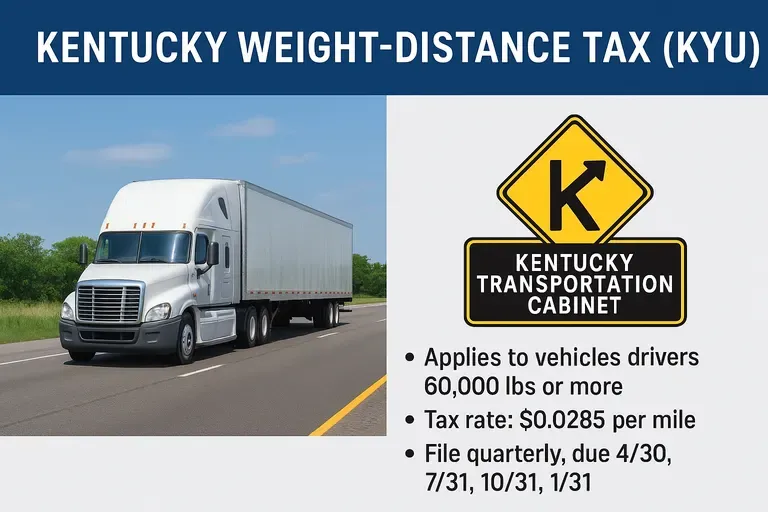
What is It?
-
The KYU tax is a mileage-based tax imposed by the Kentucky Transportation Cabinet (KYTC) on commercial motor vehicles operating on Kentucky public highways that meet certain weight thresholds.
-
Despite being called a “weight-distance” tax, the key is: vehicles with a combined licensed or actual gross weight of more than 59,999 pounds (i.e., 60,000 lbs or more) when operating on Kentucky highways are subject to the tax.
-
The tax license/number issued for this is called a “KYU number.”
How it’s calculated & reported
-
The tax rate is $0.285 per mile for each qualified vehicle traveling on Kentucky highways.
-
Returns are filed quarterly, even if no miles were traveled in Kentucky during that quarter. Filing zero-miles is required to remain in compliance.
-
Filing due dates:
-
Q1 (Jan-Mar): Due April 30
-
Q2 (Apr-Jun): Due July 31
-
Q3 (Jul-Sep): Due October 31
-
Q4 (Oct-Dec): Due January 31 (following year)
-
-
As of 4th quarter 2024, returns must be filed and paid online through the Motor Carrier Portal; paper checks are no longer accepted for KYU filings.
Who must comply
-
Any carrier (intrastate or interstate) whose vehicle(s) have a combined licensed weight (or actual weight when operated) of 60,000 lbs or more and operates on Kentucky public highways.
-
The tax applies even if the carrier is based out-of-state but uses Kentucky highways with qualifying vehicles.
-
Note: The KYU tax is separate from other taxes such as:
-
International Fuel Tax Agreement (IFTA) fuel tax filings
-
Federal heavy-highway vehicle use tax (HVUT)
They may all apply (depending on operations), but you cannot use IFTA filings instead of KYU.
-
Record-keeping & audit requirements
-
Records must be kept for 5 years for KYU (mileage records, vehicle lists, etc.).
-
Acceptable documentation includes: Individual Vehicle Mileage Records (IVMR) showing: date, origin/destination, route details, beginning & ending odometer readings, miles traveled, unit number.
-
If using software for mileage tracking, the recap must show equivalent details (unit number, date, origin/destination, miles, jurisdiction by miles) plus drivers’ logs and fuel receipts.
Compliance pitfalls & tips
-
Zero-mile filings: If you are registered but do not travel any miles in Kentucky during a quarter, you still must file a return with zero miles to avoid penalties.
-
Late filing penalties: Failure to file by deadline may result in license revocation and a $500 penalty.
-
Vehicle list updates: All qualified vehicles must be listed (and updated) in your KYU inventory. Missing vehicles can trigger citations.
-
Temporary travel: If you only pass through Kentucky infrequently, you may be eligible for a one-time temporary KYU permit (per truck) rather than full quarterly filings.
-
Payment method: Since Jan 1, 2025 (for 4Q 2024 onward) you must pay online (credit card or ACH); mailed paper checks are no longer accepted.
Quick Summary Table
| Item | Details |
|---|---|
| Weight threshold | 60,000 lbs (combined weight) or more |
| Tax rate | $0.285 per mile |
| Filing frequency | Quarterly |
| Must file even if 0 miles | Yes |
| Record retention | At least 5 years |
| Payment method (post-2024) | Online only (credit/ACH) |
| Temporary permit option | Available for infrequent KY travel |