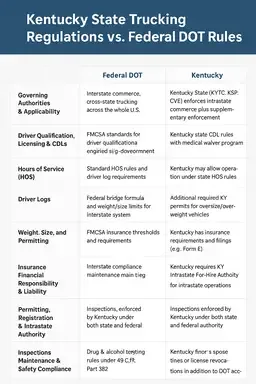
Where They Overlap / Align
-
Hours of Service (HOS) for interstate carriers
-
Kentucky carriers engaged in interstate operations must follow the federal HOS rules (e.g., maximum 11 driving hours after 10 consecutive off-duty hours; 14-hour on-duty window; rest break after 8 cumulative hours of driving).
-
These are set at the federal level, so Kentucky must enforce them for interstate operations.
-
-
Requirement for USDOT number for many carriers
-
The FMCSA says: you must have a USDOT number if you operate in interstate commerce and meet certain criteria.
-
Kentucky likewise requires carriers doing certain intrastate/ interstate business to obtain the Federal USDOT number.
-
-
Safety and driver qualification standards
-
Federal regulation sets standards for driver qualifications, medical certificates, hours, vehicle inspection and maintenance (e.g., 49 CFR Part 391 et al.).
-
Kentucky regulation (601 KAR 1:005) explicitly states that “a commercial motor vehicle and its operator … shall be governed by the … Motor Carrier Safety Regulations … adopted and issued by the United States Department of Transportation.”
So Kentucky incorporates (or defers to) many of the federal safety standards for carriers.
-
-
Oversize/Overweight permit requirement
-
Federal rules (e.g., 23 CFR 658) set minimum width/length limits for certain segments of the national network.
-
Kentucky has a permitting scheme for overweight/over-dimensional loads.
So both federal and state frameworks impose restrictions and permit regimes for large/oversize loads.
-
Where Kentucky Imposes Additional or Different Requirements
-
Medical certification for CDL drivers
-
Under federal rules, not all CDL holders may be required to hold a DOT medical certificate depending on the type of operation (see 49 CFR 391).
-
Kentucky law requires all CDL holders in the state to have a valid DOT medical card, regardless of whether they are in an excepted operation.
-
So Kentucky is more stringent in this respect.
-
-
Intrastate-only carrier licensing/authority
-
For carriers operating solely within Kentucky (intrastate), Kentucky has specific requirements: e.g., if you are a for-hire carrier operating intrastate you may need a Kentucky Intrastate For-Hire License (TC95-1 form) and other state filings.
-
Federal interstate rules don’t cover purely intrastate operations — states fill that gap.
-
-
Weight / dimension limits on state highways
-
Kentucky has weight limits for its highways (e.g., 80,000 lbs gross on many interstates, with axle‐specific limits: single axle 20,000 lbs, tandem 34,000 lbs, tridem 48,000 lbs) for state‐designated roads.
-
Federal regulations set minimum/maximum limits for certain highways (e.g., width 102 inches on the National Network) but states retain significant authority to regulate weight/axle limits beyond those minima.
-
Kentucky’s specific limits/routes may differ from what federal minimums allow.
-
-
Oversize/Over-Dimensional Permit Requirements in Kentucky
-
Kentucky’s rules: e.g., permits for certain widths, lengths, heights; e.g., width up to 16′ allowed (with permit) in Kentucky.
-
The federal rules (23 CFR 658) do not impose maximum height limits and allow states to set height restrictions.
-
So Kentucky may impose more restrictive or specific state permit terms in addition to federal baseline.
-
-
Fuel tax / mileage tax / intrastate filings
-
Kentucky imposes certain state‐specific taxes/licensing for vehicles operating intrastate: e.g., KYU (Kentucky highway use tax) for vehicles > 59,999 lbs (or as the literature suggests) for operation in Kentucky.
-
Federal rules do not manage state fuel or mileage taxes — those are state functions.
-
Key Points to Remember for Carriers in Kentucky
-
If you operate interstate (crossing state lines), you must comply with all applicable federal FMCSA regulations.
-
Even if you operate intrastate (within Kentucky only), you must comply with Kentucky’s state regulatory regime, which may impose additional requirements beyond federal law.
-
Having a USDOT number, operating authority, driver qualification files, electronic logs (ELDs) etc are federal requirements that will apply (depending on your operations).
-
Kentucky’s permit, weight/axle, intrastate licensing, and medical card requirements may add extra obligations — failing to comply with state rules can lead to citations even if federal rules are met.
-
When transporting oversize or overweight loads, you must check both federal minimums (for the National Network) and Kentucky’s specific permit rules, width/height/length/weight allowances.
-
Route planning should check the state’s “National Truck Network” map in Kentucky (routes designated for large trucks) and check for state‐specific truck restrictions.
Why This Matters
-
Non-compliance with either federal or state regulations can result in serious penalties, shutdowns, insurance issues, liability exposure.
-
Knowing where Kentucky is more restrictive helps avoid surprises (e.g., medical card requirement for all CDL holders) and ensures safe legal operation.
-
For carriers based in Kentucky, or operating frequently in Kentucky, understanding the interplay ensures you’re not treating Kentucky merely as a “follow federal law” state — there are state-specific laws.
-
For logistics/planning, the state vs federal differences influence cost (permits, taxes, fees), route choices (what roads you can use), and equipment specs (weight, size, driver qualification).