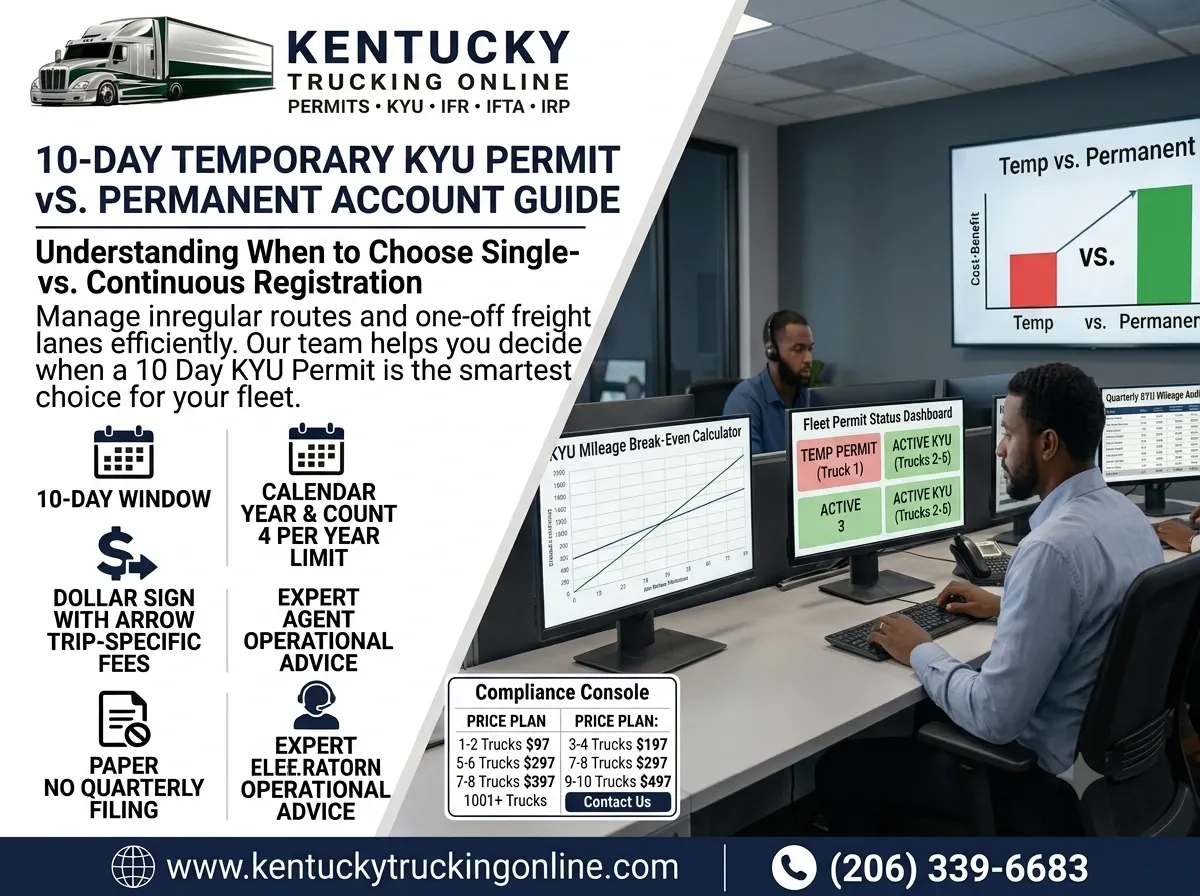
Kentucky Temporary KYU Trip Permits: Cost-Benefit Math for Occasional Runs
Table of Contents
-
Introduction
-
Understanding Kentucky’s KYU Weight-Distance Tax
-
Option A: The Temporary 10-Day KYU Trip Permit
-
Option B: Permanent KYU Registration
-
The Financial Breakdown: When to Switch to a Permanent Number
-
Our Transparent Compliance Pricing
-
Hidden Administrative Costs Beyond the State Fees
-
Simplify Your Bluegrass State Compliance
-
Frequently Asked Questions (FAQ)
Introduction
Operating a successful commercial fleet means keeping tight control over operational expenses. While interstate fuel taxes are generally smoothed out by the International Fuel Tax Agreement (IFTA), a few states enforce separate, independent road-use taxes that require specialized planning. Chief among these is the Commonwealth of Kentucky.
If your commercial motor vehicles cross into Kentucky with a registered gross vehicle weight or combined licensed weight exceeding 59,999 pounds, you are automatically subject to the state's mileage tax laws. To stay fully compliant, carriers must make a strategic choice: purchase temporary, short-term trip clearances or establish a permanent tax account. Finding the right solution for your bottom line comes down to basic cost-benefit math.
Understanding Kentucky’s KYU Weight-Distance Tax
The Kentucky Highway Use License, universally referred to as a KYU number, is a dedicated weight-distance tax profile. It is entirely separate from IFTA and requires carriers to pay a flat road-use assessment fee for every single mile logged on public Kentucky roadways.
Unlike other states where the mileage tax scales strictly based on variable weight tiers, Kentucky computes its standard weight-distance charge at a baseline rate of $0.0285 per mile for qualified heavy vehicles. Every mile counts whether your tractor is pulling a heavy trailer, running deadhead, or operating as a bobtail unit. Before your wheels even touch Kentucky asphalt, your vehicle must be covered by a valid KYU credential.
Option A: The Temporary 10-Day KYU Trip Permit
For fleets that rarely travel east through the Bluegrass State, the Kentucky Transportation Cabinet offers an on-demand, temporary bypass option known as a Temporary KYU Trip Permit.
-
The Workflow: Instead of establishing a permanent account with the state, you purchase an isolated tax permit dedicated to a single truck's Vehicle Identification Number (VIN).
-
The Duration: This permit is strictly valid for 10 consecutive days, allowing that specific truck to conduct its operations within state borders for the duration of the pass.
-
The Advantage: It is a transactional, "one-and-done" tax clearance. You pay the upfront cost, complete your run, and walk away with absolutely zero long-term record-keeping or back-end reporting requirements.
Option B: Permanent KYU Registration
The alternative strategy is to register your company permanently with the state and establish a continuous KYU tax account.
-
The Workflow: Once your business is registered, you receive a permanent KYU number that covers your entire truck inventory.
-
The Advantage: Your trucks can enter, exit, and transit Kentucky seamlessly at any hour without needing ahead-of-time transaction processing. You pay exactly the raw $0.0285 per-mile rate for your actual travel.
-
The Requirement: A permanent account locks you into long-term administrative duties. You are legally required to track your exact in-state mileage and submit official electronic tax filings every single quarter, aligning precisely with your standard IFTA reporting deadlines. Furthermore, if your trucks do not enter Kentucky at all during a specific quarter, you must still submit a mandatory "zero-mile return" to keep your account active and avoid severe state enforcement penalties.
The Financial Breakdown: When to Switch to a Permanent Number
Because temporary 10-day trip permits carry built-in administrative processing surcharges and flat state fees, using them repeatedly for regular lanes will rapidly drain your profit margins.
To determine the exact operational turning point, consider this clear cost-benefit breakdown:
| Annual Kentucky Trips (Per Fleet) | Best Compliance Approach | Core Business Reason |
| 1 to 4 Trips Per Year | Temporary 10-Day Permits | The transactional permit cost is cheaper than paying a specialist to manage and file four quarterly tax returns. |
| 5 or More Trips Per Year | Permanent KYU Account | The raw mileage tax savings completely erase the administrative overhead of quarterly filing. |
If your trucks enter Kentucky multiple times a quarter, continuing to purchase standalone 10-day trip passes results in clear financial overpayment. Conversely, if you only accept a freight lane through Kentucky once or twice a year, the baseline tax rate savings do not justify the labor and oversight required to track, store, and file complex tax returns every three months.
Our Transparent Compliance Pricing
To make your compliance budgeting as simple as possible, we align our service options with predictable, tiered structures based directly on the size of your operational fleet. No hidden surprises, just straightforward pricing to keep you moving.
| Fleet Size | Service Investment Plan |
| 1–2 Trucks | $97 |
| 3–4 Trucks | $197 |
| 5–6 Trucks | $297 |
| 7–8 Trucks | $397 |
| 9–10 Trucks | $497 |
| 1001+ Trucks | Contact Us Directly! |
Hidden Administrative Costs Beyond the State Fees
When auditing your fleet's compliance budget, remember that state fees are only part of the equation. Savvy logistics managers look at the entire administrative picture:
Audit Protection
Carriers running on a permanent KYU account must preserve highly accurate, microscopic records, including detailed ELD printouts, GPS routing histories, and primary IFTA trip records for a minimum of several years. If your background record-keeping is disorganized, a surprise state mileage audit can bring devastating structural fines. Temporary trip permits carry zero long-term audit exposure because the tax obligation is settled upfront at purchase.
Dispatch Bottlenecks
If you depend heavily on spot-market freight or rapid broker load boards, waiting to clear transactional trip permits can slow down your operation. Having an active, permanent KYU number means your drivers are completely pre-cleared to accept high-paying loads crossing Kentucky freight lanes 24/7/365, without administrative delays at dispatch.
Simplify Your Bluegrass State Compliance
Navigating state-specific trucking regulations shouldn't pull your focus away from keeping your trucks moving and your drivers safe. At Kentucky Trucking Online, we specialize in taking the confusion out of regional highway tax structures.
Whether your immediate schedule demands an instant, on-demand, temporary 10-day trip pass to safely cross a Port of entry or you want to establish a permanent KYU profile and hand off your quarterly tax filing duties to professionals, we are here to help. We handle the paperwork, protect you from expensive compliance delays, and protect your operating margins.
FAQ
What specific weight threshold triggers Kentucky KYU tax requirements?
Any commercial vehicle or combination configuration with an official registered gross weight or combined licensed operating weight of 60,000 pounds or greater must have KYU credentials to operate on Kentucky public roads.
Does my IFTA license cover my road-use tax obligations in Kentucky?
No. While your fuel usage tax is handled through your standard IFTA filings, Kentucky’s weight-distance tax is an entirely independent, standalone road-use program. You must maintain separate KYU credentials or single-trip tax clearances.
What is the penalty for missing a permanent KYU quarterly filing deadline?
Failing to submit your mileage report on time results in immediate financial penalties, interest accumulation, and the rapid suspension of your authority to operate in the state. Kentucky imposes a flat $500 late penalty for delinquent filings, even if your fleet drove zero miles in the state during that quarter.
How long am I required to archive my primary Kentucky mileage logs?
Carriers utilizing a permanent KYU account must maintain complete tracking records, including ELD logs and matching trip dispatches, for at least four years to remain fully protected during state DOT audits.
Can my truck enter a Kentucky Port of Entry to purchase a permit?
While temporary trip passes can technically be secured at physical state border enforcement checkpoints, doing so frequently subjects your driver to lengthy inspection lines and delays. Securing your compliance documents electronically before dispatch is always the most efficient choice.