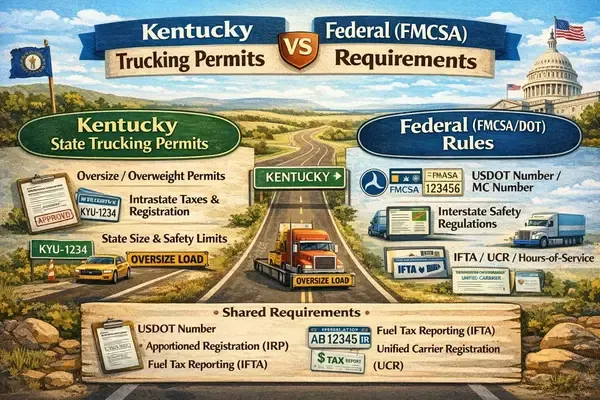
1. Federal (FMCSA & DOT) Requirements
These are the baseline rules you must follow any time you operate as a commercial motor carrier in interstate commerce (across state lines):
Interstate Safety & Operating Regulations
-
USDOT Number: Required for carriers operating vehicles above a certain weight in commerce as mandated by FMCSA.
-
Operating Authority (MC Number): Required for for-hire interstate carriers transporting regulated goods.
-
Driver Safety Regulations: FMCSA rules cover hours-of-service, drug & alcohol testing, vehicle maintenance, inspections, and driver qualifications.
-
Unified Carrier Registration (UCR): Federal-mandated annual registration for interstate carriers.
-
IFTA (Fuel Tax): A federal-coordinated fuel tax agreement — carriers operating in multiple states report fuel use quarterly under this system.
-
IRP (Apportioned Registration): Federal-linked vehicle registration that allocates registration fees based on miles driven in each member jurisdiction if you operate in multiple states.
Federal regulations do not issue the actual oversize/overweight load permits — those are state issued (see next section) — but the federal bridge formula does set maximum weight criteria for interstate (National Network) travel.
2. Kentucky State Trucking Permits & Requirements
Oversize & Overweight Load Permits
-
Kentucky requires permits for vehicles or loads that exceed state legal limits for width, height, length, or weight before operating on state highways.
-
These permits are issued by the Kentucky Transportation Cabinet (KYTC) and must be carried during transport.
-
Rules specify how the application is submitted, what measurements must be provided, and conditions for validity.
-
State also sets safety conditions like escort vehicle requirements when needed.
Important distinction: The federal government does not issue oversize/overweight permits — each state (including Kentucky) has its own permit system, and Kentucky will enforce its own permit requirements even if the load meets federal minimum standards.
3. How Federal & State Rules Interact
When Federal Rules Apply
-
If you operate interstate, you must follow all applicable FMCSA rules (safety, licensing, registration such as USDOT/MC, IFTA, UCR, HOS, insurance).
-
FMCSA sets baseline size and weight standards for travel on the National Network of federal highways, but does not replace state permit requirements.
State Permits Add Requirements
-
Kentucky adds its own permit requirements for specific conditions like oversize or overweight movements, and it imposes additional local licensing & tax obligations such as KYU weight-distance tax numbers and intrastate certificates.
-
Even if you meet federal minimums, Kentucky can have more restrictive state limits or additional documentation requirements.
4. Key Examples of Differences
| Category | Federal (FMCSA) | Kentucky State |
|---|---|---|
| Baseline truck safety standards | Required for interstate carriers | States enforce in addition, can have local checkpoints |
| USDOT/MC/Ifta/IRP | FMCSA governs for interstate operations | KYTC may enforce use of corresponding state licenses like KYU or KIT (intrastate fuel tax) |
| Oversize/Overweight permits | Not issued federally — federal rules set weight limits & definitions | KY issues its own permits for loads exceeding state limits |
| Legal dimension limits | Federal sets minimums for National Network | KY can set different limits and require permits for exceedances |
Summary
-
FMCSA federal requirements create a foundation of safety, registration, and operating standards for interstate trucking.
-
Kentucky’s trucking permits and regulations sit on top of that foundation and govern specific state issues such as oversize/overweight permits and state-level taxes/licensing.
-
You must comply with both federal and Kentucky rules when operating within or through Kentucky.
https://drive.ky.gov/Motor-Carriers/Pages/Commercial-Motor-Vehicle-Credentials.aspx