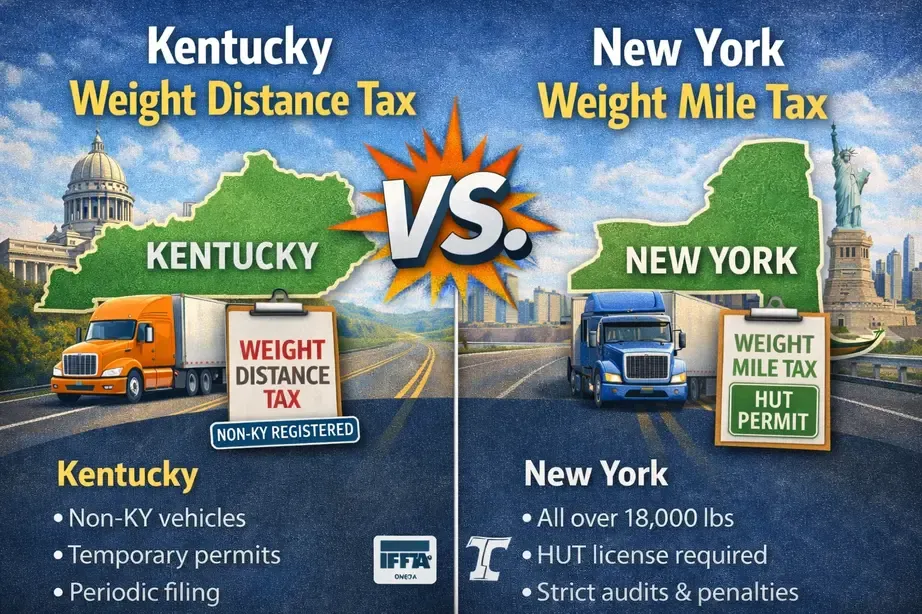
For Kentucky Weight Distance Account and Permits visit here, instant permits guaranteed - https://www.kentuckytruckingonline.com/
For New York Weight Distance Account and Permits visit here, fast approval guaranteed - https://www.newyorktruckingonline.com/
What Each Tax Is
Kentucky Weight Distance Tax (KY WDT)
Kentucky imposes a Weight Distance Tax on certain non-Kentucky registered vehicles operating on Kentucky highways. The tax is based on:
-
Vehicle weight
-
Miles traveled in Kentucky
It primarily affects out-of-state carriers that are not fully registered under Kentucky’s base registration programs.
New York Highway Use Tax (HUT) – Often Called Weight Mile Tax
New York’s Highway Use Tax (HUT) applies to:
-
Vehicles with a gross weight over 18,000 lbs
-
Or combinations exceeding 26,000 lbs
The tax is based on:
-
Weight category
-
Miles traveled within New York
New York’s system is one of the strictest and most actively enforced in the U.S.
Key Differences at a Glance
| Category | Kentucky Weight Distance Tax | New York Weight Mile (HUT) |
|---|---|---|
| Official name | Weight Distance Tax | Highway Use Tax (HUT) |
| Applies to | Mostly non-KY registered carriers | All qualifying carriers (in-state & out-of-state) |
| Weight threshold | Heavy commercial vehicles over GVW 59,999 pounds | Over 18,000 lbs (or 26,000 combined) |
| Tax basis | Weight × KY miles | Weight class × NY miles |
| Filing frequency | Periodic / as required | Quarterly |
| Permit system | Temporary permits available | HUT permit required |
| Enforcement intensity | Moderate | Very strict |
| Known for | Targeting unregistered carriers | Heavy fines & audits |
How the Taxes Are Calculated
Kentucky
-
Tax is calculated using declared gross vehicle weight
-
Applied only to miles driven in Kentucky
-
Often handled through temporary permits or reporting requirements
New York
-
Uses multiple weight brackets
-
Mileage must be tracked precisely
-
Tax rates increase sharply at higher weight levels
Permits & Registration
Kentucky
-
Mandatory for the trucks with registered grossweight over 59,999 pounds
-
Temporary weight distance permits are available for short operations
New York
-
Requires a Highway Use Tax (HUT) permit
-
Carriers receive a HUT decal and certificate
-
No operation allowed without an active HUT account
Enforcement & Penalties
Kentucky
-
Enforcement through weigh stations and roadside checks
-
Penalties typically involve fines or permit violations
New York
-
Aggressive enforcement by NYSDOT
-
Penalties may include:
-
Heavy fines
-
Back taxes
-
Vehicle impoundment
-
Audit assessments
-
Key Compliance Differences
-
Kentucky focuses on registration status and distance traveled
-
New York focuses on detailed mileage reporting and weight accuracy
-
New York requires much more recordkeeping than Kentucky
Key Takeaways
-
Kentucky’s tax is simpler and more situational
-
New York’s HUT is mandatory, complex, and strictly enforced
-
New York carriers should prioritize accurate trip records
-
Carriers running both states need separate compliance strategies
https://transportation.ky.gov/Audits/Pages/Weight-Distance-and-Intrastate-Audit-Assistance.aspx