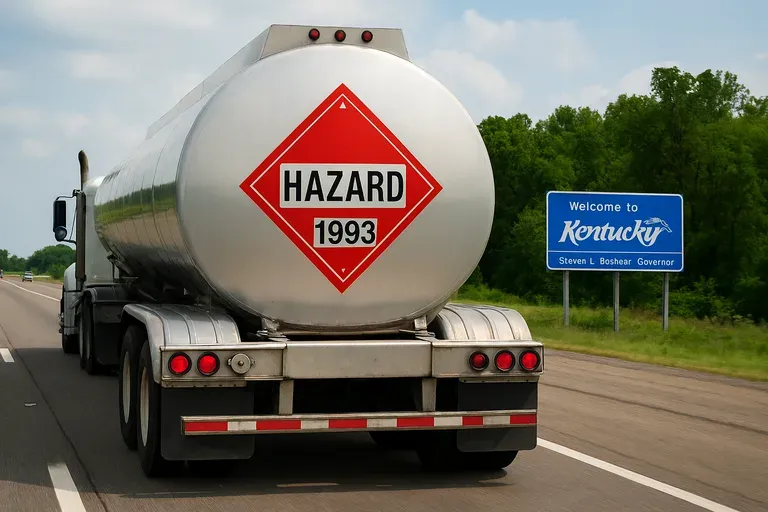
1. Regulatory Framework: Federal & State
-
Kentucky adopts the federal hazardous materials transportation regulations (HMTR) by reference. Specifically, 601 KAR 1:025 states that the following federal regulations govern hazardous materials transport by air or highway in Kentucky: 49 CFR Parts 107, 130, 171-173, 175, 177, 178, 180.
-
Another regulation, 601 KAR 1:005, reinforces that motor carriers operating in Kentucky (intrastate or interstate) transporting hazardous materials must comply with 49 CFR Parts 397 (transportation of hazardous materials) and 1572 (security threat assessments) among others.
-
For drivers applying for a Hazardous Materials Endorsement (HME) on a CDL, Kentucky’s regulation 502 KAR 10:120 sets the procedures (including fingerprinting and background checks) consistent with federal law (49 CFR 1572).
2. Driver Requirements – Hazardous Materials Endorsement (HME)
When a driver will operate a vehicle transporting hazardous materials requiring placarding/licensing under federal rules, Kentucky requires:
-
The driver must hold a valid Kentucky CDL or instruction permit before applying for the HME.
-
The driver must undergo a fingerprint-based criminal background check, processed through the Kentucky State Police (KSP) and the Transportation Security Administration (TSA). For example, a fee of $138.25 is required for the fingerprinting / background check.
-
After “no security threat” is determined by TSA, the driver is then eligible to take the written knowledge test for HME.
-
At renewal or transfer of endorsement, the same procedures apply (or the security threat assessment period remains as set by TSA).
-
The driver must ensure proper placarding, shipping papers, training, and follow the commercial driver requirements under federal regulation. Kentucky adopts 49 CFR Parts 391 (driver qualification), 392 (driving rules), 395 (hours of service), and especially 397 (transport of hazardous materials).
3. Carrier / Vehicle Requirements
Beyond driver licensing, carriers transporting hazmat in Kentucky must:
-
Follow the federal HMTR: ensure shipping papers, marking/labeling, placarding, packaging, vehicle condition, and driver training per 49 CFR Parts 171-180. Kentucky’s statute/regulation (601 KAR 1:025) explicitly adopts those parts.
-
Register appropriately: For example, entities transporting hazardous waste (a subset of hazardous materials) must register with the Kentucky Energy and Environment Cabinet if they transport hazardous waste in the state. For instance, the form DWM 7053 indicates companies transporting hazardous waste must pay an annual registration fee ($300) even if out-of-state.
-
Ensure the vehicle is placarded correctly on all required sides, the driver has the proper endorsement, and the shipment meets the federal definitions (e.g., requires placard) and state adoption.
-
Adhere to route restrictions, local/bridge clearances, and other conditional requirements when moving certain classes of hazardous materials (especially explosives, radioactive materials, etc). While Kentucky’s regulation may not list all route restrictions, federal rules in 49 CFR may apply and Kentucky incorporates these.
4. Why This Matters & Consequences of Non-Compliance
-
Transporting hazardous materials without meeting required endorsements, registration, placarding or documentation can result in severe penalties: fines, interruption of operations, denial of movement, liability for spills or accidents.
-
The endorsement process (background check, testing) ensures drivers transporting these high-risk materials are vetted for security and safety.
-
Carriers must maintain safety and environmental compliance, since hazardous materials pose significant risk to public safety, environment, and infrastructure.
-
Operating in Kentucky (or passing through) means you must be aware of both federal HMTR and the Kentucky adoption/regulations — missing a state requirement can lead to violations even if you’re compliant federally.
5. Practical Steps for Carriers & Drivers
If you’re planning to transport hazardous materials in Kentucky, here’s a checklist:
-
Determine if your load qualifies as hazardous material under 49 CFR § 171.8 (definitions) and if it requires placarding, shipping papers, driver endorsement, etc.
-
Ensure your driver has a valid Kentucky CDL and the HazMat Endorsement (HME): background check, fingerprinting, testing completed.
-
Register your carrier/vehicle appropriately if you’ll transport hazardous waste or other regulated hazardous materials in Kentucky (e.g., pay registration fee, obtain EPA ID, etc.).
-
Ensure the vehicle meets placarding/labeling/marking/shipping papers requirements under 49 CFR Parts 172, 173, 177 (as adopted by Kentucky).
-
Route plan and check for any local restrictions — certain materials may have limited access to tunnels, bridges, populated areas.
-
Train your driver and staff on emergency response, documentation, security, driver qualifications, vehicle inspection, and hazard communication.
-
Maintain documentation and compliance records — truck insurance, driver records, shipping papers, placards, inspection logs.
-
If in doubt, consult with the Kentucky Transportation Cabinet (KYTC) and/or Kentucky Energy & Environment Cabinet for specific registration or transport questions.