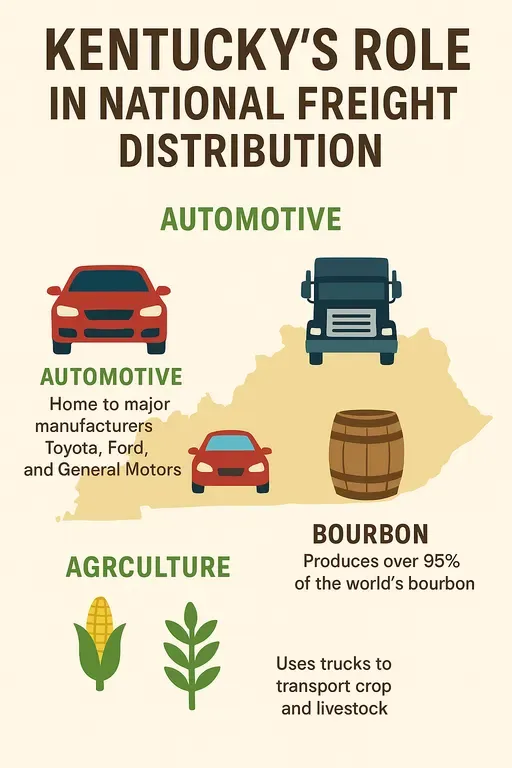
Automotive Freight
Kentucky is home to major automotive manufacturers, including Toyota (Georgetown), Ford (Louisville), and General Motors (Bowling Green).
-
Thousands of trucks transport auto parts, engines, and finished vehicles daily to assembly plants and dealerships nationwide.
-
The I-65 and I-75 corridors serve as primary automotive logistics routes.
-
Many Tier 1 and Tier 2 suppliers operate near Louisville and Lexington, forming a dense freight ecosystem.
Bourbon Industry
Kentucky produces over 95% of the world’s bourbon, and trucking is essential to its supply chain.
-
Tanker trucks move raw materials like grain and mash between distilleries and storage sites.
-
Finished bourbon is transported in barrels and bottles to domestic and export distribution centers.
-
Louisville and Bardstown are major hubs for bourbon logistics, combining local trucking, warehousing, and intermodal rail connections.
Agriculture
Agricultural freight includes corn, soybeans, poultry, cattle, and hemp.
-
Trucks connect rural farms to processing plants, feed mills, and ports along the Ohio and Mississippi Rivers.
-
Kentucky’s agricultural trucking is heavily affected by seasonal road weight restrictions and harvest cycles.
-
The state’s rural infrastructure improvements continue to enhance farm-to-market freight efficiency.
Logistics & Infrastructure Advantages
-
Central location: Within a day’s drive of 65% of the U.S. population.
-
Interstates: I-64, I-65, I-71, I-75, and I-24 form Kentucky’s freight backbone.
-
Air hubs: UPS Worldport (Louisville) and DHL Express (Cincinnati/Northern Kentucky Airport) are among the largest in the world.
-
River ports: Facilitate multi-modal connections for bulk commodities.
Conclusion
Kentucky’s trucking industry forms the backbone of its economic success — linking the automotive, bourbon, and agriculture sectors with national and global supply chains. The state’s balanced blend of manufacturing, agriculture, and logistics keeps its highways among the busiest freight corridors in the U.S.