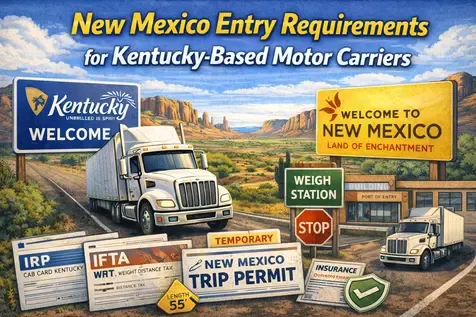
For New Mexico Permanent or Temporary Permits visit here - https://www.newmexicotruckingonline.com/
1. Federal and Interstate Registration Requirements
If you operate commercial vehicles for interstate commerce — such as Kentucky carriers entering New Mexico — you must be properly registered at the federal level:
-
USDOT Number: Required for carriers operating commercial vehicles with a GVWR of 10,001 lbs or more in interstate commerce.
-
MC Operating Authority: If you are a for‑hire carrier transporting goods through or into New Mexico, federal operating authority (MC number) from FMCSA is required.
These federal credentials are typically checked at New Mexico Ports of Entry.
2. IRP Registration or Trip Permits
IRP (International Registration Plan)
-
Carriers that travel in two or more jurisdictions — including Kentucky and New Mexico — should ideally have vehicles IRP‑registered with apportioned plates and cab cards.
-
If the IRP cab card does not include New Mexico, you will likely need a New Mexico Trip Permit to legally operate inside the state.
Temporary Trip Permits
-
Kentucky carriers without New Mexico listed on their IRP apportioned plates can obtain a temporary trip permit before or at the first New Mexico port of entry.
-
These permits allow short‑term legal operation inside the state and are typically valid for about 5 days.
Both the trip permit and IRP credentials are often checked at weigh stations and POEs.
3. IFTA Fuel Tax or Temporary Fuel Permits
IFTA (International Fuel Tax Agreement)
-
Interstate carriers with qualified vehicles (usually >26,000 lbs GVW or 3+ axles) must carry a valid IFTA license and decals issued by their base state (Kentucky) to report fuel use.
-
New Mexico enforcement officers will verify IFTA credentials upon entry.
Temporary Fuel Permits
-
If the Kentucky carrier does not have IFTA credentials covering New Mexico, a temporary fuel permit is required before entry.
-
Like trip permits, the fuel permit is typically valid for around 5 days and allows use of New Mexico highways while covering fuel tax obligations.
4. New Mexico Weight Distance Tax (WDT)
Unlike many states, New Mexico has a Weight Distance Tax (WDT) for carriers operating vehicles over certain weight thresholds (e.g., >26,000 lbs).
-
Out‑of‑state carriers must either:
-
Register for a permanent WDT permit/account, at https://www.newmexicotruckingonline.com/
-
Purchase a temporary WDT permit before entry if operating occasionally at https://www.newmexicotruckingonline.com/
-
-
This tax is calculated based on miles driven within New Mexico and must be reported accordingly.
5. Ports of Entry and Stops
New Mexico law requires that all commercial motor vehicles entering the state stop at designated Ports of Entry (POEs) for inspection and permitting.
At POEs, officers check:
-
USDOT and MC authority
-
IRP registration or trip permits
-
IFTA decals or fuel permits
-
WDT accounts or temporary WDT permits
-
Vehicle and driver safety compliance
Failure to stop at a POE can result in fines, vehicle hold, or mandatory inspection.
6. Oversize/Overweight and Other Permits
If your loads exceed legal size or weight limits:
-
OSOW (Oversize/Overweight) Permits are required before entry into New Mexico for vehicles or loads exceeding statutory limits.
-
Escort vehicles may also require certification if used for these loads.
Ensure you secure these permits before the state line, as enforcement is strict.
7. Insurance and Safety Documentation
Commercial carriers should have:
-
Proof of valid federal/state liability insurance
-
IFTA and IRP credentials or temporary permits
-
Trip, fuel, WDT, and OSOW permits (if applicable)
-
DOT/MC paperwork
These documents should be kept in the vehicle at all times for POE inspections.
Quick Compliance Checklist for Kentucky Carriers Entering New Mexico
Before Entry
USDOT number and MC authority
IRP registration with New Mexico or a trip permit
IFTA license and decals or a temporary fuel permit
WDT permanent account or temporary WDT permit at https://www.newmexicotruckingonline.com/
Oversize/Overweight permit (if needed)
At Entry/POE
Stop at first Port of Entry
Present all credentials and permits
Ensure safety and equipment compliance
Ongoing
File fuel and weight distance tax reports as required at https://www.newmexicotruckingonline.com/
Maintain records of miles traveled in New Mexico
Bottom Line
Kentucky‑based carriers must comply with several New Mexico entry requirements before operating in the state — including registration (IRP/IFTA), permits (trip, fuel, WDT), and stops at Ports of Entry — to avoid fines, delays, or citations. Planning and securing permits before arrival is essential for smooth interstate operations.
https://www.mvd.newmexico.gov/commercial/commercial-vehicles/ports-of-entry-information/