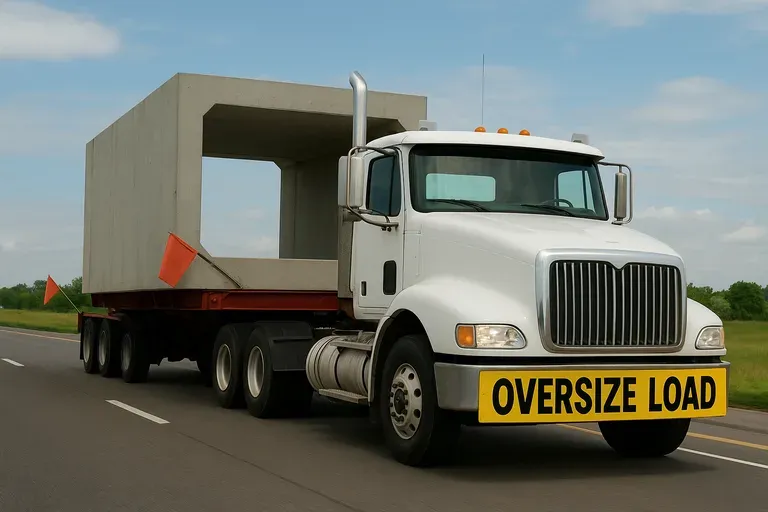
1. Governing Law & Regulations
-
The primary regulation is 601 KAR 1:018 – Special overweight or overdimensional motor vehicle load permits (Kentucky Administrative Regulations) which implements statute under KRS 189.270, KRS 189.271, KRS 189.2715, KRS 189.2717.
-
Additional regulation for farm equipment: 601 KAR 1:019 – Overweight or overdimensional farm equipment.
-
General weight limits before requiring permits are under 603 KAR 5:066 – Weight (mass) limits for trucks.
2. When is a Permit Required?
-
A permit is required prior to movement of any vehicle/load exceeding the legal statutory or regulatory limits for width, height, length or weight.
-
Specifically:
-
Width: Loads wider than 8 ½ feet (8'6") generally require a permit.
-
Height: Loads taller than 13 feet 6 inches trigger a permit requirement.
-
Weight/axle limits: If gross weight or axle group weights exceed the statutory/regulatory limits, a permit is needed.
-
-
Load divisibility: A permit typically will not be issued for a divisible load that could be dismantled, divided, or rearranged to meet legal limits.
-
Farm equipment exception: Some farm equipment is exempt (moving between farms, from farm to dealer, etc.) under 601 KAR 1:019, but still subject to safety/escort requirements.
3. Key Dimension & Weight Limits
Dimensions
-
Width: Legal width is 8 ft 6 inches (8'6") on interstates/designated highways. Loads wider than that require a permit.
-
Height: Standard maximum height is 13 ft 6 in. Loads exceeding that height must obtain a permit, and loads above 15 ft 6 in may need a route survey.
-
Length: There are length limits; for example a manufactured home with combined length of towing vehicle + home greater than 120 ft is prohibited.
Weight/axle group limits (for permitted loads)
-
Steering axle: max ~20,000 lbs.
-
Single dual-wheel axle: ~24,000 lbs.
-
Tandem dual-wheel axle group (5 axle combination): ~45,000 lbs.
-
Tandem dual-wheel axle group (6+ axle combination): ~48,000 lbs.
-
Tridem dual-wheel: ~60,000 lbs.
-
Gross weights by configuration:
-
5-axle combination: up to ~96,000 lbs.
-
6-axle: up to ~120,000 lbs.
-
7-axle: up to ~160,000 lbs (for certain permits).
-
-
The formula also provides that axle weight cannot exceed “700 lbs × tire width (in inches)” or the specified maxima.
4. Types of Permits & Application Process
-
Single trip permit: Valid for one move. Under 601 KAR 1:018, the single-trip permit is valid for one move and duration of up to 10 days.
-
Annual permit: Valid for unlimited moves (within conditions) for 365 days.
-
Application:
-
Complete form TC 95-10 (Worksheet for single-trip) or TC 95-25 (Application for annual) and submit to Division of Motor Carriers.
-
Payment of applicable fees: e.g., single-trip permit fee and annual permit fee are specified under statute/regs.
-
Provide required information: vehicle and towing unit details (VIN, license plate, jurisdiction), description of cargo, route, registration details, axle configuration, etc.
-
-
Online system: www.kentuckytruckingonline.com
5. Route, Travel, and Operational Conditions
-
Permits specify the approved route. Any deviation from the route must receive prior written approval from the Division of Motor Carriers.
-
Travel hours: Generally allowed 24/7 unless the permit says otherwise. However, specific loads such as mobile homes may have daylight-only restrictions.
-
County/peak-traffic restrictions: In certain counties (e.g., Boone, Campbell, Fayette, Jefferson, Kenton) permitted loads are restricted from traveling in rush-hour windows (7 am-9 am, 4 pm-6 pm) on weekdays.
-
Weather/conditions: Loads wider than 12 ft cannot move if a wind advisory is issued or if road conditions are dangerous.
-
Highway/truck network constraints: A permit may be denied or restricted if the route includes interstate segments and the load is divisible, or if bridges/structures on the route cannot support the load.
6. Escort, Signage & Other Safety Requirements
-
Oversize loads may require one or more escort vehicles (pilot cars) depending on width, height, route, and local/permit conditions.
-
The permit holder is responsible for the safe movement of the load, including any necessary traffic control when crossing bridges or where the load encroaches on other lanes.
-
The permit holder is financially responsible for any damage to roads, signs, guardrails, other public/private property caused by the load movement.
7. Divisible vs Non-divisible Loads
-
Kentucky will not issue an OS/OW permit for a load that is reasonably divisible — i.e., could be reconfigured, disassembled or divided to meet legal limits — except under specific statutory authority.
-
Loads considered “non-divisible” (such as large equipment or structures where dismantling isn’t feasible) may qualify for permit if other conditions met.
8. Practical Tips for Carriers and Shippers
-
Always submit your permit application early to allow time for review (especially annual/special loads).
-
Review the approved route carefully and ensure trucks follow exactly — deviation without approval can invalidate the permit or lead to enforcement.
-
Carry the physical or electronic permit in the vehicle at all times and produce it when requested by law enforcement.
-
Check for local county/truck-traffic restrictions, rush-hour windows, weather advisories (especially for wide loads).
-
Ensure tractor/trailer equipment is adequate (braking, horsepower, registration weight) for the load. Under KY rules, gross/axle overweight not permitted on units less than 5 axles.
-
Confirm route clearances (bridges, underpasses) if height or width is significant. For heights over 15’6” a route survey may be required.
-
Monitor special load categories (manufactured homes, seaworthy containers, etc) which may have additional requirements.
-
Keep documentation showing load is non-divisible if required.
-
Remember: The permit does not guarantee safe passage — you are responsible for compliance and safety.