-
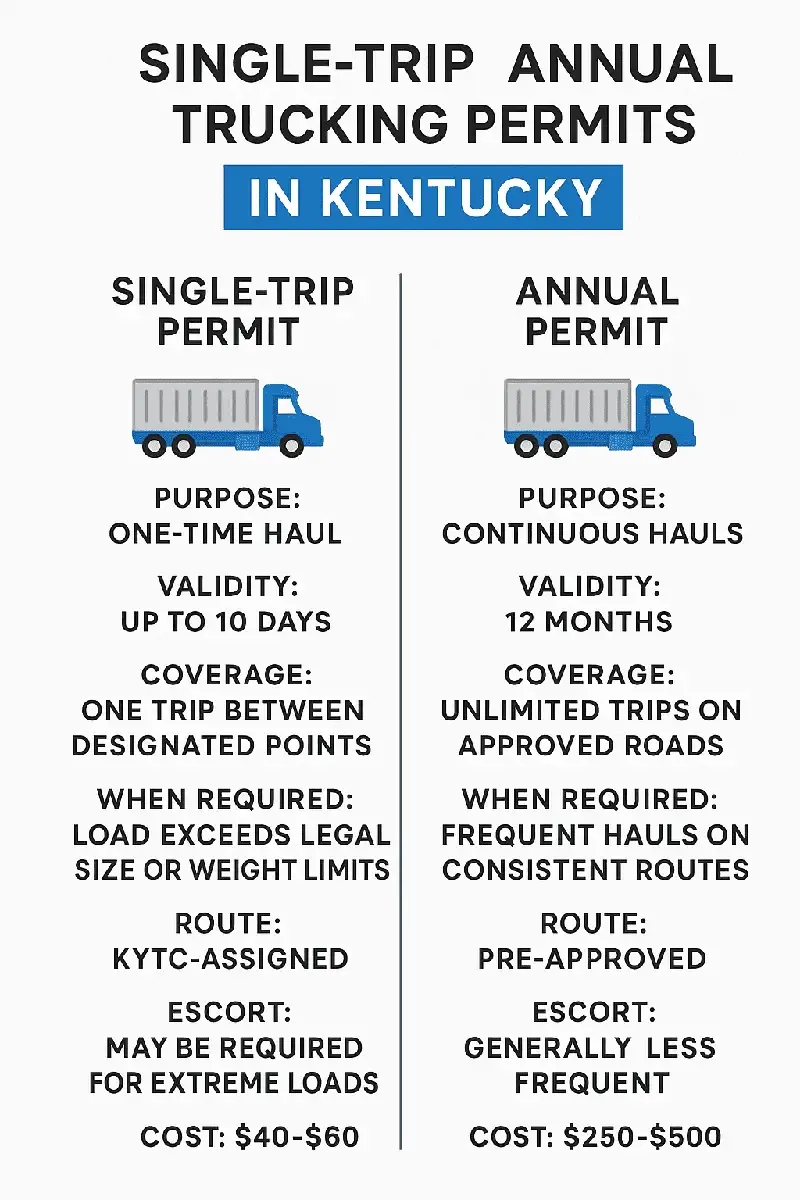
Single-Trip Permit → for one-time or occasional hauls
-
Annual Permit → for frequent moves of similar loads or routes
Both permit types ensure that trucks comply with state regulations to protect highways, bridges, and public safety.
2. Single-Trip Permits
Purpose:
A Single-Trip Permit allows a carrier to make one specific trip between designated points in Kentucky for an oversize or overweight load.
Key Details:
-
Validity: Up to 10 consecutive days.
-
Coverage: One-way trip between the approved origin and destination (or round-trip if requested and within the same timeframe).
-
When Required:
-
Load exceeds legal size or weight limits:
-
Width: over 8’6”
-
Height: over 13’6”
-
Length: over 65’ (combination vehicles)
-
Weight: over 80,000 lbs gross or per-axle limit
-
-
-
Route: KYTC assigns an approved route based on bridge capacities, construction, and clearance restrictions.
-
Escort Requirements: May be required for extremely wide or long loads.
-
Cost: Typically $40–$60, depending on load and route type.
-
How to Apply: www.kentuckytruckingonline.com
Best For:
-
One-time or occasional equipment deliveries.
-
Out-of-state carriers hauling through Kentucky.
-
Construction or agricultural equipment transfers.
Pros:
-
Lower up-front cost.
-
Simple approval for individual moves.
Cons:
-
Must reapply for each load.
-
Route-specific—limited flexibility.
3. Annual (Multi-Trip) Permits
Purpose:
An Annual Permit allows the movement of certain oversize or overweight loads on a continuous basis for a year, as long as they remain within defined limits.
Key Details:
-
Validity: 12 months from the date of issue.
-
Coverage: Unlimited trips on pre-approved state routes within permitted dimensions.
-
Eligible Loads:
-
Width up to 12 ft
-
Height up to 14 ft 6 in
-
Length up to 75 ft (varies by configuration)
-
Weight up to 120,000 lbs (on approved configurations)
-
-
Routes: KYTC maintains maps of approved highways and routes for annual permits.
-
Cost: Usually $250–$500 per year, depending on vehicle class and weight.
-
How to Apply: www.kentuckytruckingonline.com
Best For:
-
Carriers that run the same routes frequently.
-
Utility companies, heavy equipment movers, or manufacturing fleets.
-
Businesses with regular, predictable loads.
Pros:
-
Unlimited trips on designated routes.
-
Saves time—no repeated applications.
-
Reduces annual permitting costs for frequent hauls.
Cons:
-
Higher up-front fee.
-
Limited to specific maximum dimensions and routes.
-
Must maintain compliance throughout the year.
4. Key Comparison Table
| Feature | Single-Trip Permit | Annual Permit |
|---|---|---|
| Validity Period | Up to 10 days | 12 months |
| Trips Covered | One (or one round-trip) | Unlimited on approved routes |
| Cost | $95–$100 per trip | $500–$1000 per year |
| Route | Specific, KYTC-assigned | Statewide approved highways |
| Best For | Occasional or unique loads | Frequent, routine hauls |
| Size/Weight Limits | Case-by-case | Up to 12’ wide, 14’6” high, 120,000 lbs |
| Escort Requirement | Possible for extreme loads | Generally less frequent |
| Processing Time | Usually same-day | May take a few days to issue |
5. Application Process
To apply for either permit:
-
Go to the www.kentuckytruckingonline.com
-
Provide:
-
Vehicle and load details (axle weights, spacing, dimensions)
-
Origin and destination points
-
Contact and insurance information
-
-
Submit payment online.
-
Print and carry the permit in the truck at all times.
6. Compliance & Safety Tips
-
Check for construction and bridge restrictions before every trip.
-
Follow escort and lighting requirements exactly as noted on the permit.
-
Keep proof of insurance and vehicle registration in the cab.
-
Renewal reminders: Apply for annual permit renewal at least two weeks before expiration.
-
Report any route damage or clearance issues to KYTC immediately.
7. Final Thoughts
Choosing between a Single-Trip and Annual Trucking Permit in Kentucky depends on your hauling frequency and load type:
-
Use a Single-Trip Permit for occasional or unique loads.
-
Choose an Annual Permit if you operate frequently on consistent routes.
Both ensure safe, legal transport while protecting Kentucky’s roadways.