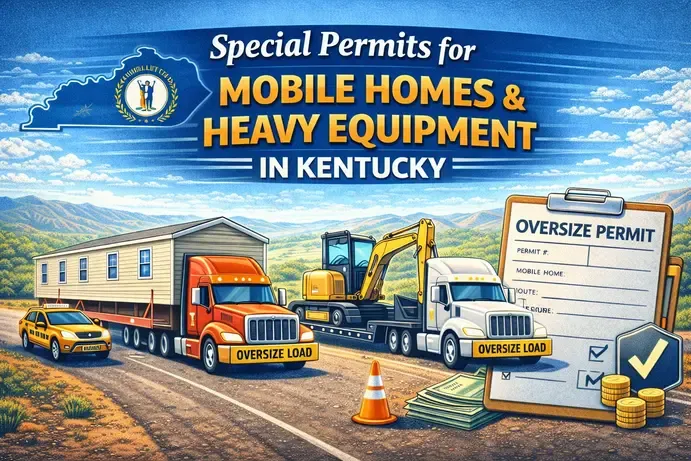
Why Special Permits Are Required
Kentucky defines legal maximums for commercial vehicles based on length, width, height, and weight. Loads that exceed these limits — such as mobile homes, modular buildings, cranes, excavators, and other large machinery — cannot travel on public highways without a special permit. Without proper authorization, carriers risk fines, vehicle impoundment, and other penalties.
Kentucky Size & Weight Limits (General)
(Note: Always verify exact statewide limits with Kentucky Transportation Cabinet before travel.)
-
Width: 8 feet 6 inches
-
Height: 13 feet 6 inches (typical maximum)
-
Length: Length limits vary by configuration
-
Weight: Based on axle, tandem, and gross vehicle weight formulas
Loads that exceed these require oversize/overweight permits.
Types of Special Permits
1. Single‑Trip Oversize/Overweight Permit
Used for one‑time moves of a specific mobile home or piece of heavy equipment. The permit specifies travel date(s), route, and conditions.
2. Annual Permit
Carriers who frequently move oversize mobile homes or heavy machinery may opt for an annual oversize/overweight permit, covering multiple trips within a year.
3. Superload Permit
For extremely large or heavy loads that far exceed standard oversize/overweight limits, Kentucky may require a Superload permit with detailed routing, engineering review, and possibly special escorts.
Permit Requirements & Conditions
Dimension & Weight Specifications
Permits are required when the load’s width, height, or weight exceeds legal maximums. Common thresholds include:
-
Width over 8’6”
-
Height over 13’6”
-
Weight over standard axle or gross limits
Large mobile homes or heavy machinery (e.g., bulldozers, cranes) often fall into these categories.
Escort and Safety Requirements
Depending on the size of the load, Kentucky may require escort vehicles (also called pilot cars):
| Load Width | Escort Requirement |
|---|---|
| Up to ~12 ft | Typically no escort |
| 12–14 ft | One escort |
| Over 14 ft | Two escorts |
| Extremely wide | Law enforcement escorts or additional controls |
Additionally, oversize loads must display:
-
“Oversize Load” banners front and rear
-
Flags on corners of the load
-
Amber lights during movement
These requirements help improve visibility and safety.
Routing and Travel Restrictions
Special permit conditions often include:
-
Designated travel routes (avoiding low bridges, sharp turns)
-
Daylight‑only travel (sunrise to sunset)
-
Restrictions on night, weekend, or holiday travel
-
Compliance with weight‑restricted bridges and roadway limits
Particularly large or heavy loads may require an engineering route survey to identify potential hazards and ensure bridge and road capacity.
How to Apply for a Special Permit in Kentucky
1. Online Permit Application
Most carriers apply through the https://www.kentuckytruckingonline.com/ entering load dimensions, vehicle details, route information, and travel dates.
2. Provide Load Documentation
Applicants must submit detailed information about:
-
Load width, height, length
-
Gross weight and axle weights
-
Proposed travel route
3. Pay Applicable Fees
Permit fees vary based on the dimensions and weight of the load, and whether the permit is one‑time or annual.
4. Receive and Carry Permit
Once approved, carriers must carry the permit document in the truck during transport (either printed or digital) and adhere to all specified conditions.
Tips to Stay Compliant
Plan routes ahead: Use detailed route planning to avoid restricted bridges or low clearances.
Check weather conditions: High winds can pose hazards when hauling tall or oversized loads.
Train drivers: Make sure drivers understand oversize procedures and safety protocols.
Carry documentation: Keep permits available for law enforcement inspections.
Penalties for Non‑Compliance
Operating without the proper special permit can lead to:
-
Fines and civil penalties
-
Vehicle impoundment or trip suspension
-
Liability for infrastructure damage
-
Increased enforcement scrutiny
Insurance claims may be denied if loads are moved without proper authorization.