Understanding Kentucky’s Permit System
When operating commercial vehicles across Kentucky state lines, carriers must comply with both registration and fuel tax requirements.
For carriers who are not registered under the International Registration Plan (IRP) or the International Fuel Tax Agreement (IFTA), Kentucky offers two short-term compliance options: Trip Permits and Fuel Permits.
Although these permits are often requested together, they serve different legal purposes.
What Is a Kentucky Trip Permit?
A Kentucky Trip Permit is a short-term registration credential that allows an out-of-state carrier to legally operate a commercial motor vehicle in Kentucky without IRP apportioned plates.
Essentially, it acts as a temporary registration authorization for interstate carriers who enter Kentucky infrequently.
When You Need a Trip Permit:
You must purchase a Kentucky Trip Permit if:
-
Your vehicle is registered in another state,
-
You do not have IRP apportioned registration, and
-
You plan to operate through or deliver loads in Kentucky.
Validity and Cost:
-
Valid for: 10 consecutive days
-
Fee: $95 per vehicle (subject to change by the Kentucky Transportation Cabinet)
-
Available from:
-
The Kentucky Division of Motor Carriers, or
-
Licensed permit service providers (e.g., J.J. Keller, Comdata, or Permits Plus)
-
Coverage:
A trip permit authorizes movement anywhere in Kentucky during its validity period, as long as weight and size limits are within normal legal limits.
What Is a Kentucky Fuel Permit?
A Kentucky Fuel Permit (also known as a temporary IFTA permit) allows non-IFTA carriers to legally pay fuel tax on miles traveled within Kentucky.
This is a fuel use tax compliance tool, not a registration document.
When You Need a Fuel Permit:
You must obtain a Kentucky Fuel Permit if:
-
Your vehicle is over 26,000 lbs. GVW or has three or more axles,
-
You are operating interstate, and
-
You do not have an active IFTA license or Kentucky fuel tax account.
In short — if you’re crossing into Kentucky with a qualified vehicle and no IFTA credentials, you need a Fuel Permit.
Validity and Cost:
-
Valid for: 10 consecutive days
-
Fee: $105 per vehicle
-
Available from: The Kentucky Division of Motor Carriers or authorized third-party providers.
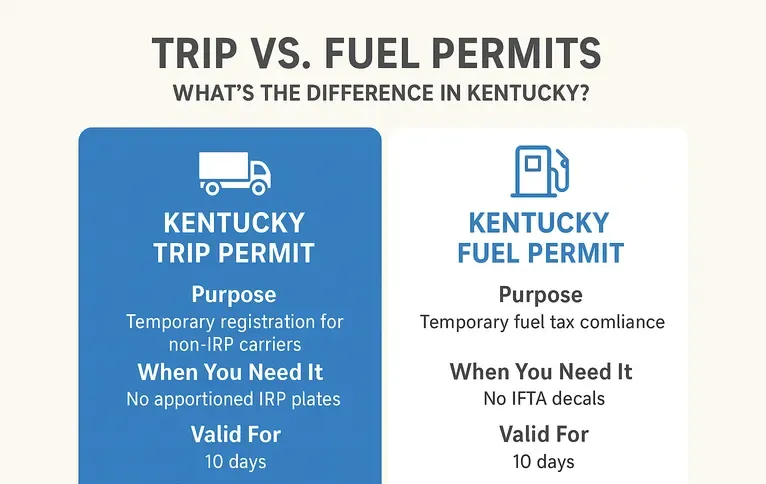
Trip Permit vs. Fuel Permit: Key Differences
| Feature | Kentucky Trip Permit | Kentucky Fuel Permit |
|---|---|---|
| Purpose | Temporary vehicle registration for non-IRP carriers | Temporary fuel tax compliance for non-IFTA carriers |
| Who Needs It | Carriers without apportioned IRP plates entering Kentucky | Carriers without IFTA decals operating in Kentucky |
| Applies To | Registration (vehicle legality on highways) | Fuel tax reporting and payment |
| Valid For | 10 days | 10 days |
| Issued By | Kentucky Division of Motor Carriers | Kentucky Division of Motor Carriers |
| Approx. Fee | $95 | $105 |
| Common Users | Out-of-state carriers hauling into Kentucky | Out-of-state carriers consuming fuel in Kentucky |
Penalties for Non-Compliance
Operating in Kentucky without the required permit can result in:
-
Fines and civil penalties from the Kentucky State Police Commercial Vehicle Enforcement Division (CVE),
-
Immediate order to purchase the correct permit roadside (often at higher administrative cost),
-
Possible delays or detainment of vehicle and freight.
Best Practices for Carriers
-
If your fleet regularly operates in multiple states, consider registering under IRP and IFTA instead of repeatedly purchasing temporary permits.
-
For occasional trips through Kentucky, purchasing both a Trip and Fuel Permit ensures compliance with all registration and tax requirements.
-
Always verify permit validity before entering Kentucky to avoid citations at weigh stations.
Key Takeaways
-
A Trip Permit covers vehicle registration, while a Fuel Permit covers fuel tax compliance.
-
Both are valid for 10 days and are essential for non-IRP and non-IFTA carriers entering Kentucky.
-
Regular interstate operators should maintain IFTA and IRP credentials for efficiency and lower long-term costs.