Current Situation
Supply vs. Demand
-
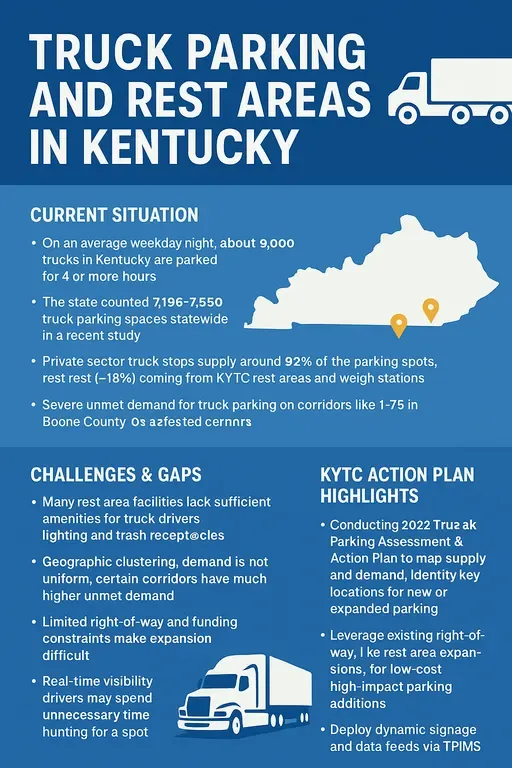
On an average weekday night, about 9,000 trucks in Kentucky are parked for 4 or more hours.
-
The state (in a recent study) counted 7,196–7,550 truck parking spaces statewide.
-
Private sector truck stops supply around 82% of the parking spots; the rest (~18%) come from KYTC rest areas and weigh stations.
-
Some corridors (for example, the Interstate 71/Interstate 75 in Boone County) show severe unmet demand for truck parking.
Key Facilities & Upgrades
-
KYTC offers a “Truck Parking” section on its website that outlines major findings and an “Action Plan” for expansion/upgrades.
-
A significant technology initiative: Truck Parking Information Management System (TPIMS) is being implemented to display real-time parking availability for truck drivers along major corridors (I-65, I-71, I-75).
-
Example project: Expansion of truck parking at rest areas and weigh stations on I-71/I-75 in Boone County to address overflow and safety issues.
Why It Matters
-
Driver Hours of Service (HOS) constraints: Truck drivers must stop after a certain number of hours, which makes having available parking critical for compliance and safety.
-
Safety and unauthorized parking: When official parking is full, trucks may park on ramps, shoulders or undesignated areas — creating hazards.
-
Freight/logistics growth: With increased tonnage and demand in trucking, particularly through Kentucky’s interstate corridors, pressure on parking infrastructure is growing.
Challenges & Gaps
-
Many rest area facilities lack sufficient amenities for truck drivers (e.g., enough spaces, restrooms, lighting). For example, KYTC’s study noted lighting and trash receptacles as “essential baseline amenities”.
-
Geographic clustering: Demand is not uniform; certain corridors have much higher unmet demand. For example, I-75 near the Tennessee border and I-24 in West Kentucky.
-
Limited right-of-way and funding constraints make expansion difficult — especially near urban zones or where residential land use abuts existing sites.
-
Real-time visibility: Without good information on parking availability, drivers may spend unnecessary time hunting for a spot, increasing fatigue and inefficiencies.
KYTC Action Plan Highlights
-
Conducted the 2022 Truck Parking Assessment & Action Plan to map supply/demand, identify key locations for new/expanded parking.
-
Leverage existing right-of-way (e.g., rest area expansions) for low-cost, high-impact parking additions.
-
Deploy dynamic signage and data feeds (via TPIMS) to inform drivers of available parking spaces ahead of exits.
-
Prioritize high-demand “clusters” (interchange areas) for expansion or improvement.
What Truck Drivers & Carriers Should Know
-
On Wednesday nights, parking demand tends to peak in Kentucky. Planning ahead for that can help.
-
Use tools (like TPIMS where available) or apps/dispatch coordination to know parking availability before committing to a stop.
-
If a rest area or weigh station is full, avoid pulling off on ramps/shoulders — this is both unsafe and may lead to enforcement issues.
-
Consider alternative parking sooner rather than later: arriving early may secure a legal spot and avoid HOS violations.
-
Monitor KYTC announcements: rest areas may undergo closures or renovations (e.g., the I-75 rest area in Scott County underwent a building closure while truck parking remained open).