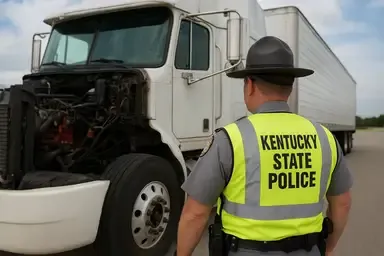
1. Primary Agency & Mission
-
The Commercial Vehicle Enforcement (CVE) Division of the Kentucky State Police (KSP) is the primary statewide agency responsible for commercial motor vehicle (CMV) safety enforcement in Kentucky.
-
Their mission statement: “Encourage and promote a safe driving environment through education and safety awareness while enforcing State and Federal laws and regulations, placing special emphasis on commercial vehicles.”
-
The CVE is staffed by sworn law-enforcement officers, regulatory weight & safety inspectors, and civilian staff.
-
They have six regional posts across the state to provide coverage statewide.
2. Inspection Programs & Focus Areas
a) Roadside/Weigh-Station Inspections
-
The CVE conducts inspections of commercial vehicles at weigh stations and mobile enforcement sites. For example, during the annual Commercial Vehicle Safety Alliance (CVSA) “International Roadcheck”, KSP’s CVE division participates in a high-volume 72-hour blitz of inspections.
-
Inspections follow the North American Standard Inspection Program levels (Level 1, etc.). In one example, KSP used Level 1 or Level V inspections where the vehicle and driver credentials are both checked.
-
Inspection items may include brake systems, tires, lighting devices, steering mechanisms, cargo securement, coupling devices, driver credentials (CDL, medical certificate), hours of service, etc.
b) Targeted Enforcement Campaigns
-
Besides routine inspections, the CVE participates in national campaigns, such as:
-
“Operation SafeDRIVE” (Distracted, Reckless, Impaired, Visibility Enforcement) – targeting unsafe driving behaviors by commercial vehicles.
-
“Brake Safety Week” – focusing specifically on faulty or inadequate braking systems on large trucks and buses.
-
c) Screening & High-Risk Targeting Systems
-
Kentucky uses an automated screening system called Kentucky Automated Truck Screening (KATS) at weigh stations and virtual weigh stations. KATS uses license-plate readers, USDOT/KYU number readers, scene cameras, and checks the vehicle/ carrier against multiple databases to flag high-risk carriers or vehicles for inspection.
-
For example, from the FY2024 state enforcement plan: E-Screening inspections (using screening systems) had higher vehicle out-of-service (VOOS) and driver out-of-service (DOOS) rates than non-screened inspections.
3. Authority, Standards & Out-of-Service Criteria
-
CVE inspectors have the authority to inspect driver and vehicle records for compliance with state and federal laws, and to physically inspect the vehicles (walk, climb, stoop around vehicles) including checking for hazardous-materials compliance, cargo manifests, etc.
-
When critical violations are found (mechanical defects, driver credential violations, hours of service, cargo insecurement, etc.), vehicles or drivers can be placed Out of Service (OOS) until the issue is corrected.
-
Kentucky’s inspections align with the federal criteria (via the FMCSA and CVSA programs) combined with state statutes and regulations. This means both state law and federal motor carrier safety regulations may apply.
4. Key Program Metrics & Improvements
-
According to Kentucky’s FY2024 eCVSP (Electronic Commercial Vehicle Safety Plan), some of the performance objectives include providing hands-on training to all KSP‐CVE inspectors, increasing usage of electronic screening software, increasing credential & safety violation identification when screening systems are used.
-
Example: The FY2024 document shows that inspections flagged via screening systems had higher violation rates (e.g., VOOS ~17.25% for non-screened vs ~30.97% for e-screening).
-
The screening system (KATS) has been recognized for improving targeting of high-risk vehicles; one earlier report noted that only ~1 % of large trucks entering weigh stations were inspected, but screening improved detection of violations.
5. What Carriers & Drivers Should Expect
-
Be prepared for inspections at weigh stations and mobile enforcement sites anytime, especially during high-volume enforcement campaigns like International Roadcheck.
-
Have all required documentation ready: valid CDL, medical certificate for driver, vehicle registration, USDOT/KYU numbers (as applicable in Kentucky), hours of service logs/ELD records, inspection & maintenance records for the vehicle.
-
Ensure the vehicle is mechanically safe: brakes, tires, lighting, cargo securement, coupling devices, steering/suspension—all are common inspection items. For example, brake system violations consistently remain among the top cause of OOS placements.
-
Know the role of screening systems: Vehicles may be automatically flagged via license-plate/number readers and directed to inspection. If your fleet has issues (credential, registration, prior violations), you might get selected more frequently.
-
If placed Out of Service, you or the carrier must rectify the condition before returning to service. Non-compliance may lead to fines, liability, increased insurance costs and a negative safety rating.
-
Know that both state (Kentucky) and federal regulations apply: meeting only federal standards may not suffice if there are additional state requirements or registration/credential issues specific to Kentucky.
6. Why This Matters
-
Trucking is a key component of Kentucky’s economy; ensuring safe operations helps protect infrastructure, drivers, other road users and the carrier’s bottom line.
-
Effective enforcement and inspection reduce crashes involving large trucks, which often have higher severity. Programs like the CVE’s screening and targeted inspections help remove unsafe vehicles and drivers proactively.
-
From a business perspective: good safety performance means fewer inspections, fewer out-of-service events → less downtime, fewer fines, better insurance rates, potential access to favorable freight.
-
From a public safety perspective: keeping commercial vehicle operations safe helps reduce risks to other motorists, especially given the presence of high-traffic corridors, mountainous terrain, rural roads and interstates in Kentucky.