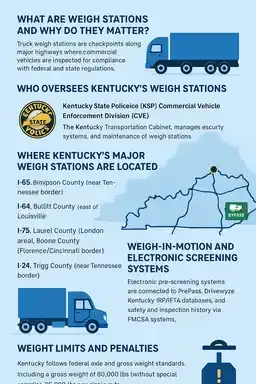
Understanding Kentucky’s Truck Weigh Station Network
1. What Are Weigh Stations and Why Do They Matter?
Truck weigh stations are checkpoints along major highways where commercial vehicles are inspected for compliance with federal and state regulations.
The main goals of Kentucky’s weigh stations are to:
-
Ensure trucks don’t exceed weight limits (protecting roadways and bridges)
-
Verify proper permits and registration
-
Check logbooks or ELDs for Hours of Service compliance
-
Conduct safety inspections (brakes, lights, tires, etc.)
Overloaded trucks cause faster road deterioration and can pose serious safety risks, which is why Kentucky closely monitors commercial vehicle weights.
2. Who Oversees Kentucky’s Weigh Stations
Weigh stations in Kentucky are operated and enforced by the Kentucky State Police (KSP) Commercial Vehicle Enforcement Division (CVE).
-
Officers are authorized to inspect commercial vehicles, check documentation, and issue citations or out-of-service orders if violations are found.
-
The Kentucky Transportation Cabinet (KYTC) manages infrastructure, electronic screening systems, and maintenance of weigh station facilities.
Together, KSP and KYTC ensure that trucks using Kentucky’s interstates and state highways follow all safety and size regulations.
3. Where Kentucky’s Major Weigh Stations Are Located
Kentucky has a network of permanent weigh stations on its busiest freight corridors, including:
-
I-65: Simpson County (near Tennessee border), Bullitt County (Shepherdsville area)
-
I-64: Shelby County (east of Louisville), Boyd County (near Ashland)
-
I-75: Laurel County (London area), Boone County (near Florence/Cincinnati border)
-
I-24: Trigg County (near Tennessee border)
These facilities are equipped with weigh-in-motion (WIM) technology that allows trucks to be screened while moving, reducing unnecessary stops for compliant carriers.
4. Weigh-in-Motion and Electronic Screening Systems
Kentucky’s modern weigh stations use electronic pre-screening systems connected to databases like:
-
PrePass and Drivewyze for bypass authorization
-
Kentucky IRP/IFTA databases for registration validation
-
Safety and inspection history via FMCSA systems
If your vehicle’s credentials and weight data pass the check, the system may display a “Bypass” green light, allowing you to continue without stopping.
If not, you’ll receive a “Pull-In” signal to enter the weigh station for further inspection.
5. Weight Limits and Penalties
Kentucky follows federal axle and gross weight standards:
-
80,000 lbs maximum gross weight (without special permits)
-
20,000 lbs per single axle
-
34,000 lbs per tandem axle
If a vehicle exceeds legal limits without a valid permit:
-
The driver may face fines and citations
-
The vehicle could be held until weight is reduced or a permit is obtained
-
Repeated violations can lead to license suspension or increased insurance costs
6. Weigh Station Bypass Tips for Truckers
To save time and avoid penalties:
✅ Maintain accurate IFTA and IRP credentials
✅ Use PrePass or Drivewyze if eligible
✅ Keep your vehicle under legal weight limits
✅ Ensure your logbooks and ELD data are current
✅ Always obey weigh station signals — skipping one can result in severe penalties
7. Future of Weigh Station Technology in Kentucky
The state is investing in smart infrastructure to automate truck screening and inspection:
-
Expanding WIM sensors to more locations
-
Integrating license plate recognition (LPR) for faster verification
-
Developing remote inspection systems to reduce manual checks
These upgrades aim to make Kentucky’s trucking network more efficient and safer while minimizing delays for compliant carriers.
8. Key Takeaway
Kentucky’s weigh station network plays a critical role in balancing road safety, infrastructure protection, and industry efficiency.
For truckers, understanding how these stations operate — and maintaining full compliance — helps prevent costly fines and keeps you rolling smoothly across the Bluegrass State.