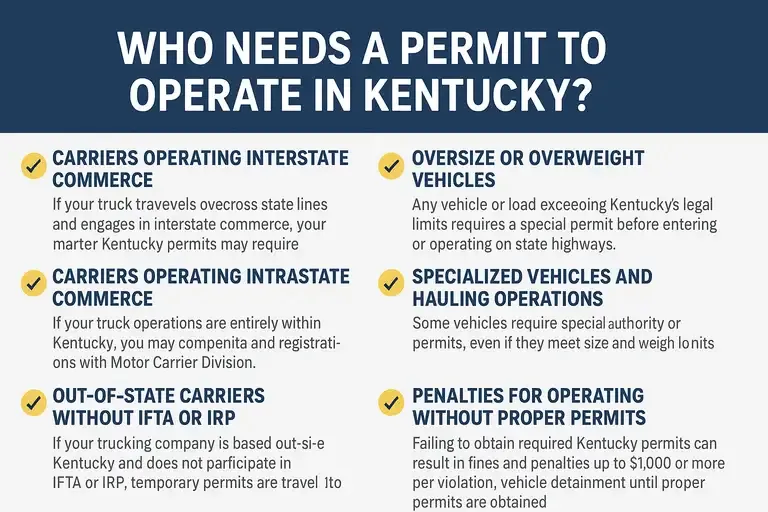
1. Carriers Operating Interstate Commerce
If your truck travels across state lines and engages in interstate commerce, you may need one or more Kentucky permits.
Even if you don’t have a business based in Kentucky, you must comply if you haul through the state.
Required Permits and Credentials:
-
USDOT Number & MC Authority (if hauling for hire)
-
Kentucky KYU Number – for carriers operating vehicles over 59,999 lbs. GVW in interstate commerce
-
Unified Carrier Registration (UCR) – federal requirement for interstate carriers
-
Temporary Trip Permit – for trucks not registered under IRP (International Registration Plan)
-
Temporary Fuel Permit – for carriers not registered under IFTA (International Fuel Tax Agreement)
Example:
A Tennessee-based carrier hauling freight into Kentucky must have UCR registration and either a valid IFTA decal or a temporary Kentucky fuel permit.
2. Carriers Operating Intrastate Commerce
If your trucking operations are entirely within Kentucky, you still need certain permits and registrations with the Motor Carrier Division.
Requirements include:
-
Kentucky Intrastate Operating Authority (from KYTC)
-
KYU Number – if your vehicle’s registered weight exceeds 59,999 lbs.
-
Weight Distance Tax Account – applies to qualified heavy vehicles operating within Kentucky
-
Vehicle Registration under the Kentucky IRP or standard intrastate tags
3. Oversize or Overweight Vehicles
Any vehicle or load exceeding Kentucky’s legal limits requires a special permit before entering or operating on state highways.
Legal Limits Without a Permit:
-
Width: 8 feet 6 inches
-
Height: 13 feet 6 inches
-
Length: 65 feet (combination)
-
Weight: 80,000 lbs. gross weight (standard federal limit)
If your vehicle exceeds these dimensions or weights, you must obtain a Kentucky Oversize/Overweight (OS/OW) Permit through the KYTC Division of Motor Carriers.
Common permit types:
-
Single-trip oversize permit
-
Annual oversize/overweight permit
-
Superload permit (for extremely large or heavy loads)
4. Out-of-State Carriers Without IFTA or IRP
If your trucking company is based outside Kentucky and does not participate in IFTA or IRP, you’ll need temporary permits to travel legally within the state.
-
Temporary Trip Permit: Valid for up to 10 days, substitutes for IRP registration.
-
Temporary Fuel Permit: Valid for up to 10 days, substitutes for IFTA credentials.
These permits can be purchased online or through third-party permitting services.
5. Specialized Vehicles and Hauling Operations
Some vehicles require special authority or permits, even if they meet size and weight limits.
Examples:
-
Farm vehicles: May qualify for farm exemptions but still require registration and farm tags.
-
Towing and recovery vehicles: Need a Kentucky Tow Truck Permit if operating for hire.
-
Mobile homes and modular buildings: Require special transport permits due to width and overhang.
-
Construction and utility vehicles: May need annual or project-specific movement permits.
6. Penalties for Operating Without Proper Permits
Failing to obtain required Kentucky permits can result in:
-
Fines and penalties up to $1,000 or more per violation
-
Vehicle detainment until proper permits are obtained
-
Suspension of KYU or operating authority for repeat offenders
7. Where to Apply
You can apply for Kentucky permits and credentials through the official portals:
-
www,kentuckytruckingonline.com
-
Call to (502) 842-1467
Quick Summary:
| Operation Type | Permit(s) Needed |
|---|---|
| Interstate (over 59,999 lbs.) | KYU Number, UCR, IFTA or Fuel Permit, IRP or Trip Permit |
| Intrastate (within KY only) | KYU Number (if heavy), Intrastate Authority |
| Oversize/Overweight Loads | OS/OW Permit (single or annual) |
| Out-of-State without IFTA/IRP | Temporary Fuel and/or Trip Permit |
| Specialized Vehicles | Farm, Tow, Mobile Home, or Project Permits |
Final Thoughts
In Kentucky, nearly every trucking operation requires some form of permit or registration — whether you’re local or out-of-state. The key is to identify your vehicle’s weight, route, and type of operation, then match them with the correct credentials.
By staying compliant, you’ll avoid fines, downtime, and unnecessary enforcement issues on Kentucky highways.