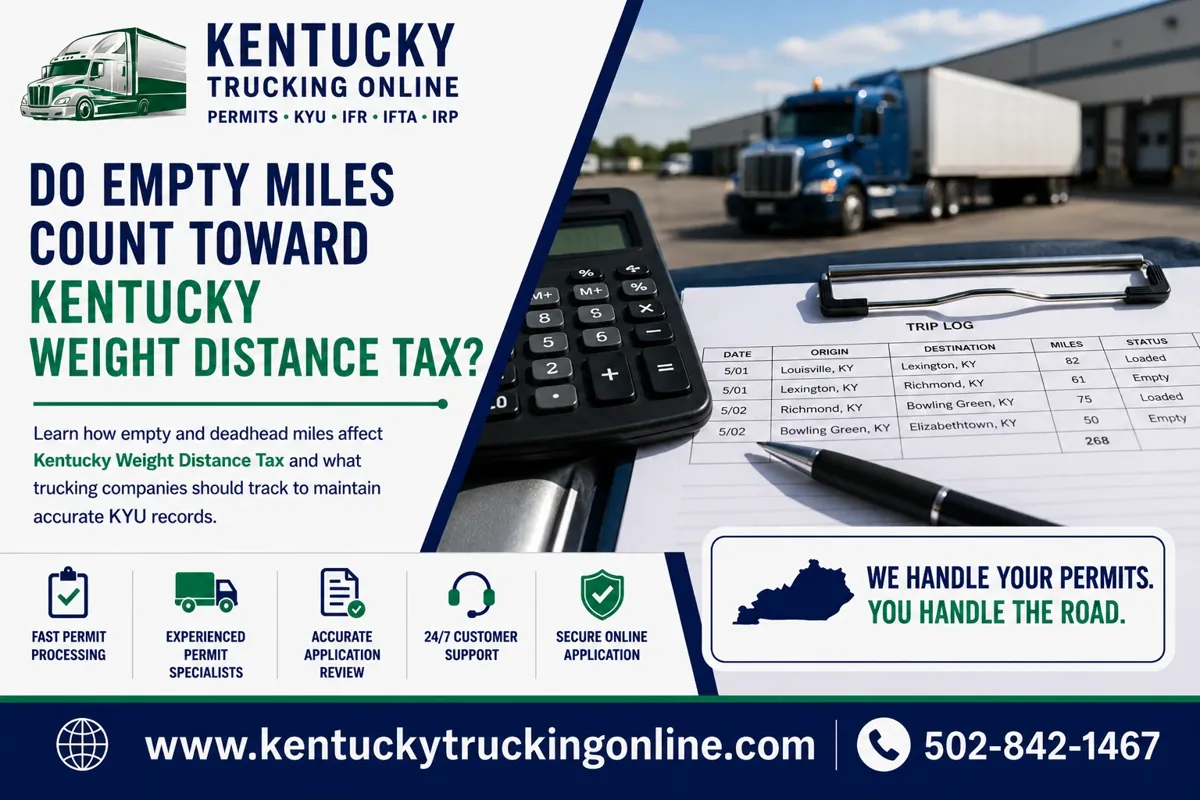
Do Empty Miles Count Toward Kentucky Weight Distance Tax?
Table Of Contents
-
Introduction
-
Do Empty Miles Count?
-
Why Empty Miles Matter
-
How Deadhead Travel Affects KYU
-
What Miles Should Be Tracked?
-
Example Of Empty Kentucky Miles
-
How To Report Empty Miles
-
Common Mistakes To Avoid
-
Why Many Trucking Companies Choose Our Service
-
FAQ
Introduction
Trucking companies often associate the Kentucky Weight Distance Tax with loaded freight. A truck enters Kentucky with a shipment, makes a delivery, and then leaves the state. But the truck may continue traveling after the delivery without another load.
This raises an important question for carriers: do those empty miles count?
For qualifying vehicles, Kentucky's mileage-based tax applies to miles traveled on Kentucky public highways. The tax is not limited only to miles driven while the truck is carrying freight. Empty and deadhead travel can therefore be important when a trucking company tracks Kentucky mileage and prepares its KYU return.
Understanding how empty miles work can help carriers maintain accurate records, avoid underreporting, and better understand the cost of operating in Kentucky.
Do Empty Miles Count?
Yes, empty miles can count toward Kentucky Weight Distance Tax.
Kentucky applies its Weight Distance Tax to qualifying vehicles operating on Kentucky public highways. The tax is based on the vehicle's taxable mileage and licensed or combined weight rather than whether the vehicle is loaded for every mile.
For example, a qualifying truck could deliver a shipment in Kentucky and then travel 75 miles empty to reach its next pickup. Those 75 Kentucky miles still represent travel by the qualifying vehicle and should be included in the company's mileage records.
The same principle can apply when a truck leaves a customer and travels empty to a terminal, another facility, or a future pickup location.
Why Empty Miles Matter
The Kentucky Weight Distance Tax is a mileage-based requirement, so carriers need a complete picture of where qualifying vehicles travel.
One common mistake is tracking only miles connected to paid loads. A truck can accumulate Kentucky miles after unloading, while repositioning equipment, or while traveling between customers.
If those miles are left out, the company's mileage records may not reflect the vehicle's complete Kentucky travel.
This is particularly important for fleets with frequent deliveries and pickups. Dispatch may focus on loaded movements, while accounting needs the complete mileage picture for accurate KYU reporting.
Keeping those two functions connected can make quarterly reporting much easier.
How Deadhead Travel Affects KYU
Deadhead travel is a normal part of trucking operations. A driver may finish a delivery and travel empty to the next pickup, return to a terminal, or reposition the truck for another assignment.
When qualifying travel occurs on Kentucky public highways, the company should include the Kentucky portion of that movement in its mileage records.
Carriers should therefore avoid a system that records mileage only when freight is on the trailer.
A better process tracks the vehicle's entire trip, including loaded travel, empty travel, stops, and route changes. This helps dispatch and accounting identify all Kentucky miles before preparing the KYU return.
What Miles Should Be Tracked?
Trucking companies should maintain records that show where each qualifying vehicle traveled and how many miles were accumulated in Kentucky.
Useful records can include:
-
Trip dates
-
Vehicle or unit number
-
Origin and destination
-
Intermediate stops
-
Routes traveled
-
Beginning and ending odometer readings
-
Total trip miles
-
Kentucky miles
These records can help the company compare the truck's actual movements with the mileage ultimately reported.
Electronic mileage systems, dispatch records, and driver trip information can also help identify empty travel that might otherwise be missed.
The more consistently the company records mileage throughout the reporting period, the easier it becomes to prepare an accurate return.
Example Of Empty Kentucky Miles
Consider a qualifying truck that travels 140 miles in Kentucky while delivering a load. After unloading, the driver travels another 60 miles within Kentucky to reach the next pickup.
The company should not look only at the 140 loaded miles when reviewing Kentucky travel. The additional 60 miles are also part of the truck's movement in the state.
This example shows why loaded and empty travel should be tracked together.
A company that records only freight-related movements could unintentionally leave part of its Kentucky mileage out of its records.
How To Report Empty Miles
The best approach is to record mileage throughout the quarter rather than trying to reconstruct every trip just before filing.
Before submitting a KYU return, trucking companies should compare the reported mileage with supporting records. Dispatch records, odometer readings, route information, and electronic tracking data can help identify missing or duplicate miles.
Carriers should also review the following:
-
Empty returns after deliveries
-
Repositioning trips
-
Detours
-
Additional stops
-
Trips involving multiple Kentucky entries
If the company discovers that its filed mileage was incorrect, it should address the error through the appropriate KYU correction process rather than carrying the mistake into a later reporting period.
Common Mistakes To Avoid
One of the most common mistakes is assuming that only loaded miles matter.
Another is relying entirely on load documentation when the truck also made empty movements between pickups, deliveries, or terminals.
Trucking companies should also avoid estimating Kentucky mileage when accurate records are available. Small gaps can add up across a fleet and across multiple reporting periods.
A final mileage review before filing can help identify missing empty miles and other discrepancies.
Why Many Trucking Companies Choose Our Service
Many trucking companies choose Kentucky Trucking Online because managing Kentucky Weight Distance Tax requirements can become difficult when fleets have frequent trips, changing routes, and empty miles between loads.
Our service provides experienced permit specialists, fast processing, secure online applications, 24/7 customer support, and weekend and holiday availability.
Our team can help trucking companies understand Kentucky requirements and make the permit and tax process more convenient.
Apply with Kentucky Trucking Online today.
FAQ
Do Empty Miles Count Toward Kentucky Weight Distance Tax?
Yes. Kentucky miles traveled by qualifying vehicles on public highways can count even when the truck is traveling without a load.
Do Deadhead Miles Count For KYU?
Yes. Empty travel between deliveries, terminals, and pickup locations should be included in the vehicle's Kentucky mileage records.
Does KYU Apply Only To Loaded Trucks?
No. The tax is based on qualifying vehicle mileage in Kentucky, not only on miles traveled while carrying freight.
How Should Empty Kentucky Miles Be Tracked?
Track them as part of the vehicle's complete trip and identify the portion of the movement that occurred in Kentucky.
Can Empty Miles Increase Operating Costs?
Yes. Empty travel can add tax and other operating costs without producing freight revenue.
How Can Trucking Companies Avoid Missing Empty Miles?
Record the complete movement of each qualifying vehicle and compare dispatch, mileage, and route records before filing the KYU return.
For more information, visit the Kentucky Transportation Cabinet.