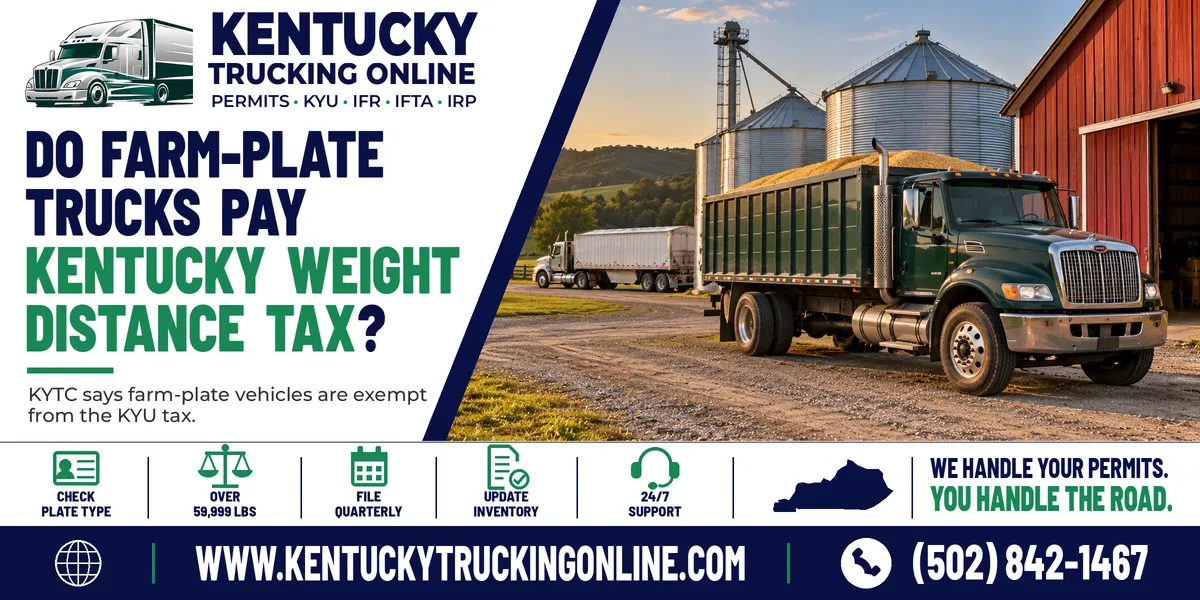
Do Farm-Plate Trucks Pay Kentucky Weight Distance Tax?
Table Of Contents
-
Introduction
-
The Short Answer
-
What the Kentucky Weight Distance Tax Covers
-
The Farm-Plate Exemption
-
Why the Plate Matters More Than the Cargo
-
Mixed Fleets: Farm Trucks and Commercial Trucks
-
What Happens If a Truck Leaves Farm Plates
-
Other Credentials Are a Separate Question
-
Common Mistakes to Avoid
-
Why Many Trucking Companies Choose Our Service
-
FAQ
Introduction
Kentucky farms move a lot of heavy freight. Grain trucks, cattle haulers, and tractor-trailers loaded with hay or tobacco can easily run over 60,000 pounds. That weight is the trigger for the Kentucky Weight Distance Tax, so farmers often ask whether they need a KYU number and quarterly returns like any other carrier.
The answer depends on how the truck is registered. This guide explains what the Kentucky Transportation Cabinet says about farm-plate vehicles, where the exemption stops, and what to watch for if you run both farm and commercial trucks.
The Short Answer
No. The Kentucky Transportation Cabinet (KYTC) says plainly: "Farm-plate vehicles are exempt from the KYU tax."
The exemption is tied to the farm plate. A heavy truck registered any other way, even one owned by a farmer, can still owe the Kentucky Weight Distance Tax if its combined licensed weight is over 59,999 pounds.
What the Kentucky Weight Distance Tax Covers
Under KRS 138.660(3), every motor carrier must pay a weight distance tax for each motor vehicle operated on Kentucky's public highways with a combined licensed weight over 59,999 pounds. The rate is 2.85 cents ($0.0285) per mile.
KYTC calls this the KYU tax. Its rules for KYU accounts include
-
A KYU license for carriers traveling Kentucky roads above the weight threshold.
-
Quarterly tax filings regardless of travel for all qualified vehicles, through KYU E-File.
-
Zero-mile returns for quarters with no travel, to avoid a penalty, interest, and a $500 revocation fee.
-
An up-to-date inventory. All qualified vehicles must be listed to avoid citations.
For occasional trips, KYTC also offers a one-time temporary KYU permit per truck.
The Farm-Plate Exemption
KYTC's KYU page lists farm-plate vehicles as exempt. In practice, that means a truck properly registered with Kentucky farm plates:
-
Does not need to be on a KYU account for the weight-distance tax,
-
Does not need quarterly KYU returns for its miles, and
-
Does not need a temporary KYU permit to run on Kentucky highways.
The farm plate itself comes with its own registration rules about who qualifies and how the truck may be used. Those rules are set by Kentucky's registration laws, and the county clerk or KYTC can confirm whether your truck qualifies.
Why the Plate Matters More Than the Cargo
Many people assume the exemption covers any truck hauling farm products. It doesn't work that way. The KYTC exemption is for farm-plate vehicles, not for farm cargo.
Here are two examples:
-
A farmer's grain truck on farm plates hauling the farm's own corn to the elevator falls under the farm-plate exemption.
-
A for-hire carrier on regular commercial plates hauling that same corn is a motor carrier, and its truck is subject to the Kentucky Weight Distance Tax if it's over 59,999 pounds combined licensed weight.
The load is the same. The registration is different, and so is the tax.
Mixed Fleets: Farm Trucks and Commercial Trucks
Some farm families also run a trucking business. They may have farm-plate trucks for the farm and commercially plated trucks for paid hauling.
In that case:
-
The farm-plate trucks stay outside the KYU tax.
-
The commercial trucks over 59,999 pounds need to be on the KYU account and reported every quarter.
-
The KYU inventory should list every qualified commercial truck, since KYTC says all qualified vehicles must be listed to avoid citations.
Keeping a simple list that shows each truck's plate type and licensed weight makes it easy to see which trucks belong on the account.
What Happens If a Truck Leaves Farm Plates
A truck's status can change during the year. If a truck moves from farm plates to regular registration over 59,999 pounds, it becomes a qualified vehicle for the Kentucky Weight Distance Tax:
-
Add it to your KYU inventory through the Motor Carrier Portal.
-
Track its Kentucky miles from the date it starts running on the new registration.
-
Report those miles on the quarterly return. Returns are filed and paid online through the Motor Carrier Portal.
-
Get a KYU account first if the business doesn't have one yet, or use a temporary KYU permit for a one-time trip.
Other Credentials Are a Separate Question
The farm-plate exemption covers the KYU tax. It does not automatically answer every other question, such as:
-
IFTA if the truck runs into other states,
-
IRP or trip permits for interstate travel,
-
Federal requirements such as a USDOT number, and
-
Rules in other states, which may treat a Kentucky farm plate differently.
Check each credential on its own before the truck leaves the farm.
Common Mistakes to Avoid
-
Assuming farm cargo means no KYU tax. The exemption is for farm-plate vehicles.
-
Leaving commercial trucks off the inventory. All qualified vehicles must be listed.
-
Skipping zero-mile returns. Quarterly filing is required regardless of travel.
-
Forgetting a re-registered truck. A truck that leaves farm plates may need to be added to KYU.
-
Using farm plates for paid hauling. Confirm your plate rules with the county clerk or KYTC.
Why Many Trucking Companies Choose Our Service
Kentucky Trucking Online helps farm operations and carriers sort out which trucks need the Kentucky Weight Distance Tax and which don't. We set up KYU accounts, update your truck inventory, and file your quarterly returns, so nothing slips through the cracks.
-
KYU permit: $95
-
Have a question? Contact Us directly!
We provide support 24/7 and also work weekends and holidays.
or
FAQ
-
Do farm-plate trucks pay the Kentucky Weight Distance Tax?
No. KYTC says farm-plate vehicles are exempt from the KYU tax.
-
What trucks owe the tax?
Trucks with a combined licensed weight over 59,999 pounds on Kentucky highways, at 2.85 cents per mile.
-
Does hauling farm products make a truck exempt?
No. The exemption is for farm-plate vehicles, not for farm cargo.
-
Do I still file KYU returns if my commercial trucks didn't run?
Yes. KYTC requires quarterly filings regardless of travel, including zero-mile returns.
-
Does the farm-plate exemption cover IFTA or IRP?
No. Those are separate credentials and should be checked on their own.
For more information, visit the Kentucky Transportation Cabinet.