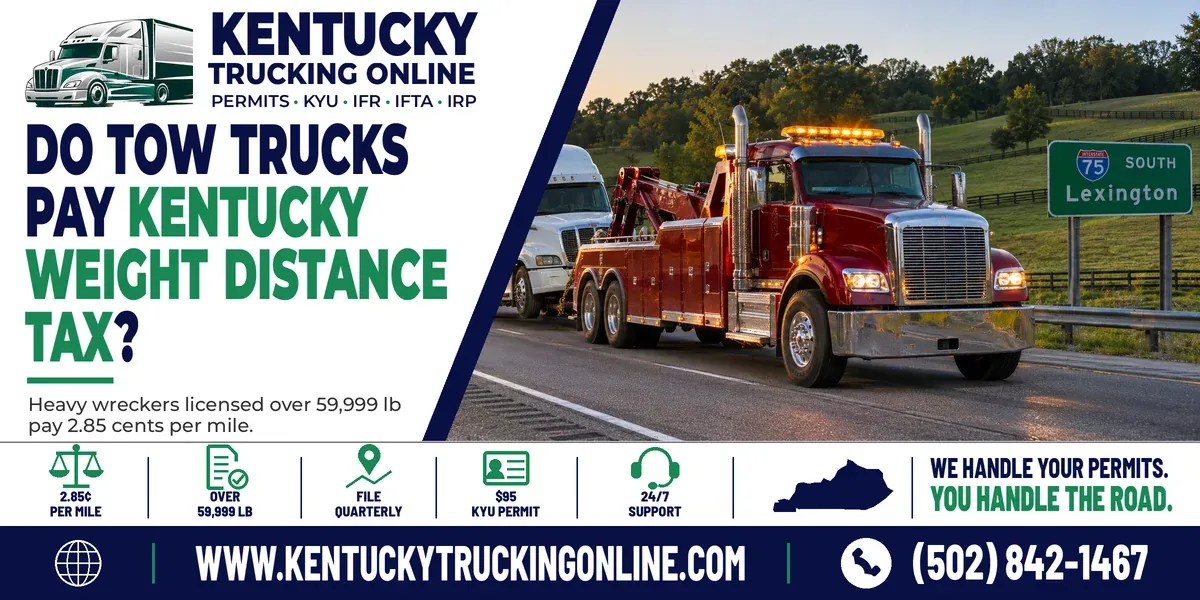
Do Tow Trucks Pay Kentucky Weight Distance Tax?
Table Of Contents
-
Introduction
-
The Short Answer
-
What the Kentucky Weight Distance Tax Covers
-
Why Licensed Weight Decides It
-
Light, Medium and Heavy Tow Trucks
-
Rotators and Heavy Recovery Units
-
Out-of-State Tow Trucks
-
Filing and Recordkeeping
-
Other Kentucky Credentials to Check
-
Common Mistakes to Avoid
-
Why Many Trucking Companies Choose Our Service
-
FAQ
Introduction
Tow trucks keep Kentucky's highways moving. When a tractor-trailer breaks down on I-65 near Elizabethtown or a wreck blocks I-75 south of Lexington, heavy wreckers and rotators are called in to clear the road. Many of these trucks are big, heavy machines that spend a lot of time on Kentucky highways.
That raises a common question for towing companies: does a tow truck owe the Kentucky Weight Distance Tax? This guide explains how Kentucky decides, which tow trucks usually qualify, and what to do if yours does.
The Short Answer
It depends on the truck's combined licensed weight, not on the fact that it's a tow truck.
-
A tow truck with a combined licensed weight over 59,999 pounds generally owes the Kentucky Weight Distance Tax.
-
A tow truck licensed at 59,999 pounds or less doesn't.
-
Most light and medium wreckers fall under the line, while many heavy wreckers and rotators go over it.
What the Kentucky Weight Distance Tax Covers
Under KRS 138.660(3), every motor carrier must pay a weight distance tax for each motor vehicle operated on Kentucky's public highways with a combined licensed weight over 59,999 pounds. The rate is 2.85 cents ($0.0285) per mile.
The Kentucky Transportation Cabinet (KYTC) calls this the KYU tax. Carriers with qualified vehicles need:
-
A KYU license for regular travel in Kentucky
-
Quarterly returns for every qualified vehicle, even in quarters with no travel
-
An up-to-date inventory listing every qualified vehicle
For occasional trips, KYTC also offers a temporary KYU permit.
Why Licensed Weight Decides It
The Kentucky Weight Distance Tax looks at how the truck is licensed, not how heavy it is on a given day or what it's towing. A tow truck's registration shows the weight it's licensed to operate at.
-
If that combined licensed weight is over 59,999 pounds, the truck is a qualified vehicle.
-
If it's 59,999 pounds or less, the truck stays outside the tax.
Heavy wreckers are often licensed high so they can legally tow loaded tractor-trailers. That higher licensed weight is what brings many of them into the tax.
Light, Medium and Heavy Tow Trucks
Tow trucks come in many sizes, and the answer changes with the class.
| Tow Truck Class | Typical Use | Kentucky Weight Distance Tax |
|---|---|---|
| Light duty | Cars and pickups | Usually not, licensed well under 60,000 lb |
| Medium duty | Box trucks, small buses | Usually not, but check the registration |
| Heavy duty | Tractor-trailers, buses | Often yes, if licensed over 59,999 lb |
| Rotators | Heavy recovery and rollovers | Often yes, if licensed over 59,999 lb |
A flatbed rollback that carries cars is usually licensed far below the threshold. A heavy wrecker that tows loaded semis is the truck most likely to owe the tax.
Rotators and Heavy Recovery Units
Rotators are some of the heaviest trucks on the road. A large rotator can weigh a lot on its own, and it often needs a high licensed weight to work legally.
If a rotator or heavy recovery unit is licensed over 59,999 pounds and runs on Kentucky highways, it should be:
-
Listed on the KYU account
-
Reported every quarter with its Kentucky miles
-
Covered by a temporary KYU permit if the company doesn't have a KYU account and the trip is occasional
A heavy unit may also need an oversize or overweight permit for some moves. That permit is separate from the weight distance tax.
Out-of-State Tow Trucks
Heavy wreckers from Tennessee, Ohio, Indiana and other states often cross into Kentucky for big recoveries. The Kentucky Weight Distance Tax applies to qualified vehicles on Kentucky highways no matter where they're based.
-
A company that runs in Kentucky often should get a KYU license.
-
A company that comes in once in a while can use a temporary KYU permit for the trip.
Since recovery calls happen fast, it helps to have the KYU credential set up before the call comes in.
Filing and Recordkeeping
Towing companies with a KYU account must file quarterly returns through KYU E-File for every qualified vehicle, even if a truck didn't run. Skipping a zero-mile return can bring a penalty, interest and a $500 revocation fee.
Keep good records for each heavy unit:
-
Trip logs with the Kentucky miles for every call
-
ELD or GPS data that supports those miles
-
Registration records that show the licensed weight
Emergency calls can make miles easy to miss, so record them right after each job.
Other Kentucky Credentials to Check
The Kentucky Weight Distance Tax is only one credential. A heavy tow truck may also need:
-
IRP registration or an IRP trip permit for interstate travel
-
IFTA or a fuel trip permit if it runs interstate and qualifies by weight or axles
-
A KIT trip permit for some carriers subject to the Kentucky Intrastate Tax
-
An oversize or overweight permit for loads over the legal limits
Common Mistakes to Avoid
-
Assuming tow trucks are exempt. There's no general tow truck exemption.
-
Looking at empty weight. Licensed weight is what counts.
-
Leaving a heavy wrecker off the inventory. Every qualified vehicle must be listed.
-
Skipping zero-mile returns. Quarterly filing is required regardless of travel.
-
Not tracking emergency miles. Every Kentucky mile must be reported.
Why Many Trucking Companies Choose Our Service
Kentucky Trucking Online helps towing and recovery companies sort out which trucks owe the Kentucky Weight Distance Tax, set up KYU accounts and get temporary permits fast, so heavy units are ready when the call comes in.
-
IRP Trip Permit over 55,000 lb: $95
-
IRP Trip Permit under 55,000 lb: $95
-
KYU Trip Permit: $95
-
IFTA Trip Permit: $95
-
KIT Trip Permit: $95
We provide support 24/7 and also work weekends and holidays.
or
FAQ
Do tow trucks pay Kentucky Weight Distance Tax?
Yes, if the combined licensed weight is over 59,999 pounds.
Do light-duty tow trucks pay it?
Usually not, since they're licensed well under 60,000 pounds.
What is the Kentucky Weight Distance Tax rate?
2.85 cents per mile.
Can an out-of-state wrecker use a temporary KYU permit?
Yes. KYTC offers a temporary KYU permit for occasional trips.
Do I need to file if my heavy wrecker didn't run in Kentucky?
Yes. KYU returns are required every quarter, even with zero miles.
For more information, visit the Kentucky Transportation Cabinet.