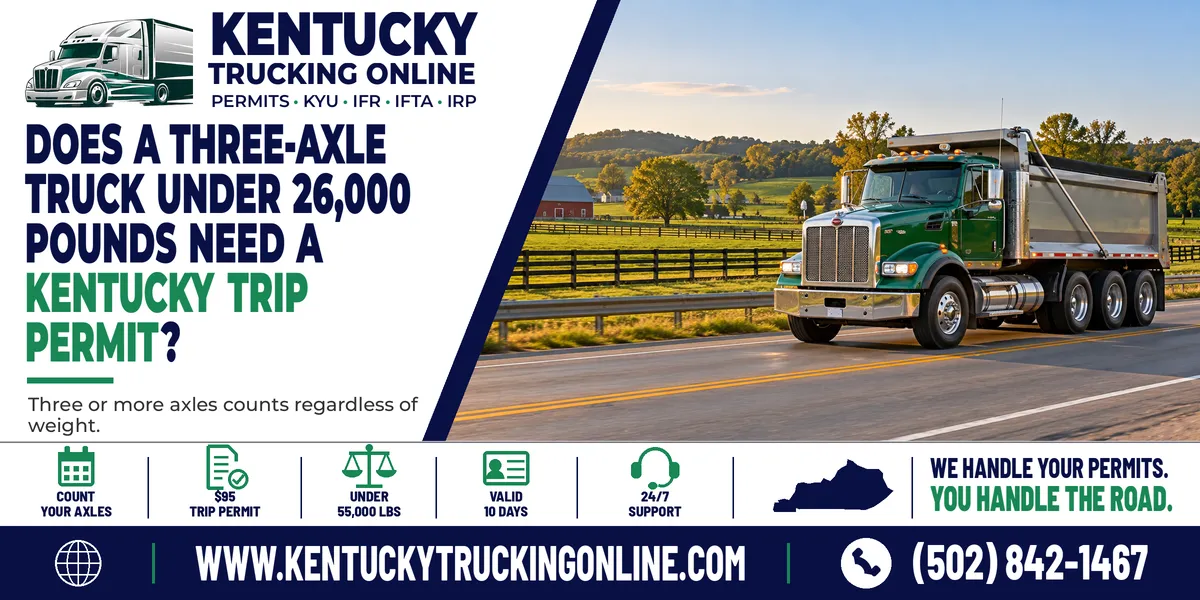
Does a Three-Axle Truck Under 26,000 Pounds Need a Kentucky Trip Permit?
Table Of Contents
-
Introduction
-
The Short Answer
-
Why 26,000 Pounds Isn't the Only Test
-
What Kentucky's IRP Rule Says About Axles
-
When Kentucky Requires a Trip Permit
-
What a Kentucky Trip Permit Covers
-
Which Permit Class a Light Three-Axle Truck Uses
-
What About KYU?
-
Examples
-
Common Mistakes to Avoid
-
Why Many Trucking Companies Choose Our Service
-
FAQ
Introduction
Many carriers learn one number for interstate registration: 26,000 pounds. If a truck is under that weight, the thinking goes, it doesn't need apportioned plates or trip permits.
That rule of thumb works for many two-axle trucks. But it doesn't work for every truck. Kentucky's regulations also look at the number of axles, and a truck with three or more axles can be covered even when it is light. This guide explains when a three-axle truck under 26,000 pounds needs a Kentucky Trip Permit.
The Short Answer
Often, yes. Under 601 KAR 9:135, a vehicle with three or more axles is an apportionable vehicle regardless of weight.
If that truck is based outside Kentucky, isn't apportioned for Kentucky, and isn't covered by a reciprocal agreement, it needs a Kentucky Trip Permit before it operates in the state.
Why 26,000 Pounds Isn't the Only Test
The 26,000-pound figure comes from the definition of an apportionable vehicle. But that definition has three separate parts, and a truck only needs to meet one of them.
A light three-axle truck can fail the weight test and still meet the axle test. That's why carriers running tri-axle dump trucks, three-axle box trucks, or light tractors with a tandem rear axle can be caught off guard at a Kentucky weigh station.
What Kentucky's IRP Rule Says About Axles
Kentucky's International Registration Plan (IRP) rules are in 601 KAR 9:135. Under Section 1(1)(a), an apportionable vehicle is a power unit used in two or more member jurisdictions that:
-
Has two axles and a gross vehicle weight or registered gross vehicle weight over 26,000 pounds, or
-
Has three or more axles, regardless of weight, or
-
Is used in combination when the weight of the combination exceeds 26,000 pounds.
The Kentucky Transportation Cabinet's IRP page says the same thing in plain terms: an apportioned plate is needed for a vehicle over 26,000 pounds "or having 3 or more axles regardless of weight" that operates outside Kentucky.
When Kentucky Requires a Trip Permit
Under 601 KAR 9:135, Section 2(1), the operator of an apportionable vehicle running in more than one jurisdiction "shall apply for apportioned registration... unless a trip permit has been purchased for each trip into the jurisdiction."
So an out-of-state three-axle truck has two choices for Kentucky:
-
Apportioned registration that includes Kentucky, or
-
A Kentucky Trip Permit for each trip into the state.
The trip permit is issued under KRS 281.838 to nonresidents whose vehicles aren't exempt from Kentucky registration fees under a reciprocal agreement. And under 601 KAR 9:040, Section 8(1), the permit "shall be obtained in advance of operations in this state."
What a Kentucky Trip Permit Covers
Under KRS 281.838, a Kentucky Trip Permit is:
-
Issued in lieu of the Kentucky registration fees under KRS 186.050,
-
Valid for a specified period not exceeding 10 days,
-
Issued for a specific vehicle.
Under 601 KAR 9:040, Section 8(2), the application must briefly describe the vehicle and include the name of the operator.
Which Permit Class a Light Three-Axle Truck Uses
KRS 281.838 splits trip permits into two classes based on declared gross weight of the vehicle and any towed unit:
-
55,000 pounds or less
-
55,001 pounds or more
A three-axle truck under 26,000 pounds falls well inside the under 55,000 lbs class. Just make sure the declared weight includes any trailer the truck pulls.
What About KYU?
Kentucky's weighted distance tax (KYU) is a separate program with a different threshold. According to the Kentucky Transportation Cabinet, a KYU license is required for carriers on Kentucky roads with a combined license weight greater than 59,999 pounds.
A three-axle truck under 26,000 pounds is far below that, so it generally won't need a KYU license or a temporary KYU permit for its own weight. The trip permit question is about registration, not KYU.
Examples
| Truck | Weight | Axles | Kentucky Trip Permit or Apportioned Plates? |
|---|---|---|---|
| Box truck | 24,000 lbs | 2 | Not by the axle or weight test |
| Box truck | 24,000 lbs | 3 | Yes, by the axle test |
| Tri-axle dump truck, empty | 25,500 lbs | 3 | Yes, by the axle test |
| Pickup and trailer | 28,000 lbs combined | 2 + trailer | Yes, by the combination test |
These examples assume an out-of-state truck that isn't apportioned for Kentucky and isn't covered by reciprocity.
Common Mistakes to Avoid
-
Looking only at weight. Three or more axles qualify regardless of weight.
-
Buying the permit at the border. Kentucky requires it in advance.
-
Using one permit for two trucks. Each permit is for a specific vehicle.
-
Assuming it lasts all month. A Kentucky Trip Permit is valid for up to 10 days.
-
Choosing the wrong class. Include any trailer in the declared weight.
Why Many Trucking Companies Choose Our Service
Kentucky Trucking Online checks your truck's axles, weight, and registration to confirm whether you need a Kentucky Trip Permit, then issues the right class fast.
-
IRP trip permit over 55,000 lbs: $95
-
IRP trip permit under 55,000 lbs: $95
-
KYU trip permit: $95
-
IFTA (fuel) trip permit: $95
-
KIT trip permit: $95
We provide support 24/7 and also work weekends and holidays.
or
FAQ
-
Does a three-axle truck under 26,000 pounds need a Kentucky Trip Permit?
Yes, if it isn't apportioned for Kentucky or covered by reciprocity. Three or more axles qualify regardless of weight.
-
Which trip permit class does a light three-axle truck use?
The class is for a declared gross weight of 55,000 pounds or less.
-
How long is a Kentucky Trip Permit valid?
Up to 10 days, for one specific vehicle.
-
Does a light three-axle truck need KYU?
Generally no. KYU applies above 59,999 pounds combined license weight.
-
Can I buy the permit after I enter Kentucky?
No. It must be obtained in advance of operations in the state.
For more information, visit the Kentucky Transportation Cabinet.