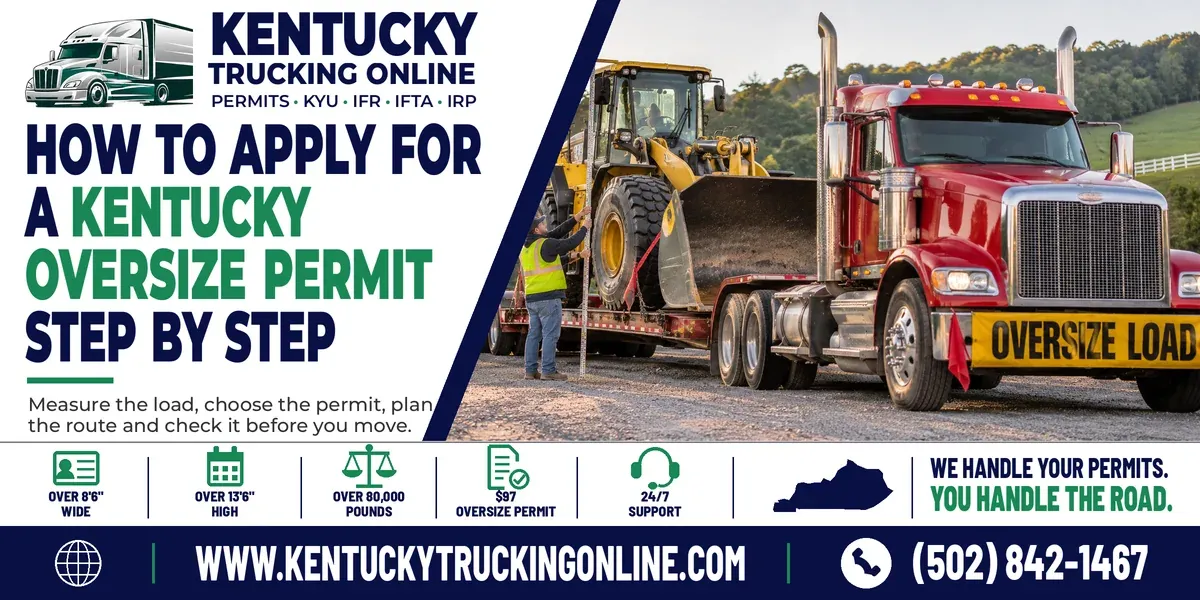
How to Apply for a Kentucky Oversize Permit Step by Step
Table Of Contents
-
Introduction
-
Before You Start
-
Step 1: Confirm the Load Needs a Permit
-
Step 2: Measure the Load Correctly
-
Step 3: Choose Single-Trip or Annual
-
Step 4: Gather Truck and Carrier Details
-
Step 5: Plan the Route
-
Step 6: Submit the Application
-
Step 7: Review the Permit Before Moving
-
Step 8: Prepare the Truck and Driver
-
How Long It Takes
-
Common Mistakes to Avoid
-
Why Many Trucking Companies Choose Our Service
-
FAQ
Introduction
Getting a Kentucky Oversize Permit isn't hard once you know the order of things. Most delays come from the same few problems: wrong measurements, missing truck details or a route that doesn't work for the load.
This guide walks through the application step by step, from measuring the load to reading the permit before the truck rolls, so your oversize move through Kentucky starts on time.
Before You Start
Oversize and overweight permits in Kentucky are issued by the Kentucky Transportation Cabinet (KYTC) under KRS 189.270. The rules for signs, flags, escorts and travel times are in 601 KAR 1:018.
Permits are issued online. Carriers can apply themselves through the KYTC permitting system, or use a permit service that handles the application for them.
Step 1: Confirm the Load Needs a Permit
A Kentucky Oversize Permit is needed when the vehicle and load go over any legal limit:
-
Width: 102 inches on the National Truck Network and designated highways, 8 feet on other roads.
-
Height: 13 feet 6 inches.
-
Length: 53-foot semitrailer on the National Truck Network, 65 feet overall on standard roads, 45 feet for a single-unit truck.
-
Weight: 80,000 pounds gross, 20,000 pounds single axle, 34,000 pounds tandem.
The load must also be non-divisible, meaning it can't reasonably be broken down to fit legal limits.
Step 2: Measure the Load Correctly
Accurate measurements are the most important part of the application.
-
Width: measure at the widest point, including mirrors on the load, tracks or attachments.
-
Height: measure from the road surface to the highest point, with the load on the trailer.
-
Length: measure the full combination, including front and rear overhang.
-
Weight: get the gross weight and each axle weight, plus the axle spacing.
A permit is only valid for the dimensions it lists. If the real load is bigger, the permit doesn't cover it.
Step 3: Choose Single-Trip or Annual
Kentucky offers two main kinds of oversize permits:
-
Single-trip permit: one move, one route, a set travel window. Best for large or unusual loads.
-
Annual permit: repeated moves for a year within set size and weight limits. Best for carriers that haul similar equipment often.
Under 601 KAR 1:018, an annual permit can't be used for a load over 13 feet 6 inches high. Tall loads need a single-trip permit.
Step 4: Gather Truck and Carrier Details
Have this information ready before you start the application:
-
Carrier name, address and USDOT number
-
Power unit details: make, year, VIN, plate and state
-
Trailer details: type, plate and number of axles
-
Load description: what's being hauled, make and model if it's equipment
-
Dimensions and weights from Step 2
-
Origin and destination, including the entry point if the trip starts outside Kentucky
-
Travel date
If the truck isn't registered for Kentucky, plan for a trip permit as well. If it's over 59,999 pounds, make sure the KYU requirement is covered.
Step 5: Plan the Route
The route has to work for the load. KYTC reviews the route against bridge, height and road restrictions.
-
Check low clearances for tall loads.
-
Check weight-restricted bridges for heavy loads.
-
Avoid roads with restrictions on larger trucks.
-
Note rush-hour limits in Louisville, Lexington and Northern Kentucky.
A good route request saves time, because KYTC may change a route that doesn't fit the load.
Step 6: Submit the Application
Enter all the details, pick the permit type and submit the application with payment.
-
Double-check every number before you submit.
-
Make sure the travel date matches when the truck will actually move.
-
Keep a record of the application in case you need to follow up.
Standard loads are usually processed quickly. Very large loads, superloads and complex routes take longer because they need extra review.
Step 7: Review the Permit Before Moving
When the Kentucky Oversize Permit is issued, read it carefully before the truck leaves:
-
Truck and trailer details match the equipment.
-
Dimensions and weights match the load.
-
Route is the one the driver will follow.
-
Dates and travel times are correct.
-
Conditions such as escorts, signs and flags are clear.
If anything is wrong, get it corrected before the move. Running on a permit with the wrong details can be treated like running without one.
Step 8: Prepare the Truck and Driver
Before departure, make sure the truck meets every condition on the permit:
-
OVERSIZE LOAD signs on the front and rear when required, such as for loads over 12 feet wide
-
Red or orange flags on the corners and ends of the load
-
Escort vehicles booked and ready when the permit requires them
-
A copy of the permit in the cab
-
The driver briefed on the route and travel time limits, including nights and holidays
How Long It Takes
Most standard single-trip permits can be issued the same day when the details are complete. Annual permits are also quick for loads within their limits. Superloads and loads that need bridge or route studies can take several days, so apply early for those.
Common Mistakes to Avoid
-
Measuring height from the deck. Measure from the road.
-
Leaving out overhang. It counts toward length.
-
Using an annual permit for a tall load. Over 13 feet 6 inches needs a single-trip permit.
-
Guessing axle weights. Use scale tickets.
-
Moving before reading the permit. Check every detail first.
Why Many Trucking Companies Choose Our Service
Kentucky Trucking Online handles the whole Kentucky Oversize Permit application for you, from checking dimensions and axle weights to route requests, so your load is ready to move without delays.
- Oversize permit: $97
We provide support 24/7 and also work weekends and holidays.
or
FAQ
Who issues a Kentucky Oversize Permit?
The Kentucky Transportation Cabinet, under KRS 189.270 and 601 KAR 1:018.
What do I need to apply?
Carrier and USDOT details, truck and trailer information, load dimensions and weights, axle spacing, route and travel date.
Can I get the permit the same day?
Most standard permits can be issued the same day. Superloads take longer.
Can an annual permit cover a load over 13 feet 6 inches?
No. That load needs a single-trip permit.
Do I need to carry the permit?
Yes. Keep a copy in the cab during the move.
For more information, visit the Kentucky Transportation Cabinet.