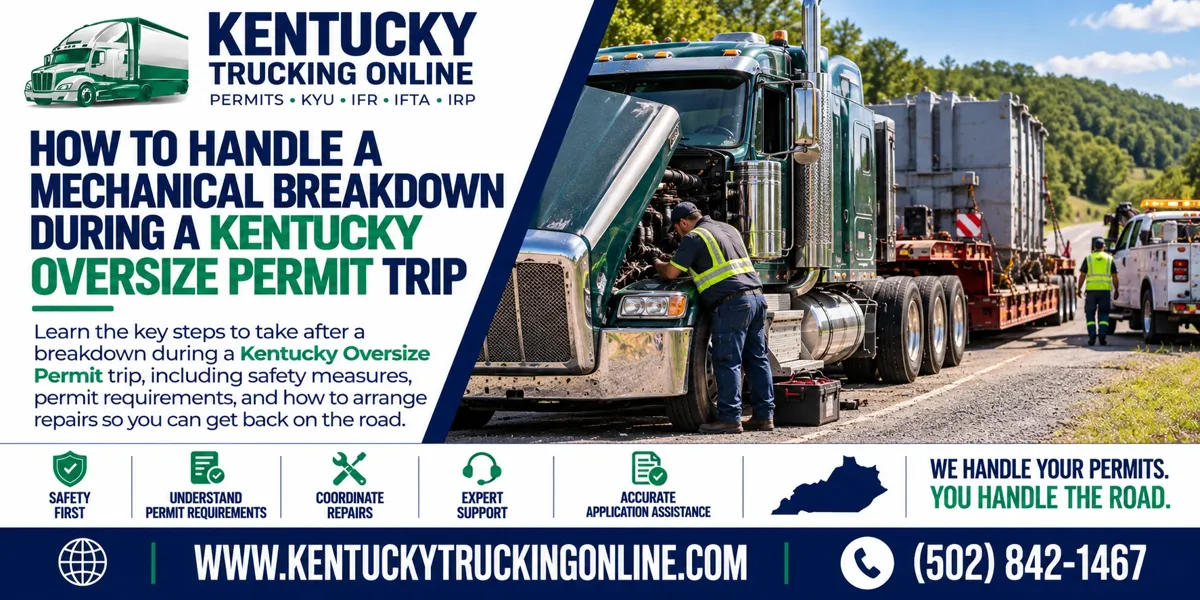
How to Handle a Mechanical Breakdown During a Kentucky Oversize Permit Trip
Table Of Contents
-
Introduction
-
Why a Breakdown Requires Careful Decisions
-
What to Do Immediately
-
Check the Permit Before Moving Again
-
Coordinate Repairs, Escorts, and Delays
-
Document the Interruption
-
Mistakes to Avoid
-
Why Many Trucking Companies Choose Our Service
-
FAQ
Introduction
A mechanical breakdown during a permitted oversize move can quickly become a safety and scheduling problem. A disabled truck can obstruct traffic or leave a large load in a difficult location. Protecting people and following permit conditions matter as much as minimizing delay.
During a Kentucky Oversize Permit trip, focus first on safety, then contact support and confirm requirements before resuming. A permit does not guarantee safe passage; carriers remain responsible for safe operation and compliance. Notify dispatch promptly so the carrier can coordinate roadside assistance, escort communication, customer updates, and any needed contact with the permit authority.
Why a Breakdown Requires Careful Decisions
An oversize vehicle may need more room to stop or be recovered than a standard truck, and its dimensions and weight can limit where it can safely be towed.
A breakdown may affect route, timing, escorts, or load condition. A convenient detour may include a bridge, turn, overhead clearance, or roadway not approved or checked for the move. A standard recovery route may not suit an oversize load.
What to Do Immediately
1. Stop in the safest practical location. If the vehicle remains controllable, leave active traffic only when safe and lawful. Avoid curves and narrow shoulders. If it cannot move safely, keep people away from traffic and call emergency services if there is immediate danger.
2. Make the scene visible. Activate hazard lights and place warning devices when it is safe and consistent with applicable requirements. Never enter moving traffic to set them. Keep everyone in a protected area away from the roadway.
3. Assess the problem without creating another risk. Identify whether the issue involves tires, engine, brakes, steering, suspension, trailer, or load securement. Do not drive if control or stability may be affected, and avoid unsafe roadside repairs.
4. Notify dispatch and the recovery provider. Share location, direction, vehicle and load details, the fault, and tow-access limits. Explain that the truck is operating under a Kentucky Oversize Permit so recovery staff can account for its size and weight.
Check the Permit Before Moving Again
Keep the permit accessible and review its route, vehicle details, load dimensions, and special conditions. Kentucky makes the permit holder responsible for reviewing the permit and checking clearances; issuance does not guarantee safe passage.
If the vehicle must move, do not take an unapproved detour because it seems easier. Kentucky requires prior written approval from the Division of Motor Carriers for a deviation from an approved route. Contact the permit authority if the breakdown makes the route impractical. Explain why the vehicle cannot safely continue, where it is stopped, and the proposed destination for repair or recovery. Do not treat a roadside emergency as automatic permission to continue on a different route.
Do not assume a delay changes the permit’s validity or conditions. Confirm status with the issuing authority before resuming, especially if repairs take time or trip details change. Record the guidance received.
Coordinate Repairs, Escorts, and Delays
Notify the escort team and agree on a safe communication plan. Escorts should not guide an unsafe truck back into traffic. If escorts are required, confirm the arrangement before resuming.
Use a repair provider experienced with heavy or oversize vehicles. Before towing, explain load dimensions, weight, location, and turning or positioning limits. Standard tow equipment may not be suitable.
After repairs, check the truck, trailer, tires, brakes, steering, suspension, and load securement. Confirm the vehicle and load still match the permit. If any permit details changed, ask the Kentucky permit authority for direction before continuing. If the load shifted or equipment was damaged, arrange a separate inspection and secure the load before movement. A successful engine repair does not automatically mean the entire combination is ready for the road.
Document the Interruption
Record the breakdown time and location, direction, symptoms, safe photographs, repair or towing details, and time cleared to move. Keep notes of relevant communications and instructions affecting route or timing.
Save repair invoices and written guidance or approvals. These records explain delays and show why and when the carrier resumed travel. Keep the documents with the trip file so dispatch, safety staff, and the driver can refer to the same timeline if questions arise later.
Mistakes to Avoid
Do not drive with a fault that threatens safe control to protect a delivery appointment. Schedule pressure is not a safety assessment.
Do not detour without required approval or let a tow operator choose an unchecked route. Before restarting, check repairs, load securement, escorts, and permit details.
Why Many Trucking Companies Choose Our Service
Planning a permitted move involves accurate vehicle and load information, route details, and an understanding of requirements before dispatch. Kentucky Trucking Online helps trucking companies navigate the permit application process and organize essential information for Kentucky travel.
Our service simplifies permit preparation, helps carriers organize required details, and provides practical support when questions arise. Planning cannot prevent every breakdown, but organized permit information can help carriers respond confidently when plans change.
FAQ
What should I do if my truck breaks down during a Kentucky oversize move?
Stop in the safest practical location, protect people from traffic, notify dispatch, and arrange qualified roadside assistance. Review permit requirements before resuming travel.
Can I take a different route to reach a repair shop?
Do not assume you can. Kentucky requires prior written approval from the Division of Motor Carriers for a deviation from an approved route. Contact the permit authority before taking an alternate route.
Should I notify the escort vehicle?
Yes. Tell the escort team about the breakdown and coordinate a safe plan. Confirm any required escort arrangements before the move resumes.
What records should I keep after a breakdown?
Keep the breakdown location and time, repair and towing records, relevant photographs, communication notes, and any written permit guidance or route approval.
For more information, visit the Kentucky Transportation Cabinet.