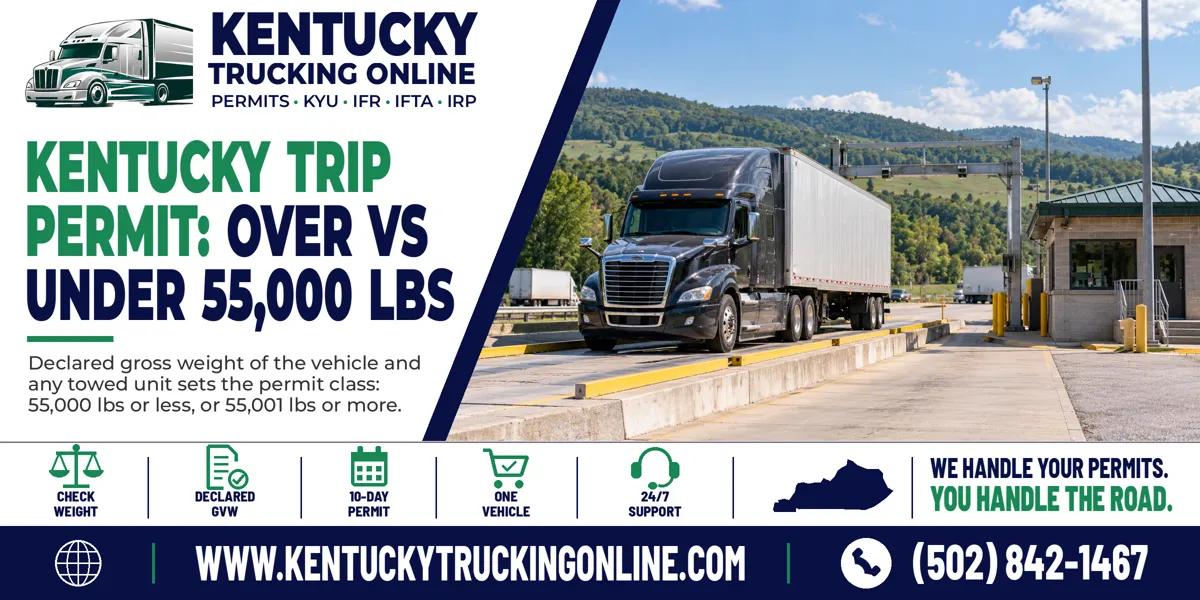
Kentucky IRP Trip Permit Over vs Under 55,000 lbs: How Declared Weight Sets Your Permit
Table Of Contents
-
Introduction
-
Who Needs a Kentucky Trip Permit
-
What Declared Gross Weight Means
-
Under 55,000 lbs vs Over 55,000 lbs
-
What the Permit Covers
-
How to Get Your Permit
-
Common Mistakes to Avoid
-
Why Many Trucking Companies Choose Our Service
-
FAQ
Introduction
Carriers without apportioned plates often need a Kentucky Trip Permit to run a load through the state. One detail decides which permit class applies: the declared gross weight of the vehicle and any towed unit. Kentucky splits trip permits at 55,000 pounds.
This guide explains where that line sits, how declared weight places your truck on one side of it, and what the permit covers once it's issued.
Who Needs a Kentucky Trip Permit
According to the Kentucky Transportation Cabinet, a vehicle that operates outside Kentucky needs apportioned (IRP) plates if it has:
-
A combined gross vehicle weight or registered gross weight over 26,000 lbs, or
-
3 or more axles, regardless of weight.
When a vehicle that meets those thresholds doesn't carry plates that cover Kentucky, it can run under a temporary permit. KRS 281.838 provides these permits for nonresidents whose vehicles are not exempt from Kentucky registration fees under a reciprocal agreement. The cabinet's IRP page calls it a "non-reciprocal temporary permit." Carriers usually just call it a Kentucky Trip Permit.
What Declared Gross Weight Means
KRS 281.838 sets the permit class by the declared gross weight of "a vehicle and any towed unit. " That means the weight is not just the tractor. It is the power unit together with the trailer it pulls.
Before you order a Kentucky Trip Permit, check what you're declaring for the whole combination. A tractor on its own may sit under 55,000 lbs, but with a loaded trailer behind it, the combination can easily go over.
Under 55,000 lbs vs Over 55,000 lbs
The statute creates two classes:
-
55,000 lbs or less: For a vehicle and any towed unit with a declared gross weight of 55,000 pounds or less.
-
55,001 lbs or more: For a vehicle and any towed unit with a declared gross weight of 55,001 pounds or more.
That single pound matters. A combination declared at exactly 55,000 lbs falls in the lower class. At 55,001 lbs, it moves to the higher class.
Our service price is $95 for either the IRP trip permit over 55,000 lbs or the IRP trip permit under 55,000 lbs. You get the same price whichever class your declared weight puts you in. You just need to order the right one.
What the Permit Covers
Under KRS 281.838, a Kentucky Trip Permit is:
-
Issued for one specific vehicle. It can't be moved to another truck.
-
Valid for a set period of up to 10 days.
The cabinet's IRP page also says a non-reciprocal temporary permit lets you haul loads if you carry a copy in your truck. Keep it in the cab for the whole trip.
How to Get Your Permit
601 KAR 9:040 sets two basic rules for a Kentucky Trip Permit:
-
Get it in advance. The permit "shall be obtained in advance of operations in this state." Don't cross the state line first and order later.
-
Describe the vehicle and operator. At a minimum, the application must briefly describe the vehicle and include the operator's name.
Have your vehicle details, the operator's name, and your declared gross weight ready before you order. That keeps the process quick and makes sure the permit matches the truck on the road.
Common Mistakes to Avoid
-
Declaring the tractor only. The weight class covers the vehicle and any towed unit.
-
Picking the wrong class. At 55,001 lbs or more, the lower class doesn't fit your combination.
-
Ordering after you enter Kentucky. The permit must be obtained before operating in the state.
-
Sharing one permit between trucks. Each permit is issued for one specific vehicle.
-
Running past the dates. The permit is good for a set period of no more than 10 days.
-
Leaving the copy at the office. Carry a copy in the truck.
Why Many Trucking Companies Choose Our Service
Kentucky Trucking Online helps carriers pick the right Kentucky Trip Permit class from their declared gross weight. Whether your combination is under or over 55,000 lbs, our price is $95. We check the vehicle details, operator name, and weight before submitting, so the permit fits the truck you're running.
We provide support 24/7 and also work weekends and holidays, so you can get a permit when your load is ready to move.
or
FAQ
-
What weight decides which Kentucky Trip Permit I need?
The declared gross weight of the vehicle and any towed unit. The line is 55,000 lbs or less versus 55,001 lbs or more.
-
How much does your service charge?
$95 for either the IRP trip permit over 55,000 lbs or under 55,000 lbs.
-
How long is a Kentucky Trip Permit valid?
For a set period of up to 10 days.
-
Can I use one permit for two trucks?
No. Each permit is issued for one specific vehicle.
-
When do I need to get the permit?
Before you operate in Kentucky. 601 KAR 9:040 requires it in advance.
-
Who needs IRP plates instead?
Vehicles operating outside Kentucky with a combined or registered gross weight over 26,000 lbs, or with 3 or more axles regardless of weight.
For more information, visit the Kentucky Transportation Cabinet Division of Motor Carriers.