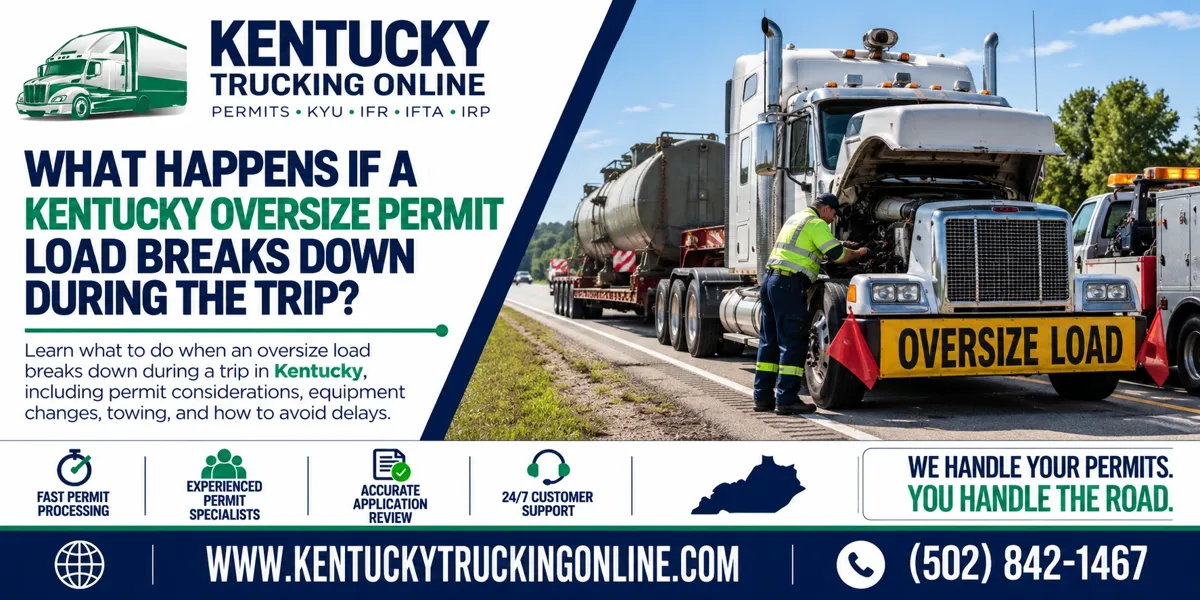
What Happens If A Kentucky Oversize Load Breaks Down During The Trip?
Table Of Contents
-
Introduction
-
Secure The Load And Protect The Scene
-
Notify Dispatch And Roadside Assistance
-
Review The Kentucky Oversize Permit
-
Determine Whether The Trip Can Continue
-
Handle Repairs And Equipment Changes
-
Manage Delays And Overnight Stops
-
What If The Truck Must Be Towed?
-
What If The Load Must Be Transferred?
-
Final Checks Before Continuing
-
Common Mistakes To Avoid
-
Why Many Trucking Companies Choose Our Service
-
FAQ
Introduction
A mechanical breakdown is stressful for any carrier, but it can create additional complications when a truck is carrying an oversize load. A disabled vehicle may block traffic, require specialized roadside assistance, or remain in place until the equipment can safely continue.
When a breakdown occurs during a permitted movement, safety should come first. The carrier should protect the driver, other road users, and the load before trying to solve the mechanical problem.
A Kentucky Oversize Permit authorizes the permitted movement, but a breakdown can change the circumstances of that movement. Before replacing equipment, changing the route, or moving the load, the carrier should review what has changed.
Secure The Load And Protect The Scene
The priority is making the location as safe as possible.
The driver should move to a safe position when that can be done without creating additional risk. Required warning devices and other safety measures should be used as appropriate.
Keep the load secured. Avoid unloading or repositioning an oversize load on the roadside unless it is necessary and can be done safely.
Notify dispatch as soon as possible so roadside assistance and the next steps can be coordinated.
Notify Dispatch And Roadside Assistance
Give dispatch clear information about the location, direction of travel, vehicle condition, load dimensions, and assistance needed.
Roadside personnel should also know that they are dealing with an oversize vehicle. A repair or recovery approach that works for an ordinary truck may not be suitable for a large or heavy combination.
Clear communication helps the carrier decide whether the original movement can continue or whether the equipment needs to be recovered.
Review The Kentucky Oversize Permit
Review the Kentucky Oversize Permit and compare it with the actual situation.
Check the permitted vehicle information, route, travel dates, load information, and special conditions.
Do not assume that a replacement tractor, different trailer, or changed equipment can automatically continue under the same permit. If the breakdown results in a significant equipment change, determine what permit action may be required before moving again.
Determine Whether The Trip Can Continue
Not every breakdown requires the same response.
A minor mechanical problem may be fixed roadside, while a major failure may require towing or equipment replacement.
Consider both the condition of the vehicle and the load. Getting the engine running does not automatically mean the truck is ready to safely carry an oversize load.
Before continuing, confirm that the truck, trailer, load securement, and permitted configuration are still suitable for the movement.
Handle Repairs And Equipment Changes
Repairs should be performed as safely as possible, with minimal disruption to the load.
If equipment must be replaced, document what changed and notify dispatch. Avoid unnecessary unloading or disassembly.
Keep records of the breakdown, repairs, equipment changes, and important decisions. Documentation can help if questions later arise about delays or the continuation of the permitted movement.
Manage Delays And Overnight Stops
A breakdown can push a trip beyond its planned schedule.
Compare the revised timing with the permit's authorized travel period. If the delay affects the travel date or another permit condition, resolve the issue before continuing.
The same applies if the truck must stop overnight because of the breakdown. An unexpected delay does not automatically mean the permit can be used indefinitely.
What If The Truck Must Be Towed?
If the vehicle cannot be repaired where it stopped, towing or recovery may be necessary.
Before moving the disabled vehicle, determine how the tractor, trailer, and oversize load will be handled safely. Recovery personnel may need the vehicle's dimensions and weight before selecting an appropriate method.
If another tractor or trailer will be used, review the permit information before the movement resumes.
What If The Load Must Be Transferred?
A serious breakdown may make a load transfer necessary.
This is more than a simple repair because the equipment and configuration may change. Document the reason for the transfer, confirm the replacement equipment, and determine whether the existing Kentucky Oversize Permit still applies.
The replacement configuration should meet the requirements of the authorized movement before the load returns to the road.
Final Checks Before Continuing
After a repair or recovery, conduct another inspection before departure.
Check the truck and trailer, verify load securement, confirm the dimensions and configuration, and review the remaining route.
Also consider whether construction, weather, traffic, or other conditions have changed while the truck was stopped.
Taking a few minutes for a final review can help prevent another problem after the original breakdown is resolved.
Common Mistakes To Avoid
Continuing Without Reviewing the Permit: Equipment or timing changes may affect the permitted movement.
Changing Equipment Without Checking: A replacement tractor or trailer may not match the authorized configuration.
Unloading In An Unsafe Location: Avoid unnecessary roadside transfers or repositioning.
Ignoring The Travel Period: A long delay may affect the permitted travel dates.
Assuming Any Tow Vehicle Will Work: Recovery equipment should be appropriate for the size and weight of the movement.
Failing To Document Changes: Keep records of repairs, equipment changes, and delays.
Why Many Trucking Companies Choose Our Service
Many trucking companies choose Kentucky Trucking Online because unexpected problems can make permit requirements harder to manage.
Our service helps carriers simplify applications, reduce paperwork, avoid unnecessary delays, and receive practical permit assistance when trip details need review. Fast processing and dedicated customer support can be valuable when a breakdown interrupts an active movement.
For carriers dealing with an unexpected equipment problem, having permit assistance available can make the administrative side of the situation easier to handle.
FAQ
Does A Breakdown Automatically Cancel A Kentucky Oversize Permit?
Not necessarily. A breakdown can create changes that affect the permitted movement, so review the situation before continuing.
Can A Different Tractor Be Used After A Breakdown?
Do not assume so. Review the permit and determine whether the replacement equipment is authorized.
What If The Repair Takes Several Hours?
Check whether the delay affects the authorized travel period or another permit condition.
Can The Load Be Transferred To Another Trailer?
A transfer may require additional review because it can change the equipment and configuration covered by the permit.
Should A Breakdown Be Documented?
Yes. Keep records of the breakdown, repairs, equipment changes, delays, and decisions made during the incident.
What Should The Driver Do First?
Protect the scene, secure the load, notify dispatch, and arrange appropriate assistance before deciding how to continue.
For more information, visit the Kentucky Transportation Cabinet.