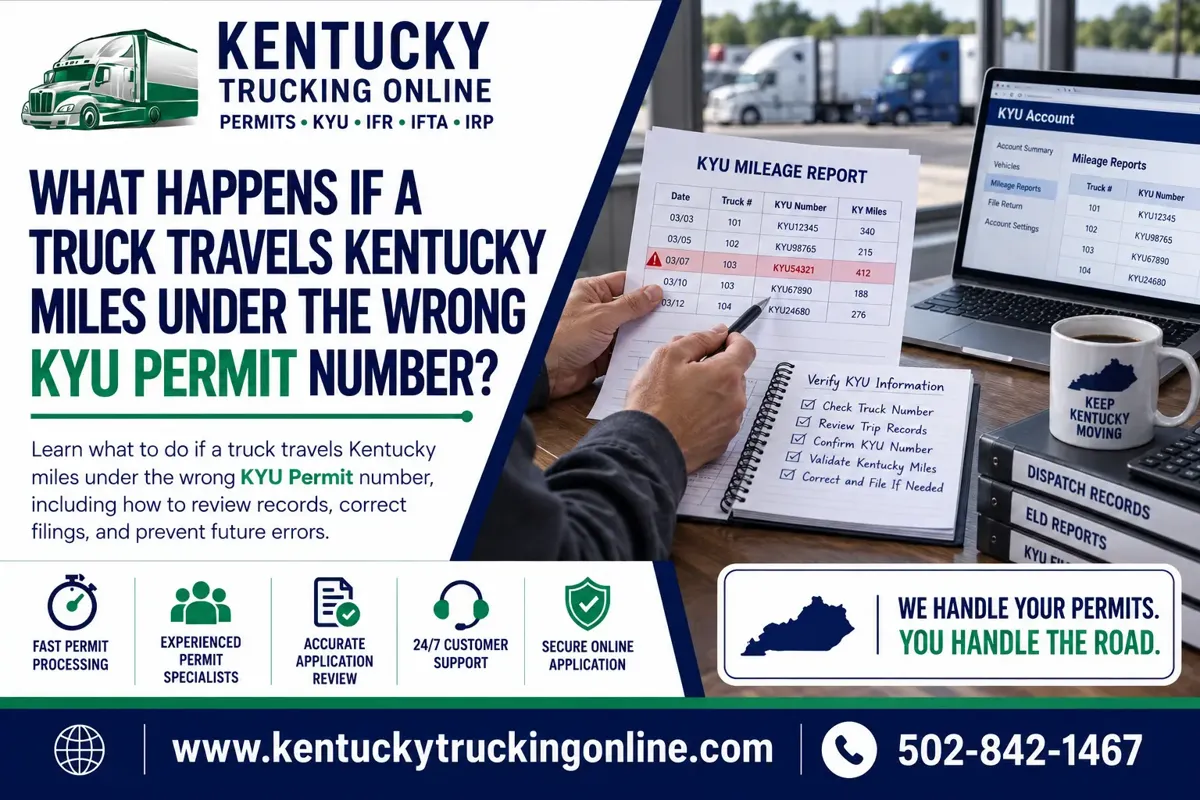
What Happens If A Truck Travels Kentucky Miles Under The Wrong KYU Number?
Table Of Contents
-
Introduction
-
Why Can The Wrong KYU Number Be Used?
-
Why Does The Correct KYU Number Matter?
-
What Should Dispatch Check First?
-
How Should The Mileage Records Be Reviewed?
-
What If The Return Has Already Been Filed?
-
What Records Should Carriers Keep?
-
How To Prevent Future KYU Number Errors
-
Why Many Trucking Companies Choose Our Service
-
FAQ
Introduction
A trucking company may discover that Kentucky mileage was recorded under the wrong KYU number. This can happen when a dispatcher selects the wrong account, a driver receives incorrect trip instructions, or a fleet has several vehicles and KYU numbers that are easy to confuse.
Because the KYU number identifies the Kentucky Weight Distance Tax license associated with the carrier, an error should be reviewed carefully before the company files its quarterly return.
Finding the problem early allows the carrier to identify the affected trips, correct its records, and determine whether the filed information needs to be amended.
Why Can The Wrong KYU Number Be Used?
KYU errors can happen for several reasons.
A company may operate multiple trucks and maintain several vehicle records in its internal systems. A dispatcher could accidentally associate a trip with the wrong KYU number, especially when unit numbers or vehicle information are similar.
Data-entry mistakes can also occur when mileage is transferred from dispatch software into accounting records.
Another possibility is that a vehicle is newly added to the fleet and the company has not updated all of its internal systems.
Whatever the reason, the first step is to identify exactly which vehicle and trips were affected.
Why Does The Correct KYU Number Matter?
Kentucky Weight Distance Tax is associated with qualifying vehicles traveling on Kentucky roads. The Kentucky Transportation Cabinet requires qualified vehicles to maintain the appropriate KYU information and file quarterly returns.
Using the wrong KYU number can create inconsistencies between the vehicle, mileage records, and tax account.
The problem may not always be obvious immediately. A carrier could have accurate Kentucky mileage but associate that mileage with the wrong account or vehicle record.
That is why correcting the identification problem is just as important as checking the mileage itself.
What Should Dispatch Check First?
When a KYU number error is discovered, dispatch should begin with the actual trip records.
Review:
-
Vehicle unit number
-
License plate
-
VIN
-
KYU number used
-
Trip date
-
Kentucky entry and exit points
-
Origin and destination
-
Kentucky mileage
The company should determine whether the incorrect KYU number was used for one trip or several trips.
Dispatch should also compare the information with the vehicle records maintained by accounting and compliance personnel.
A clear list of affected trips makes the correction process much easier to manage.
How Should The Mileage Records Be Reviewed?
The company should separate the mileage from the account-identification error.
First, verify how many Kentucky miles the vehicle actually traveled. Then determine which KYU number was recorded for those miles.
Supporting documents can include trip sheets, dispatch records, odometer readings, GPS information, ELD data, and other mileage records maintained by the carrier.
The goal is to establish three things:
Which truck traveled the miles?
How many Kentucky miles were traveled?
Which KYU number was incorrectly associated with the trip?
Once those details are clear, the carrier can determine the appropriate correction.
What If The Return Has Already Been Filed?
The next step depends on whether the error was discovered before or after the quarterly KYU return was submitted.
If the return has not been filed, the carrier should correct the records before submitting it.
If the return has already been filed, the carrier should review the filing and determine whether an amendment is necessary. Kentucky allows carriers to amend a KYU return to increase reported miles through its electronic filing system. For a decrease in reported miles, carriers are instructed to contact the Division of Motor Carriers.
The carrier should keep documentation explaining what was wrong and what was corrected.
What Records Should Carriers Keep?
Good recordkeeping is essential when a KYU number is entered incorrectly.
The carrier should maintain records connecting each Kentucky trip to the correct vehicle and account.
Useful records include:
-
KYU account information
-
Vehicle identification
-
License plate
-
Unit number
-
Trip dates
-
Kentucky mileage
-
Odometer records
-
ELD or GPS mileage
-
Dispatch records
-
Filed quarterly returns
-
Correction documentation
Keeping these records organized can help the carrier explain the discrepancy and support any necessary correction.
How To Prevent Future KYU Number Errors
The best way to prevent a wrong KYU number is to connect the account information directly to the vehicle record used by dispatch.
Each truck should have a clear internal profile containing its unit number, plate, VIN, and applicable KYU information.
Before a trip begins, dispatch should verify that the vehicle and KYU information match.
Before quarterly filing, accounting should also reconcile the fleet's mileage records with the appropriate KYU records.
This extra verification can catch an incorrect account before the return is submitted.
Why Many Trucking Companies Choose Our Service
Many trucking companies choose Kentucky Trucking Online because KYU compliance can become difficult when fleets have multiple vehicles, mileage records, and account details to manage.
Our service helps simplify Kentucky permit and KYU processes with fast processing, experienced specialists, secure online applications, and convenient customer support.
We help trucking companies organize their Kentucky requirements and address permit-related questions when vehicle or account information changes.
FAQ
What Happens If Kentucky Miles Are Reported Under The Wrong KYU Number?
The carrier should identify the affected trips, verify the actual Kentucky mileage, determine the correct KYU information, and review whether the filing needs to be corrected.
Why Might A Truck Use The Wrong KYU Number?
Common causes include similar vehicle records, dispatcher data-entry mistakes, incorrect account selection, or failure to update internal records after a fleet change.
What Should Dispatch Review First?
Dispatch should compare the vehicle unit, plate, VIN, trip dates, Kentucky route, mileage, and KYU number associated with the trip.
What If The Quarterly Return Has Not Been Filed?
The carrier should correct its records before submitting the return so the mileage is associated with the correct KYU information.
What If The KYU Return Has Already Been Filed?
The carrier should review the return and determine whether an amendment is necessary based on the error.
What Records Can Help Resolve A KYU Number Error?
Trip sheets, dispatch records, odometer readings, ELD or GPS records, vehicle information, and filed returns can help establish which vehicle traveled the Kentucky miles.
Can One Company Have Multiple KYU Numbers?
A carrier's KYU account and vehicle records should be managed carefully so mileage is associated with the appropriate account and vehicle information.
How Can Carriers Prevent This Problem?
Maintain accurate vehicle profiles, verify KYU information before dispatch, and reconcile mileage records before filing each quarterly return.
For more information, visit the Kentucky Transportation Cabinet.