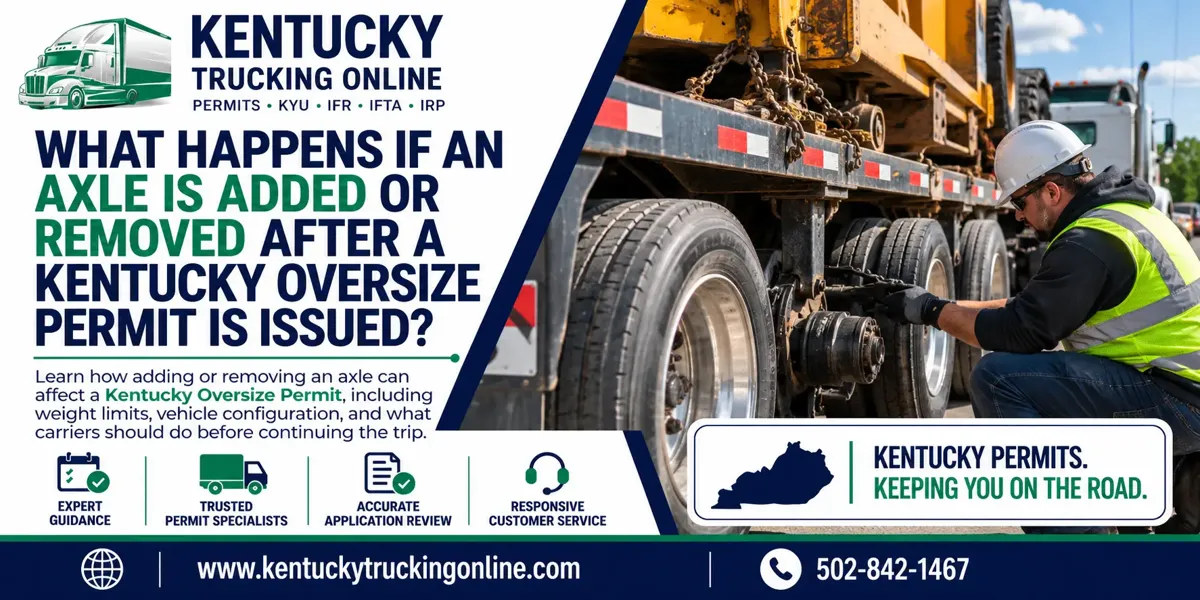
What Happens If An Axle Is Added Or Removed After A Kentucky Oversize Permit Is Issued?
Table Of Contents
-
Introduction
-
Why Axle Configuration Matters
-
What Happens If An Axle Is Added?
-
What Happens If An Axle Is Removed?
-
Can A Single-Trip Permit Be Changed?
-
What Carriers Should Do Before Continuing
-
How To Prevent Axle And Permit Problems
-
Why Many Trucking Companies Choose Our Service
-
FAQ
Introduction
A Kentucky Oversize Permit is issued using specific information about the vehicle, load, route, and requested movement. That information becomes important when the truck or trailer configuration changes after the permit has already been issued.
One situation that can create confusion is adding or removing an axle before the permitted trip begins or while the movement is underway. An axle change can affect vehicle configuration, axle weights, gross weight, and the information used for the permit.
Carriers should therefore avoid assuming that an existing permit automatically remains suitable after an axle configuration changes.
Why Axle Configuration Matters
Axle configuration is important because Kentucky has specific limits for individual axles and axle groups. The number and spacing of axles can affect how weight is distributed across the vehicle and how the combination is evaluated.
Kentucky requirements distinguish between different axle arrangements, including single axles, tandems, and tridems. Maximum permissible weights depend on the axle arrangement and the overall combination.
Adding an axle does not simply mean that the same load is being carried on a different setup. Removing an axle can create the opposite problem by increasing the weight carried by the remaining axles.
What Happens If An Axle Is Added?
If an axle is added after a Kentucky Oversize Permit has been issued, the carrier should not assume that the permit automatically covers the new configuration.
The new axle may change the number of axles, axle spacing, weight distribution, and permitted weight characteristics of the vehicle.
Before travel, compare the actual configuration with the issued permit. If the permit does not reflect the current vehicle setup, the carrier should resolve the change before the truck begins the permitted movement.
Do not simply add the axle and continue because the total weight remains below the amount shown on the permit. The vehicle configuration itself can be part of the permitting information.
What Happens If An Axle Is Removed?
Removing an axle can create a different problem. Although the vehicle may become lighter overall, the remaining axles can carry more of the load.
That can change individual axle weights, axle-group weights, and the way the vehicle's weight is distributed. It may also change the configuration described on the permit.
For that reason, carriers should not assume that removing an axle makes the original permit automatically valid or makes the permit unnecessary. The revised setup should be checked against the permit and applicable requirements before the truck continues.
Can A Single-Trip Permit Be Changed?
Kentucky guidance states that a single-trip overweight/overdimensional permit is one-time, vehicle-, route-, and load-specific. The state also states that a single-trip permit cannot be amended, except when the Permit Section made an error in issuing it.
This is important when an axle is added or removed. A carrier should not modify the issued permit by hand or assume that a configuration change can be added to the existing single-trip authorization.
Instead, compare the actual vehicle with the permit and address the configuration change through the appropriate Kentucky permitting process before traveling under the changed setup.
Annual permits are different. Kentucky states that annual permits are truck-specific and can be amended one time, with changes to truck information, weights, or dimensions subject to the applicable amendment process.
What Carriers Should Do Before Continuing
When an axle is added or removed, stop and review the permit before continuing whenever possible.
Check:
-
Total number of axles
-
Axle spacing
-
Axle-group arrangement
-
Gross vehicle weight
-
Individual and group axle weights
-
Trailer and power-unit configuration
-
Permit information
-
Route and travel conditions
Kentucky places responsibility on the permit holder to provide accurate information and review the permit before traveling.
Do not cross out axle information, write in a new configuration, or otherwise alter the permit manually. If the vehicle no longer matches the issued authorization, resolve the issue before the trip proceeds.
How To Prevent Axle And Permit Problems
The easiest way to avoid an axle-related permit problem is to finalize the vehicle configuration before the permit application is submitted.
Before ordering a Kentucky Oversize Permit, carriers should confirm the truck and trailer setup, axle count, axle spacing, expected weights, and load configuration.
If equipment has to be changed after the permit is issued, notify the person responsible for permits before dispatch.
Companies should also keep accurate vehicle records and make sure drivers and maintenance personnel understand that an equipment change can affect an active oversize movement.
Why Many Trucking Companies Choose Our Service
Kentucky Trucking Online gives trucking companies a straightforward way to manage permit applications without handling every administrative step on their own. Our service helps carriers save time, simplify permit processing, reduce paperwork, and avoid unnecessary delays when preparing for Kentucky trips.
With fast processing, accurate permit assistance, and dedicated customer support, Kentucky Trucking Online makes the permit application process more convenient. Carriers can spend less time working through administrative details and more time focusing on drivers, equipment, schedules, and upcoming loads.
FAQ
Can I add an axle after my Kentucky Oversize Permit is issued?
Do not assume that the existing permit automatically covers the new configuration. Review the vehicle information and resolve the change through the appropriate permitting process before travel.
What if I remove an axle?
Removing an axle can change axle weights, axle-group weights, and the vehicle configuration. Review the permit before continuing.
Can a single-trip Kentucky Oversize Permit be amended for an axle change?
Kentucky states that single-trip permits cannot be amended, except when the Permit Section made an error in issuing the permit.
Does an added axle always require a new permit?
The requirement depends on the permit type and resulting vehicle configuration. For a single-trip permit, the state does not allow ordinary amendments, so the carrier should resolve the changed configuration before traveling.
Can I write the new axle information on the permit?
No. Do not manually alter the issued permit. Address the change through the appropriate permit process.
What should I check after an axle change?
Review the axle count, axle spacing, axle-group weights, gross weight, vehicle configuration, and permit information before continuing.
For more information, visit the Kentucky Transportation Cabinet.