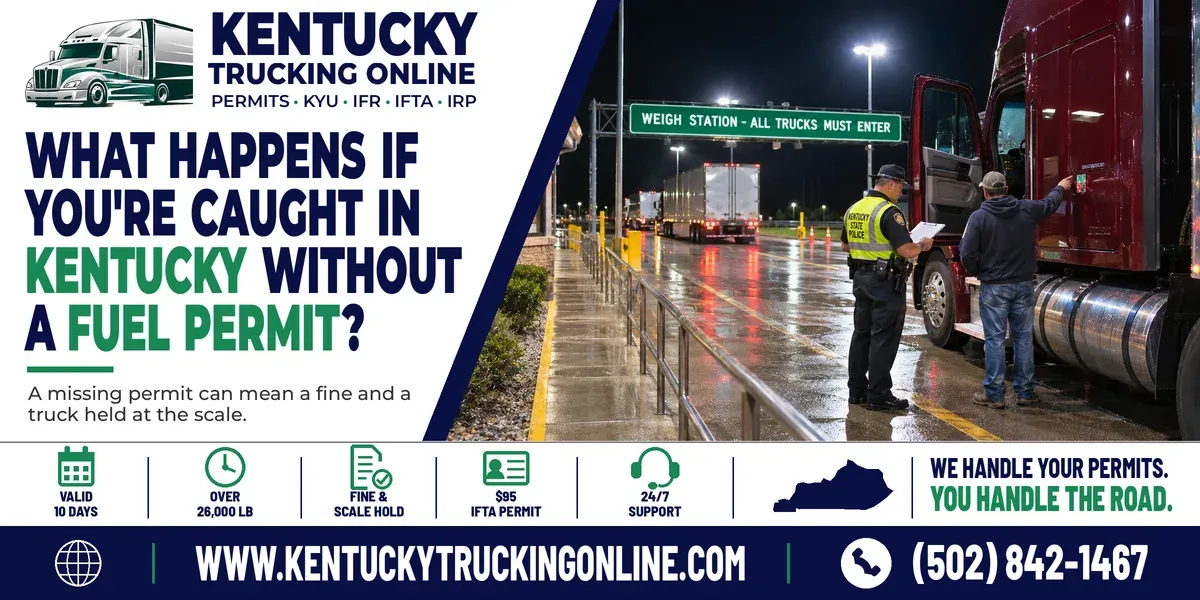
What Happens If You're Caught in Kentucky Without a Fuel Permit?
Table Of Contents
-
Introduction
-
The Short Answer
-
Which Trucks Need IFTA or a Kentucky Fuel Permit
-
Where Trucks Get Checked
-
What Happens at the Scale
-
The Real Cost of Getting Caught
-
Common Reasons Trucks Get Caught
-
What a Fuel Permit Does Not Cover
-
How to Avoid Getting Caught Without a Permit
-
Why Many Trucking Companies Choose Our Service
-
FAQ
Introduction
Kentucky sits on some of the busiest freight lanes in the country. I-65, I-75, I-71, I-64 and I-24 carry trucks between the Midwest, the Southeast and the East Coast, and Kentucky's weigh stations check fuel credentials along with weight and registration.
A heavy truck that enters Kentucky without IFTA credentials and without a Kentucky Fuel Permit can turn a quick scale stop into a long, expensive day. This guide explains what happens when a truck is caught, what it can cost, and how to keep it from happening.
The Short Answer
A truck caught in Kentucky without the right fuel credentials can face:
-
A citation and fine for operating without IFTA or a fuel permit
-
Being held at the scale until a Kentucky Fuel Permit is in place
-
Lost hours of drive time and a missed delivery window
-
More scrutiny on the truck's other credentials, such as IRP and KYU
In most cases, the truck can move again once the permit is issued and any fine is dealt with. But the delay and the cost are much higher than buying the permit before the trip.
Which Trucks Need IFTA or a Kentucky Fuel Permit
According to the Kentucky Transportation Cabinet (KYTC), an interstate truck is a qualified motor vehicle when it has:
-
A gross vehicle weight or registered gross vehicle weight over 26,000 pounds, or
-
Three or more axles, regardless of weight
A qualified truck needs one of two things to run in Kentucky:
-
An IFTA license and decals, with the fuel reported on the quarterly return, or
-
A Kentucky Fuel Permit, which covers fuel tax for 10 days
A truck that isn't qualified, such as a two-axle pickup under 26,000 pounds, doesn't need either.
Where Trucks Get Checked
Kentucky enforcement doesn't just happen at the state line. Trucks can be checked at:
-
Weigh stations on the interstates, including sites near the state lines on I-65, I-71, I-75 and I-24
-
Bypass and screening systems that flag trucks with credential problems and call them into the scale
-
Roadside inspections by Kentucky State Police commercial vehicle enforcement officers
-
Traffic stops anywhere in the state
Officers can check IFTA status electronically, so missing decals or an expired license show up quickly.
What Happens at the Scale
When an officer finds a qualified truck with no IFTA and no Kentucky Fuel Permit, this is what usually happens:
-
The truck is pulled aside. The driver is asked for the cab card, IFTA license and any trip permits.
-
A citation may be written. Operating without fuel credentials is a violation that can bring a fine and court costs.
-
The truck may be held. In many cases, the truck can't leave until a valid fuel permit is in place.
-
The carrier gets the permit. Once the permit is issued, the driver shows it to the officer.
-
The truck is released. The truck continues the trip, usually hours later than planned.
If other credentials are also missing, such as an IRP trip permit or KYU coverage, each one can add its own citation and delay.
The Real Cost of Getting Caught
The fine is only part of the cost. A truck held at a scale can also mean:
-
Lost drive time while the driver waits for the permit
-
Missed appointments and possible late fees from the shipper or receiver
-
Hours of service problems when the wait pushes the driver past their limits
-
A record of the violation that can affect the carrier's safety profile
-
Paying for the permit anyway, on top of the fine
A Kentucky Fuel Permit costs much less than one lost day for a truck and driver.
Common Reasons Trucks Get Caught
Most carriers caught without fuel credentials didn't plan to break the rules. These are the usual causes:
-
Assuming the truck isn't qualified. A two-axle truck with a trailer can reach three axles or go over 26,000 pounds.
-
Expired IFTA license or decals. Decals must be renewed each year, and old decals don't count after the grace period ends.
-
A permit that ran out. The permit is valid for 10 days, and a delayed trip can outlast it.
-
A new or replacement truck. The truck isn't on the IFTA account yet.
-
A one-time trip. Carriers who rarely leave their home state forget they need fuel coverage.
What a Fuel Permit Does Not Cover
A Kentucky Fuel Permit covers fuel tax only. It doesn't replace other Kentucky credentials. A heavy truck may also need:
-
IRP trip permit: If Kentucky isn't on the truck's IRP cab card.
-
KYU license or KYU trip permit: For vehicles with a combined licensed weight over 59,999 pounds, under the Kentucky Weight Distance Tax.
-
KIT trip permit: For some carriers subject to the Kentucky Intrastate Tax.
A truck with a fuel permit can still be cited for a missing IRP or KYU permit, so check all of them before the trip.
How to Avoid Getting Caught Without a Permit
-
Check the Weight and Axles. Over 26,000 pounds or three axles makes the truck qualified.
-
Check IFTA Status. Make sure the license is active and the decals are current.
-
Order the Kentucky Fuel Permit Before the Trip. Have it in place before the truck enters Kentucky.
-
Check the Dates. Make sure the 10-day permit covers the whole trip.
-
Check IRP and KYU. Add trip permits if the truck needs them.
-
Keep Copies in the Cab. The driver must be able to show every permit at the scale.
Why Many Trucking Companies Choose Our Service
Kentucky Trucking Online gets your Kentucky Fuel Permit in place before the truck reaches the state line, along with any IRP, KYU or KIT permits the trip needs, day or night.
-
IRP Trip Permit over 55,000 lb: $95
-
IRP Trip Permit under 55,000 lb: $95
-
KYU Trip Permit: $95
-
IFTA Trip Permit: $95
-
KIT Trip Permit: $95
We provide support 24/7 and also work weekends and holidays.
or
FAQ
What happens if I'm caught in Kentucky without a fuel permit?
You can be cited and fined, and the truck may be held until a Kentucky Fuel Permit is in place.
Which trucks need a Kentucky Fuel Permit?
Interstate trucks over 26,000 pounds or with three or more axles that don't have IFTA.
How long is a Kentucky Fuel Permit valid?
10 days.
Can I get a fuel permit after I'm stopped?
Yes, but you may still get a fine, and the truck may wait at the scale until the permit is issued.
Does a fuel permit cover the Kentucky Weight Distance Tax?
No. Vehicles over 59,999 pounds also need a KYU license or KYU trip permit.
For more information, visit the Kentucky Transportation Cabinet.