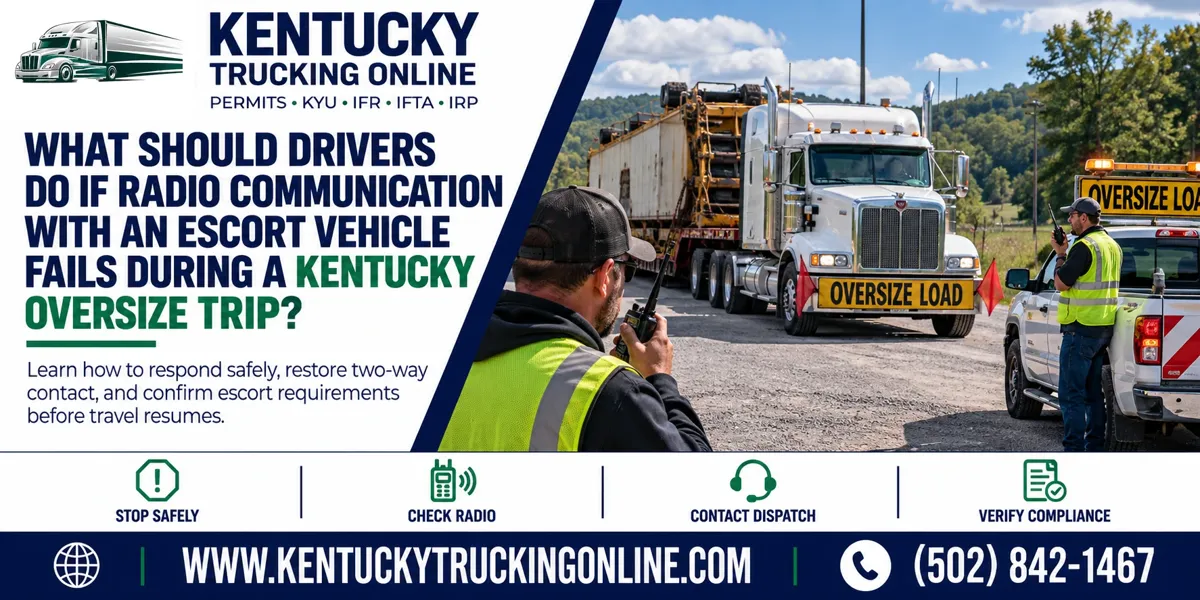
What Should Drivers Do If Radio Communication With an Escort Vehicle Fails During a Kentucky Oversize Trip?
Table Of Contents
-
Introduction
-
Why Escort Radio Communication Matters
-
What Drivers Should Do Immediately
-
How to Restore Communication
-
When to Arrange Replacement Equipment or Support
-
What to Check Before Resuming the Trip
-
Mistakes to Avoid
-
Why Many Trucking Companies Choose Our Service
-
FAQ
Introduction
Reliable communication between an oversize truck and its escort vehicle is essential for safe travel. Escorts help drivers identify approaching hazards, navigate restricted areas, and coordinate maneuvers that may affect surrounding traffic. If radio contact suddenly fails, the truck driver may no longer receive important warnings at the right time.
During a Kentucky Oversize Permit trip, a communication failure should be treated as a safety issue, not simply an inconvenience. Drivers should follow an established response plan, find a safe place to stop when necessary, and restore the required communication before continuing under the escort arrangement.
Why Escort Radio Communication Matters
Kentucky's overweight and overdimensional escort requirements specify that a required escort vehicle must maintain radio contact with the permitted load. Escorts must also meet applicable lighting and signage requirements, and certain tall loads require a lead escort equipped with a height pole.
Radio communication helps the truck driver and escort coordinate lane positioning, warn each other about traffic conditions, and respond to potential clearance problems. This is particularly important on narrow roads, near bridges, at intersections, and when the load needs additional space to maneuver.
If radio contact is lost, the driver may not know whether the escort has identified a hazard ahead. The escort may also be unable to warn the truck about a sudden change in traffic or road conditions. Continuing without addressing the failure can therefore create unnecessary risks.
What Drivers Should Do Immediately
1. Stay Calm and Maintain Control. Do not make sudden braking or steering movements simply because the radio has stopped working. Maintain a safe following distance and assess the traffic around the truck.
2. Follow the Pre-Trip Communication Plan. Use the agreed procedure for lost contact. The driver and escort should already know how to signal a communication problem and where to stop safely if necessary.
3. Find a Safe Stopping Location. If the required coordination cannot be maintained, move to a suitable safe location as soon as conditions allow. Avoid stopping in an active lane, on a narrow shoulder, or where the truck would obstruct an intersection or create a hazard.
4. Notify Dispatch When Safe. Tell dispatch that communication has failed and provide the truck's location, direction of travel, and current safety concerns. Do not handle a phone or send messages while driving.
5. Keep the Escort Informed. Use a previously agreed backup method only when it is safe and appropriate. Do not rely on improvised signals or assume the escort understands the situation without confirmation.
How to Restore Communication
Once the vehicles are stopped safely, check whether the failure is caused by a simple equipment problem or a more serious malfunction.
Start with basic checks. Confirm that the radios are powered on, set to the correct channel, and operating at an audible volume. Check battery levels, antenna connections, microphones, and any accessories used for hands-free communication. If the radio has a replaceable battery or a spare unit is available, use the equipment according to the manufacturer's instructions.
Ask the escort to confirm that the same channel and settings are being used. If terrain, distance, or interference may have caused the problem, follow the agreed procedure for restoring contact without separating the vehicles unsafely.
Test communication in both directions. The driver should hear the escort clearly, and the escort should confirm receiving the driver's response. A radio that works only intermittently may not provide dependable communication for the remainder of the trip.
If basic troubleshooting does not resolve the failure, contact dispatch and the escort provider to arrange replacement equipment or another appropriate solution.
When to Arrange Replacement Equipment or Support
A spare radio may be sufficient when the failure is limited to one device. If the escort vehicle itself cannot maintain communication, the carrier may need a replacement communication system or a replacement escort vehicle.
Before arranging a substitute, confirm the number and positions of escorts required by the Kentucky Oversize Permit and any special conditions attached to the movement. A replacement must meet the applicable requirements and be able to coordinate effectively with the truck.
Do not assume that a mobile phone automatically replaces the required radio contact. If the available alternative is uncertain, confirm with the relevant permit authority or enforcement officials what arrangement is acceptable before resuming the movement.
If a replacement escort is necessary, coordinate the handoff carefully. The truck driver should know when the new escort is ready, which vehicle will lead or follow, and how communication will be maintained.
What to Check Before Resuming the Trip
Before moving again, complete the following checks:
-
Confirm Two-Way Contact. Verify that the truck and escort can communicate clearly and consistently.
-
Review Escort Positions. Make sure required lead and rear escort positions are covered.
-
Check the Permit Conditions. Confirm that the planned movement still follows the permitted route and any special instructions.
-
Reassess Road Conditions. Check traffic, visibility, weather, and the location where the truck will re-enter the road.
-
Update Dispatch. Report that the problem has been resolved and record any replacement equipment or escort arrangements.
-
Document the Incident. Record the approximate time, location, cause if known, steps taken, and any instructions received.
If the radio remains unreliable or a required escort arrangement cannot be maintained, do not resume the movement until the issue has been resolved and the operation can comply with applicable requirements.
Mistakes to Avoid
Do not continue simply to keep a delivery appointment, assume the escort can communicate through hand signals at highway speed, or use a phone while driving. Avoid stopping in a dangerous location when a safer stopping point is available.
Do not restart the trip after a brief test message if contact remains inconsistent. Reliable two-way communication and compliance with the permit conditions must be confirmed before proceeding.
Why Many Trucking Companies Choose Our Service
Kentucky Trucking Online helps carriers navigate permit applications and organize the vehicle, route, and trip information needed for Kentucky operations. Accurate permit details can reduce paperwork confusion and make it easier for dispatch teams to verify movement conditions before a truck departs.
Our service provides practical permit assistance and customer support to help trucking companies prepare for permitted trips. Drivers and carriers must still follow applicable escort requirements, maintain the required communication, and resolve safety issues before continuing a movement.
FAQ
-
Does Kentucky require radio contact between an escort vehicle and an oversize load?
Yes. Kentucky's escort safety requirements specify that a required escort vehicle must maintain radio contact with the load. -
Can a driver continue if the escort radio stops working?
If required communication cannot be maintained, the driver should move to a safe location when conditions allow and resolve the issue before continuing under the required escort arrangement. -
Can a mobile phone replace the escort radio?
Do not assume it can. Confirm whether an alternative communication arrangement is acceptable under the applicable permit conditions. -
What should dispatch do when radio communication fails?
Coordinate safe stopping, troubleshoot the equipment, and arrange replacement equipment or escort support if necessary. -
Should the communication failure be documented?
Yes. Record the location, time, troubleshooting steps, corrective action, and any instructions received. -
When can the truck resume the Kentucky oversize trip?
Resume when reliable communication is restored, required escort coverage is in place, and the driver can comply with the permit conditions.
For more information, visit the Kentucky Transportation Cabinet's KYU.