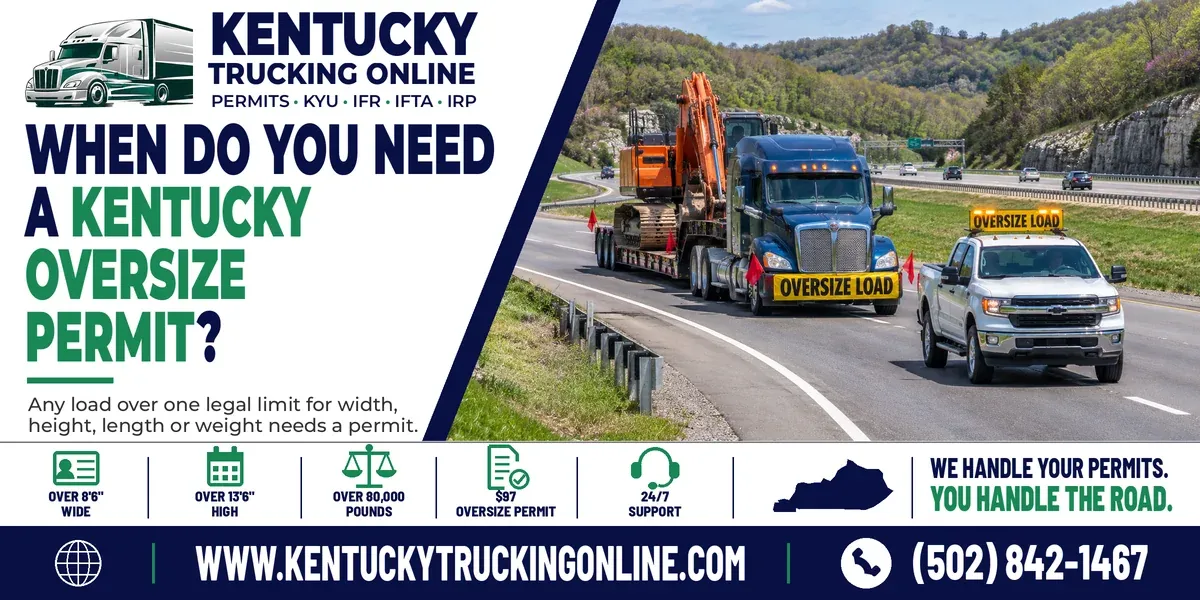
When Do You Need a Kentucky Oversize Permit?
Table Of Contents
-
Introduction
-
The Short Answer
-
What Kentucky Law Says
-
Kentucky's Legal Width Limits
-
Kentucky's Legal Height Limit
-
Kentucky's Legal Length Limits
-
Kentucky's Legal Weight Limits
-
The Non-Divisible Load Rule
-
Common Loads That Need a Permit
-
Single-Trip or Annual Permit?
-
What Comes With the Permit
-
Common Mistakes to Avoid
-
Why Many Trucking Companies Choose Our Service
-
FAQ
Introduction
Kentucky sits in the middle of some of the busiest freight lanes in the country. I-65, I-75, I-64 and I-24 carry construction equipment, industrial machinery, transformers and farm equipment through the state every day.
Many of those loads are too wide, too tall, too long or too heavy for normal limits. Before a load like that moves, the carrier needs a Kentucky Oversize Permit. This guide explains exactly when a permit is required, what the legal limits are, and what else comes with the permit.
The Short Answer
You need a Kentucky Oversize Permit when a vehicle and its load go over any of Kentucky's legal limits for width, height, length or weight, and the load can't reasonably be broken down.
-
Going over just one limit is enough to need a permit.
-
A load that stays within every limit doesn't need one.
-
The rules apply to every carrier on Kentucky roads, wherever the carrier is based.
What Kentucky Law Says
KRS 189.270 lets the Kentucky Transportation Cabinet issue permits for non-divisible loads that go over legal size or weight limits. The details, including signs, flags, escorts and travel times, are in 601 KAR 1:018, the regulation for overweight and overdimensional permits.
Kentucky's standard dimension limits are in 603 KAR 5:070. If a load goes past those limits, it needs a Kentucky Oversize Permit before it moves.
Kentucky's Legal Width Limits
Width depends on the road.
-
National Truck Network and designated highways: 102 inches, or 8 feet 6 inches.
-
Other roads: 8 feet.
Anything wider needs a Kentucky Oversize Permit. Excavators, bulldozers, wide steel beams and modular building sections are the most common over-width loads.
Kentucky's Legal Height Limit
The legal height limit is 13 feet 6 inches, measured from the road to the top of the load.
Tall loads need extra care in Kentucky. Under 601 KAR 1:018, an annual permit can't be issued or used when the vehicle and load together are over 13 feet 6 inches high. A tall load needs a single-trip permit, and the carrier must check clearances on the route.
Kentucky's Legal Length Limits
Length limits depend on the vehicle and the road:
-
Single-unit truck: 45 feet.
-
Combination on standard roads: 65 feet.
-
On the National Truck Network: a 53-foot semitrailer in a single-trailer combination, or 28-foot trailers in a double combination.
Long loads such as bridge beams, poles, pipe and wind tower sections often go past these limits and need a permit.
Kentucky's Legal Weight Limits
Weight limits include the gross weight and the weight on each axle.
-
Gross weight: 80,000 pounds on the National Truck Network.
-
Single axle: 20,000 pounds.
-
Tandem axle: 34,000 pounds.
A truck can be under 80,000 pounds and still need a permit if one axle group is over its limit. Overweight loads need a permit just like oversize ones.
The Non-Divisible Load Rule
A Kentucky Oversize Permit is only for loads that can't reasonably be broken down into smaller pieces.
-
Non-divisible: a single excavator, a transformer or a steel beam.
-
Divisible: a load of loose gravel, stacked lumber or pallets that could be split into two trucks.
If a load can be divided to fit legal limits, it must be. The permit isn't a way to haul more freight on one truck.
Common Loads That Need a Permit
Some loads almost always need a Kentucky Oversize Permit:
-
Construction equipment such as excavators, dozers and cranes.
-
Farm equipment such as combines and wide tillage tools.
-
Industrial machinery and transformers.
-
Manufactured and modular homes.
-
Boats wider than 8 feet 6 inches.
-
Bridge beams, pipe and wind turbine parts.
Single-Trip or Annual Permit?
Kentucky offers two main kinds of permits.
-
Single-trip permit: covers one move on one route. It's needed for most loads over 13 feet 6 inches high and for larger loads.
-
Annual permit: covers repeated moves within set limits for a year. It's useful for carriers that move similar equipment often.
Choose based on how often you haul and how big the load is.
What Comes With the Permit
A Kentucky Oversize Permit comes with conditions the driver must follow:
-
Signs and flags: red or orange flags on the load, and OVERSIZE LOAD signs for loads over 12 feet wide or with front overhang.
-
Escort vehicles: larger loads may need one or more escorts.
-
Travel times: restrictions on nights, holidays and rush hours in some cities.
-
Route: the load must stay on the route listed on the permit.
Common Mistakes to Avoid
-
Checking only width. Height, length and axle weights can trigger a permit too.
-
Using an annual permit for a tall load. Over 13 feet 6 inches needs a single-trip permit.
-
Not splitting a divisible load. If it can be broken down to fit legal limits, it must be.
-
Measuring without the trailer. Height and length include the truck and trailer.
-
Leaving the permitted route. The permit only covers the listed roads.
Why Many Trucking Companies Choose Our Service
Kentucky Trucking Online checks your load against Kentucky's limits and gets the right Kentucky Oversize Permit for the move, so your load is legal before it reaches the state line.
- Oversize permit: $97
We provide support 24/7 and also work weekends and holidays.
or
FAQ
When do you need a Kentucky Oversize Permit?
When a vehicle and load go over any legal limit for width, height, length or weight and the load can't be broken down.
What is the legal width in Kentucky?
102 inches on the National Truck Network and designated highways, and 8 feet on other roads.
What is the legal height in Kentucky?
13 feet 6 inches.
Can an annual permit cover a load over 13 feet 6 inches?
No. That load needs a single-trip permit.
Does an overweight load need a permit too?
Yes. Loads over the gross or axle weight limits need a permit.
For more information, visit the Kentucky Transportation Cabinet.