Get The Latest News, Advice & Best Practice From Blog
Temporary Weight Increase Permit in Kentucky
When your trucking operation occasionally needs to move heavier loads than normally allowed, the Temporary Weight Increase Permit offered by the Kentucky Transportation Cabinet (KYTC) provides a legal and flexible solution. This permit allows carriers to exceed their registered weight temporarily without permanently altering their vehicle registration or base weight. Below is a detailed guide explaining when and how to obtain this permit, what it covers, and how to stay compliant on Kentucky roads.
Nov. 1, 2025, 7:02 p.m.
Read more
How to Apply for a Kentucky Trip Permit
A Kentucky Trip Permit allows out-of-state commercial vehicles to operate temporarily in Kentucky without obtaining permanent registration or a Kentucky Weight Distance (KYU) number. Managed by the Kentucky Transportation Cabinet (KYTC), this permit is essential for carriers making short-term hauls through or into the state. Whether your fleet is making a one-time delivery in Louisville or passing through on I-75, understanding how to apply for a Kentucky Trip Permit helps ensure full compliance and smooth operations.
Oct. 31, 2025, 8:11 p.m.
Read more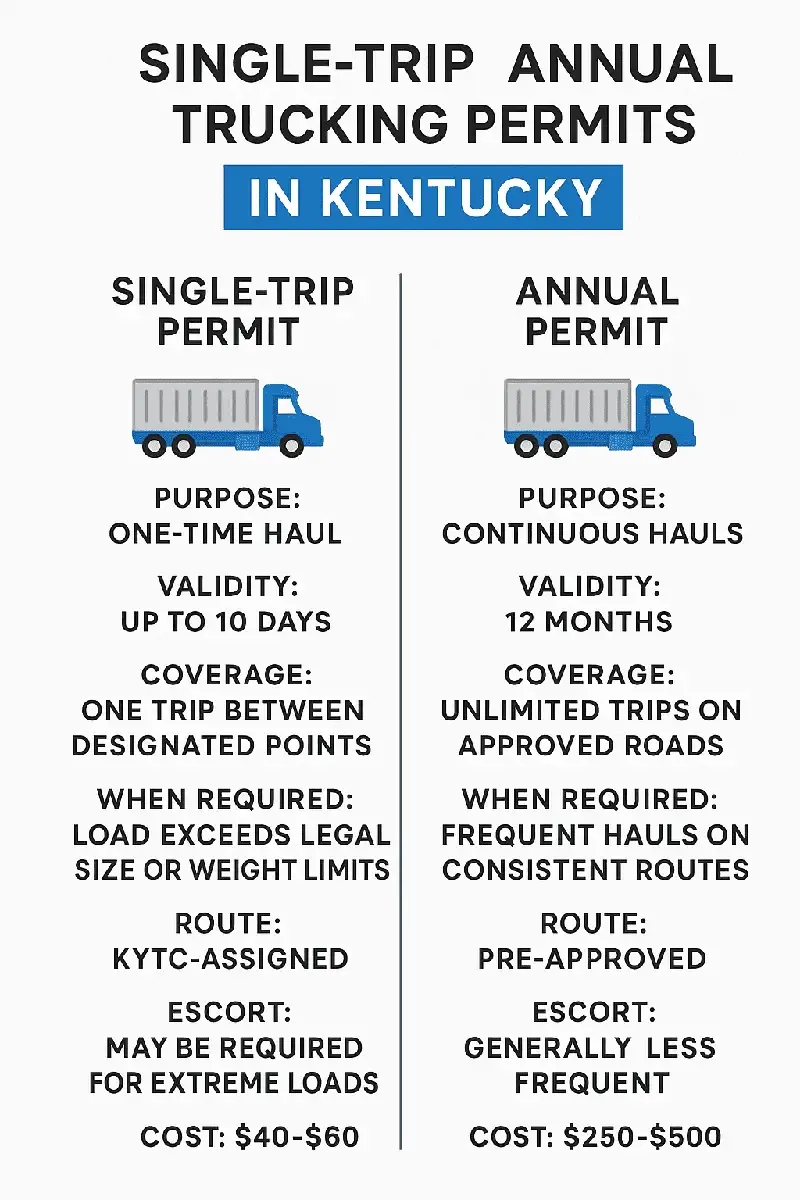
Single Trip vs Annual Trucking Permits in Kentucky
In Kentucky, commercial carriers transporting oversize or overweight (OS/OW) loads must obtain proper permits from the Kentucky Transportation Cabinet (KYTC) – Division of Motor Carriers. The type of permit you need depends on how often and where you operate:
Oct. 30, 2025, 1:34 p.m.
Read more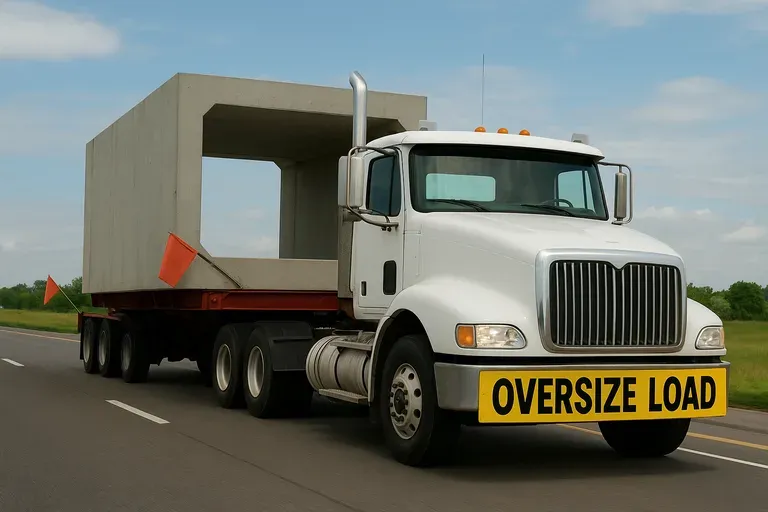
Oversize Overweight (OS OW) Permit Rules in Kentucky
Here is a detailed breakdown of the oversize/overweight (OS/OW) permit rules for Kentucky Transportation Cabinet (KYTC) including key dimensions, weights, application process, restrictions, and practical tips. Always verify with the most current KYTC guidance before moving a load, as regulations can change.
Oct. 29, 2025, 5:15 p.m.
Read more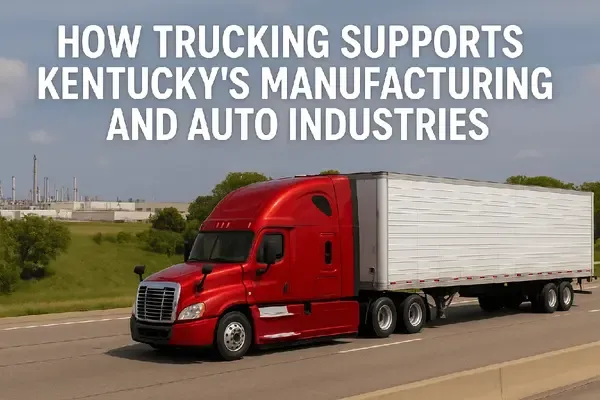
How Trucking Supports Kentucky’s Manufacturing and Auto Industries (Toyota, Ford, GM Plants)
Trucking is the backbone of Kentucky’s manufacturing economy, particularly in the automotive sector, where just-in-time deliveries and high-volume freight movement are essential. With major plants from Toyota, Ford, and General Motors, the state’s highways pulse with the movement of parts, raw materials, and finished vehicles every day.
Oct. 28, 2025, 1:25 p.m.
Read more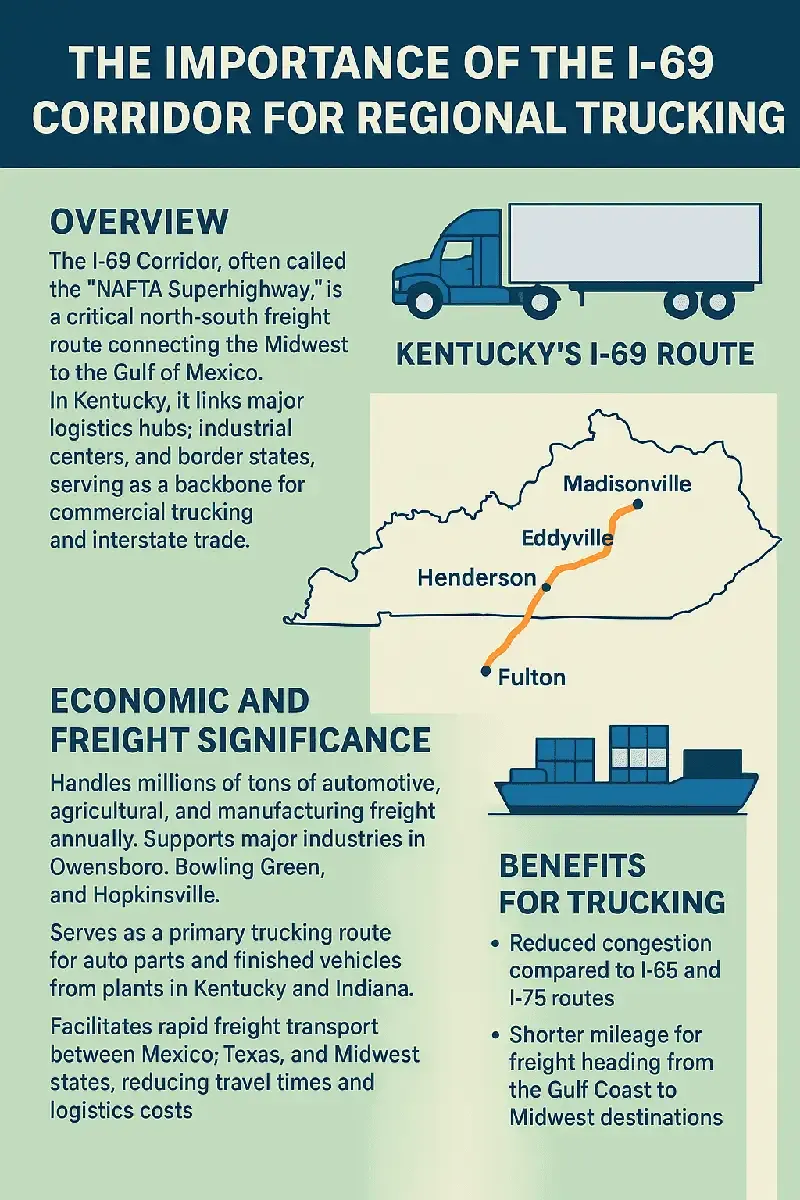
The Importance of the I-69 Corridor for Regional Trucking
The I-69 Corridor, often called the “NAFTA Superhighway,” is a critical north-south freight route connecting the Midwest to the Gulf of Mexico. In Kentucky, it links major logistics hubs, industrial centers, and border states, serving as a backbone for commercial trucking and interstate trade.
Oct. 27, 2025, 1:08 p.m.
Read more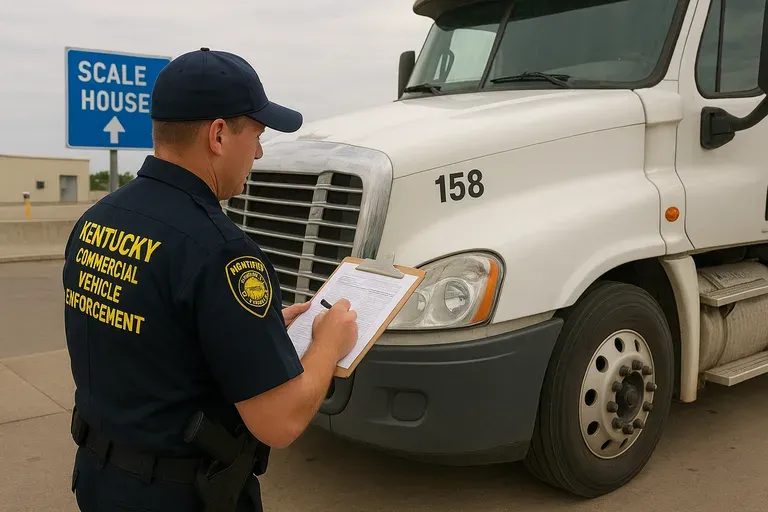
Understanding Kentuckys Commercial Vehicle Enforcement Division
Trucking across Kentucky means sharing the road with one of the most active safety enforcement agencies in the region — the Kentucky Commercial Vehicle Enforcement (CVE) Division. Understanding how this division operates can help carriers and drivers stay compliant, avoid violations, and keep Kentucky’s highways safe for everyone.
Oct. 26, 2025, 4:20 p.m.
Read more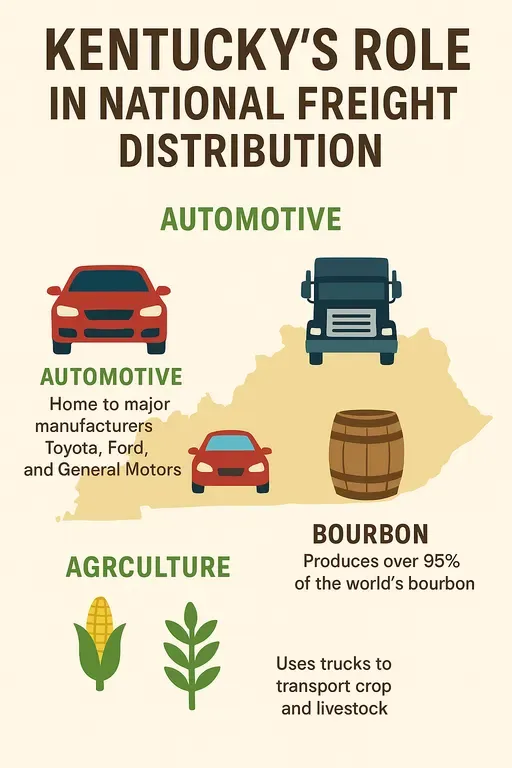
Kentuckys Role in National Freight Distribution (Automotive, Bourbon, Agriculture)
Kentucky is a critical freight distribution hub in the United States, thanks to its strategic central location, diverse manufacturing base, and well-connected transportation infrastructure. With easy access to major interstates, rail lines, and air freight hubs, Kentucky efficiently moves billions of dollars in goods annually across the nation.
Oct. 25, 2025, 3:58 p.m.
Read more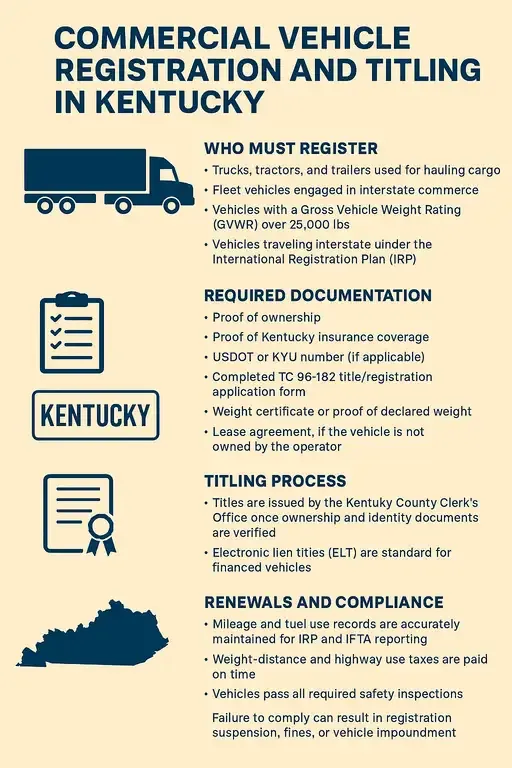
Commercial Vehicle Registration and Titling in Kentucky
Registering and titling commercial vehicles in Kentucky is required for all carriers operating within or through the state. The process is overseen by the Kentucky Transportation Cabinet (KYTC), Division of Motor Carriers, which ensures vehicles meet safety, tax, and regulatory standards before they hit the road.
Oct. 24, 2025, 5:52 a.m.
Read more